You Didn’t Learn Politics, You Watched It: The Illusion of Political Awareness on Instagram
By Aadrita Nandi on April 22, 2026
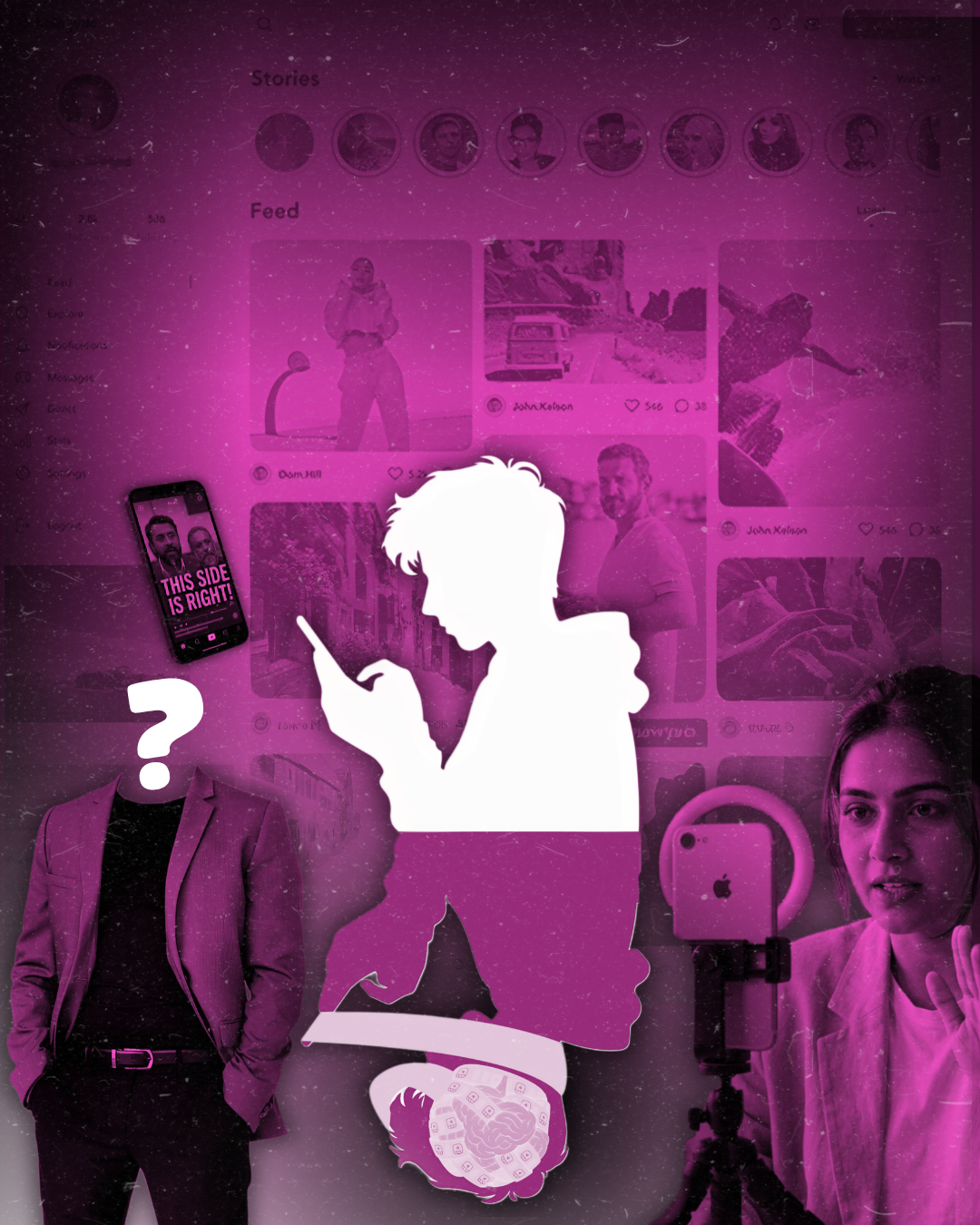
Open Instagram for five minutes and you will inevitably run into politics, not in the form of something you consciously chose to engage with, but as something that slips into your feed already shaped into an opinion. A creator speaks with confidence, crisp captions (in Helvetica Neutral and Yellow is a must) the edits are tight, and within seconds you are being told not just what is happening, but what it means and where you are supposed to stand on it.
The striking part is not that people are talking about politics online, it is how “definite” everything sounds. There is no visible process, no hesitation, no sense that the person speaking is still figuring things out. It arrives as a conclusion, not even as an opinion at times. And because it is delivered so cleanly, so convincingly, it creates a quiet sense of certainty. You don’t feel like you’ve just watched someone’s opinion, rather you feel like you’ve understood something correctly.
Then you keep scrolling, and a few reels later, someone else is explaining the same issue in a completely different way, with the same level of clarity, and the same confidence that this version is the right one.
This is where things start to get uncomfortable. Because what you’re consuming isn’t just information, it’s interpretation packaged to feel like fact. It is someone else’s reading of an issue, someone else’s framing, someone else’s conclusion which is delivered in a way that leaves very little room for you to question it. And when you see enough of it, especially from creators who sound like they know exactly what they’re talking about, it becomes very easy to trust not just the content, but the confidence with which it is delivered.
A large part of Gen Z’s political awareness is now shaped in this exact way. Not through much needed reading or difficult conversations, but through repeated exposure to reels that explain the world in under a minute. It makes politics feel accessible, even engaging, and to an extent, that’s not a bad thing. More people are paying attention, more people are aware that things are happening beyond their immediate lives, and being politically ‘aware’ (no matter the means) is never a bad thing, is it?
But the awareness being built here often feels thinner than it appears. Because the same system that makes politics accessible also strips it down. Context disappears because it takes too long to explain and nuance is avoided because it complicates the message.
In the end, what remains is the version that is softer to chew and easiest to share. Over time, this creates a habit where understanding is replaced by recognition as if you’ve seen the issue before, you know the tone, you can repeat the stance, putting you under the impression that you’re “well-informed” when you’re just well rehearsed.
At the same time, being “politically aware” has quietly turned into something performative. It is no longer just about what you know, but about what you show. You post a story about an issue, you re-share a reel, you use the right language, and now your “woke” political awareness is almost like a personality trait you can curate and display; and this is where the idea of “wokeism,” especially online, starts to make sense. Not as a deeply examined political position, but as a kind of aesthetic of awareness. You are expected to know, to react, to speak, and most importantly, to do it quickly and confidently. It is less about engaging with politics and more about appearing aligned with the masses.
For instance, you might not know the history of a conflict, or the policies that shape it, or even the basic facts beyond what you’ve seen in passing, but you will know which celebrities have spoken up, who has stayed silent, and which side the internet has collectively decided is the “right” one to support. That becomes enough to participate, enough to post, enough to feel like you are part of the conversation without ever really entering it.
Because politics, in its actual form, has never been this quick. It has always been slow, layered, and often frustrating to get. Being politically aware once meant something that carried weight. It meant you had taken the time to read, to listen and sit with arguments that did not resolve immediately. Even without years of research, there was always an expectation of effort.
What you mostly encounter on reels is not raw information; it is someone else’s opinion, already processed and presented in a way that is meant to shape yours. You are not starting from scratch; you are rather starting from someone else’s endpoint. And if you are not careful, you begin to adopt that endpoint as your own, without ever going through the thinking that led to it. Social media can introduce you to issues, but they cannot replace the process of understanding them. They can show you what is happening, but they cannot teach you how to think about it in a way that is your own. For that, you still need time, patience, and a willingness to step outside the feed.
Because at some point, the question stops being whether you have seen enough. It becomes whether you have thought enough, and those two things are not the same.