Weighed in Gold: Dowry Violence, Child Marriage, and the Commodification of Women in India
By Swarnim Sethi on May 26, 2026
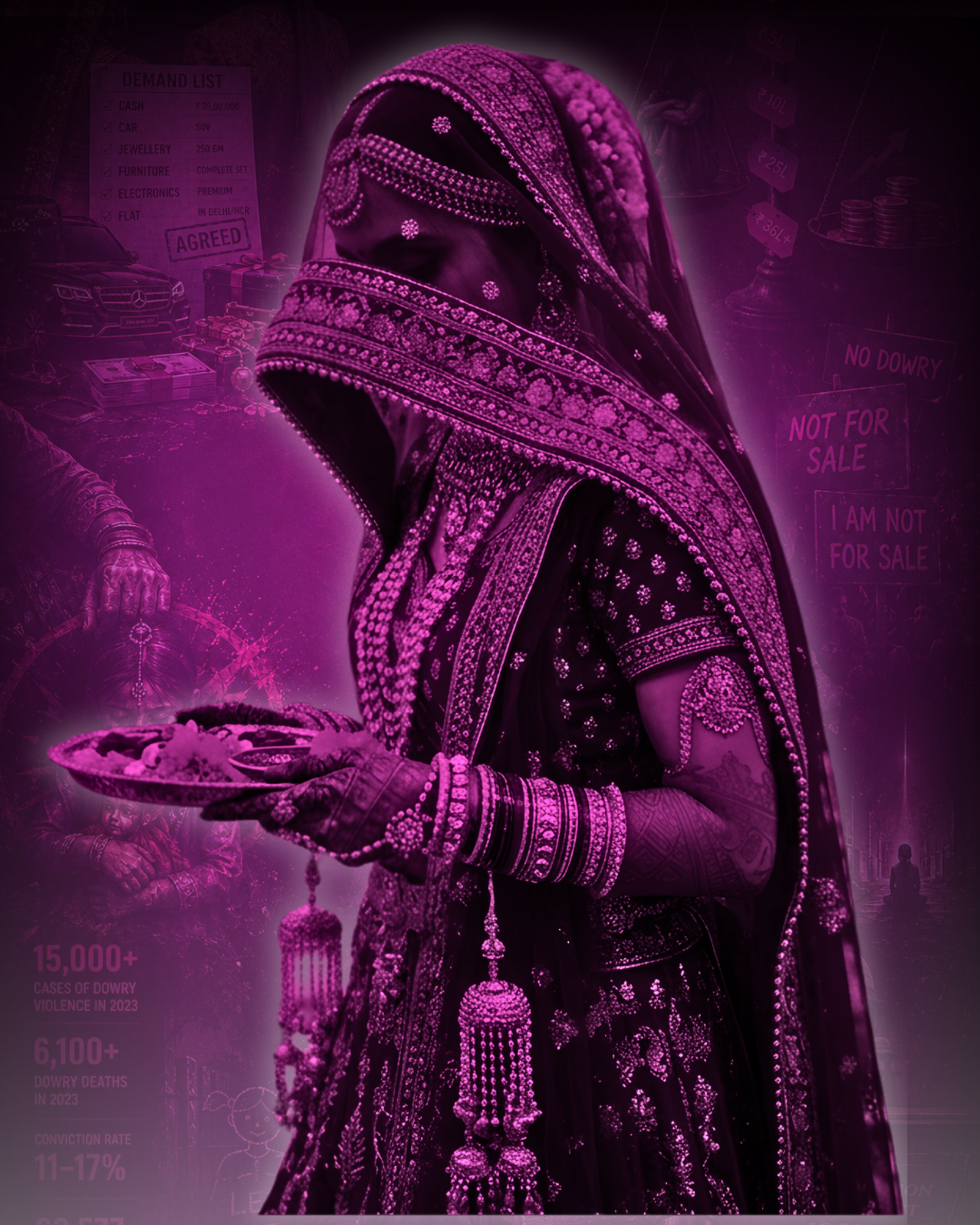
The Prohibition of Dowry Act was passed in 1961, more than sixty years ago. It made the giving and taking of dowry a criminal offence. It did not end the practice. In fact, this social evil is still very much part of today’s “progressive society “The practice today operates across caste, class, and religion. It is negotiated openly at engagement ceremonies. It is indexed to the groom’s salary, his qualifications, and his family’s social standing. It is tracked and itemised like a contract.
In August 2025,a 26-year-old woman named Nikki Bhati was found with severe burn injuries at her in-laws’ home in Greater Noida. Her sister Kanchan, who was married into the same family, recorded a video of the attack and told reporters: “We were beaten and tortured for days. They were demanding Rs 36 lakh. They hit her on the neck and head, threw acid, and set her on fire in front of her child.” Nikki had been married to Vipin Bhati since 2016. Her family alleged that soon after the wedding, she was subjected to repeated abuse over dowry demands, including Rs 35 lakh in cash and a car. She succumbed to 70 per cent burn injuries while being transferred to a Delhi hospital. Bhati was later shot in the leg by police after attempting to flee custody during a routine medical check.
In May 2026 ,an actor and model, Twisha Sharma from Noida, who was married to Samarth Singh in December 2025, died at her matrimonial home just 12 months into the marriage. Her family alleged mental torture and dowry harassment by her husband and his mother, a former judge. Her husband was arrested on May 22 after evading police for over a week.
These are not outliers from remote villages. These are cases from peri-urban Uttar Pradesh, from families with access to SUVs and smartphones, in a region an hour from the capital. The geography matters. The proximity to courts, police stations, and media did not protect these women.
Stripped to its logic, the dowry system communicates one thing with clarity: a woman is a liability.
She is a financial burden to the family that raises her and an acquisition of debatable value for the family that receives her. Her personhood, her education, her ambitions, her health, none of these are assets in the marriage economy.
This is objectification in its most complete form, not the sexualised objectification that Western feminist discourse has focused on, but something older and perhaps more totalising: the reduction of a human being to her exchange value. A woman under the dowry system is not primarily a person. She is a transaction.
The consequences ramify outward. Female foeticide, the selective abortion of female foetuses, is in part a response to the economic terror of raising a daughter. Female infanticide. Malnutrition of girl children relative to their brothers. Denial of medical care. These are not incidental to the dowry system. They are its logical extensions.
One of the most cruel extensions of Dowry is child marriage. The connection between the dowry system and child marriage is direct, documented, and devastating.
India has more child brides than any other country in the world. The logic is simple: the younger a girl is at the time of marriage, the lower her dowry price. A girl who is twelve or thirteen years old costs her in-laws less in social expectation than a woman of twenty-five. Poverty-stricken families, facing the financial dread of a daughter’s marriage, marry her off as early as possible to minimise the cost.
This calculus also shapes decisions about education. Sending a daughter to school costs money, money that, unlike investment in a son’s education, will not return to the family. A son’s education increases his earning power, which stays within the family unit. A daughter’s education benefits only the family she marries into. In a society structured by patrilocality and dowry, educating a daughter is, for many families, simply not economically rational.
Girls are therefore kept home, taught domestic skills, trained to be “better housewives”, which is to say, trained to be more valuable commodities at the point of sale. Their intellectual development is not the goal. Their marriageability is.
The cruelty of this system extends to its most educated participants. Scholars have documented how educated young men frequently use their qualifications as leverage to demand a higher dowry. A man with an engineering degree or a government post does not use his education to question the system he uses it to extract more from it. The more he has earned in credentials, the more his family demands at the negotiating table. Education, in this context, does not liberate women. It enriches the men who marry them.
What Will It Actually Take?
The widespread misuse of Section 498A has forced a legislative recalibration that now compromises the safety of genuine victims. Originally enacted as a stringent, non-bailable offence to protect women from dowry harassment, the provision’s rampant abuse for “legal terrorism” has prompted the Supreme Court to implement crucial safeguards—such as a mandatory preliminary inquiry before arrests and a two-month arrest protection period post-FIR. While these protections for the accused are necessary, the resulting cautionary approach now means genuine victims face a justice system where the once-automatic teeth of the law have been significantly dulled. Consequently, although dowry remains a pervasive menace with over 15,000 cases and 6,100 deaths reported in 2023 alone—the ability to secure timely justice is alarmingly slim; the overall conviction rate for dowry-related violence languishes at a meager 11–17%, and of the average 6,500 cases sent for trial annually, over 90% end without a conviction and can languish in the judicial backlog, with 60,577 dowry death cases alone pending at the end of 2022.
The harsher truth is that the dowry system persists not because Indians lack legislation, but because it is often enforced. It persists because it is load-bearing infrastructure — holding up ideas about family honour, gender hierarchy, and economic exchange that entire communities have organised themselves around for generations. You cannot repeal a worldview.
What can shift it is economic reality. When women earn their own incomes, the calculus of entrapment changes. A woman who is financially dependent on her husband’s family has nowhere to go. A woman who earns has an exit imperfect, stigmatised, frightening, but real. This is not an argument for women’s education because educated women command lower dowry prices, which is the grotesque version of the same logic. It is an argument that economic independence is the one lever that makes leaving survivable.
Alongside that, the social meaning of divorce must change. As long as a woman returning to her parents’ home is treated as their failure and her disgrace, the threat of leaving will remain hollow. Families will continue to absorb the knowledge of a daughter’s abuse rather than face the ruin of a broken marriage. Nikki Bhati’s father knew she was being harassed. Countless parents try to resolve the issue because they care more about “what society will say “instead of what their daughter might be going through. That instinct is not callousness. It is the rational response to a social structure that punishes exit. Changing it requires sustained cultural work: in media, in schools, in courtrooms, in the language leaders use when they speak about women who leave.
And the courts must continue to hold the full family unit accountable.The dowry system is not merely a cultural curiosity or an economic arrangement. It is a structure of violence — one that begins with a price set before a girl reaches adulthood, continues through the denial of her education and freedom, and in thousands of cases each year, ends in her death.
India has laws . It has judicial precedents. What it has not yet been fully assembled is the collective will to treat women as people rather than payments.
Until it does, the numbers will keep climbing.