The Great Indian Patriarchy Paradox: A Nation Clutches Its Pearls
By Tanushka Rathore on September 15, 2026
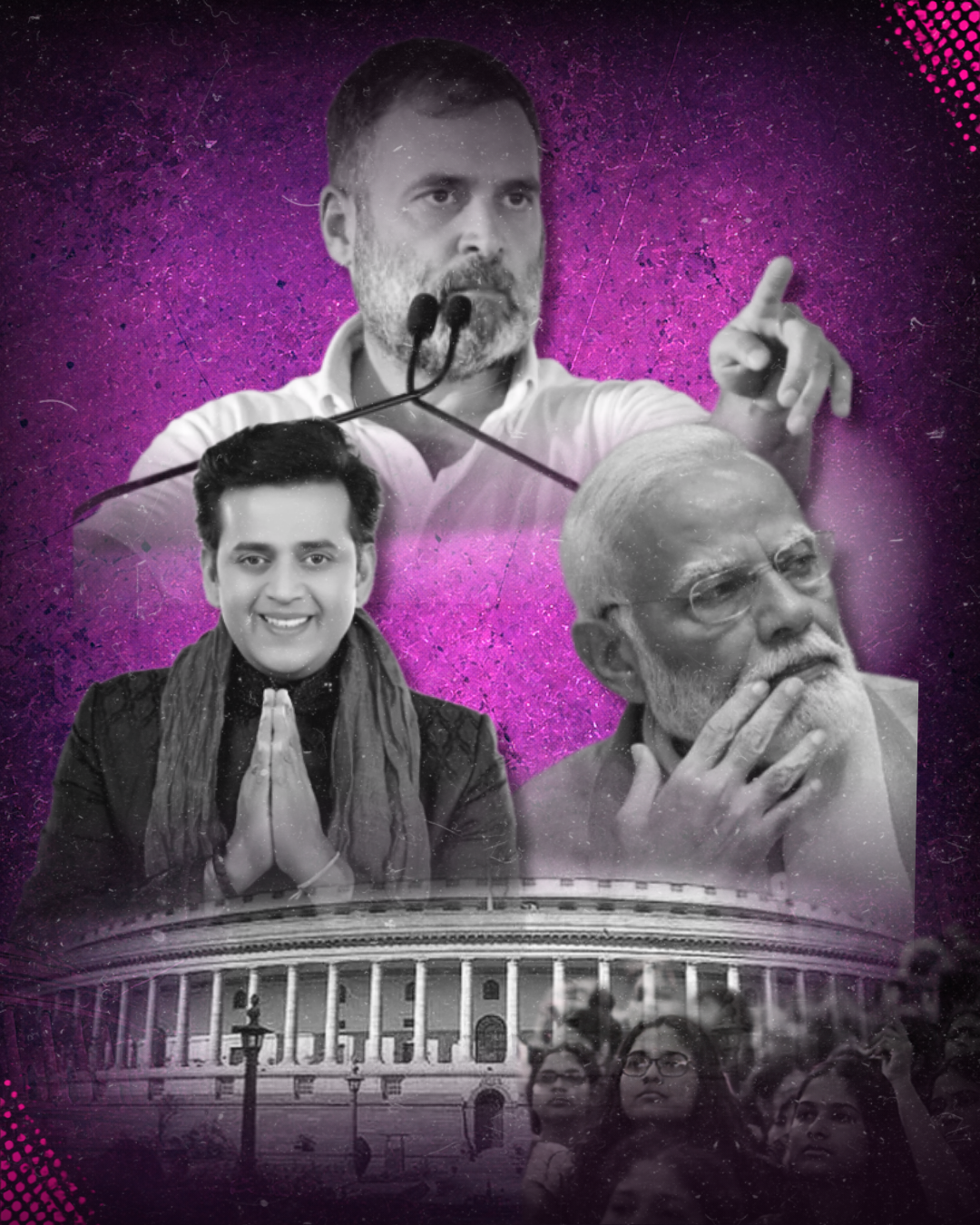
WAIT. He said THAT? On a stage? Out loud? In front of cameras?
That was basically the national reaction when Rahul Gandhi stood in Pune at his ‘Chhatron Ki Goonj’ outreach, a women-only edition of the event, addressing some 15,000 young women surrounded by students. He even called up an Adivasi speaker, Nisha Sable – the daughter of a sanitation worker from small-town Maharashtra and used the word “patriarchy.” Not “empowerment.” Not “upliftment,” that handy Indian-politics euphemism we use to file away anything uncomfortable about gender without actually looking at it. He said patriarchy, said it needed smashing, and tied it directly to the mindset that locks girls up while letting boys run free. He even took a swing at old comments from RSS chief Mohan Bhagwat and minister Manohar Lal Khattar about who’s really to blame for sexual violence.
Indians might not have topped the global happiness index, or ranked high on the press freedom index; as a journalist, that one stings, and we might still be a “developing” country by most measures. But there’s one thing very few countries can beat us at: our collection of quotable, baffling politicians. I follow politics, and conveniently my writing gives me an excuse to put it down on paper; however, the youth, apparently, don’t need one. Whatever our politicians say seems to land as either comedy gold or a breaking-news chyron, and rarely anything in between.
Here’s a question worth sitting with: since when did naming a problem become the scandal, instead of the problem itself?
Because that’s genuinely what happened, commentators called it “novel.” A “new political language.” Entire pieces got written just to marvel that a national leader had used the word without flinching. Which raises a second, meaner question: if saying “patriarchy is bad” counts as a bold and original move in 2026, what exactly has everyone else been saying instead?
Gandhi didn’t just say the word; he got called “Pappu” all over again for it, the usual insult reserved for anyone who sounds too soft or too pro-woman for comfort. And on the other side of the aisle, BJP MP Ravi Kishan got the same treatment in reverse; he told Parliament he touches his wife’s feet out of respect, and within the hour it was a punchline, memed and mocked by his own side. Different party, different gesture, same reflex: it seems the fastest way to get laughed at by other men in this country is to be caught respecting a woman on camera. You would expect that those who sit in parliament, those who have a voice and vote, would conduct themselves with a superior mindset. You would be expecting too much.
So, which is it? Is respecting your wife too radical to say out loud? Or is supporting women the unusual act? Because right now India seems to be running both plays at once.
Then comes specimen three, and this one made me sit up. Prime Minister Modi put out a video saying he’d suffered a “cultural shock” after a clip went around of a teenage girl swearing at him during the Gen Z protests. Fair enough on its face; nobody enjoys being cussed out on camera, whatever their politics. In all the fairness bestowed upon me, it is indeed an upsetting sight to be the subject of public resentment. But here’s the question nobody in power seemed to want asked: where was this cultural shock for the last decade, every time a woman minister, a woman protester, a woman journalist, or a woman MP got dragged through the same mud? Where was this shock when Sanjay Nirupam called Smriti Irani a “nachaniya,” or when Chandrakant Patil told Supriya Sule to go home and cook, or when Priyanka Gandhi got called “skirt wali bai” on the floor of a rally? Or, for that matter, where was it when the men in that very same protest were saying the same things?
Selective outrage is basically its own genre in Indian politics by now. This one just happened to air on prime time.
To be fair, because it would be too easy not to be, none of this is as clean as it looks from the outside. Rahul Gandhi’s framing has critics who call it strategy dressed up as conviction. Kishan’s gesture, by most accounts, wasn’t performed for cameras; it’s genuinely how he feels. And Modi’s discomfort at being sworn at was probably real, even if the timing was convenient. People are allowed to read all three differently. Nobody here gets to be the villain of a cartoon.
But strip away the memes and the headlines, and one word out loud, one gesture turned into a joke, one very selective heartbreak, none of them are really about patriarchy at all. They’re about how uncomfortable this whole country still is with just talking about it plainly, without flinching, without laughing, without picking sides on who’s allowed to be hurt.
And yes, one is free to say that it was performative, that Rahul Gandhi knew what the crowd wanted to hear. But, smashing patriarchy shouldn’t come with a party exemption. Congress’s own bench has Randeep Surjewala, caught on video making a derogatory remark about Hema Malini that he later had to walk back, and Charanjit Singh Channi, who ended up apologising “with folded hands” after Punjab’s own women’s commission came after him for comments about women. You don’t get to hand out a manifesto on respecting women while your own front row is still learning the basics. Naming the disease is the easy part; curing it is another issue altogether. You are free to say, Ravi Kishan is trying too hard to ride the Gen Z wave, but by no parameters where the statements given by them disrespectful to anyone. Whether right or wrong might be a personal opinion, but I know this: they weren’t insulting an entire gender. Whilst the prime minister’s concern for women becoming crass is an entirely different story.
So, here’s the question we keep circling back to, and it doesn’t have a clean answer: if a country can be this shocked by a single word, this amused by a small act of tenderness, and be so selective about who gets to maintain decorum and who doesn’t, what does that actually say about how far it thinks it’s already come?
Yes, India’s Economy and IT game might have been better than before, but is it really fair to say we, as a nation, have come a long way when public acts of sexism are treated as just another Tuesday?
Maybe the youth have already decided the government doesn’t look like them anymore. Fair enough. But here’s a parallel worth drawing: progress in this country has always been slow, uneven, and grudging, and yet it has happened, in fits and starts, across decades. The youth are going through the same arc, just faster. They’re more aware, more critical, and crucially louder than the generation before them. The politicians clearly haven’t caught up to that yet. They still seem to think the electorate arriving at the ballot box in five years is the same one that showed up a decade ago. It isn’t, and pretending otherwise is its own kind of miscalculation.
Freedom of speech (on paper) is a law in India, so leaders are allowed to say what they like, and the same goes for the public. They are free to laugh at a politician who respects women, and are free to say that a speech on patriarchy is performative. The law is the same for all, and hence this serves as a reminder to the government to exercise caution; the youth are watching. Power and money might buy a seat in parliament today, but whether that seat actually means anything in ten years is a question only accountability gets to answer, and nobody, no one at all, gets to opt out of being asked that.