The Exam Was Never the Point
By Ronita Bhattacharya on August 23, 2026
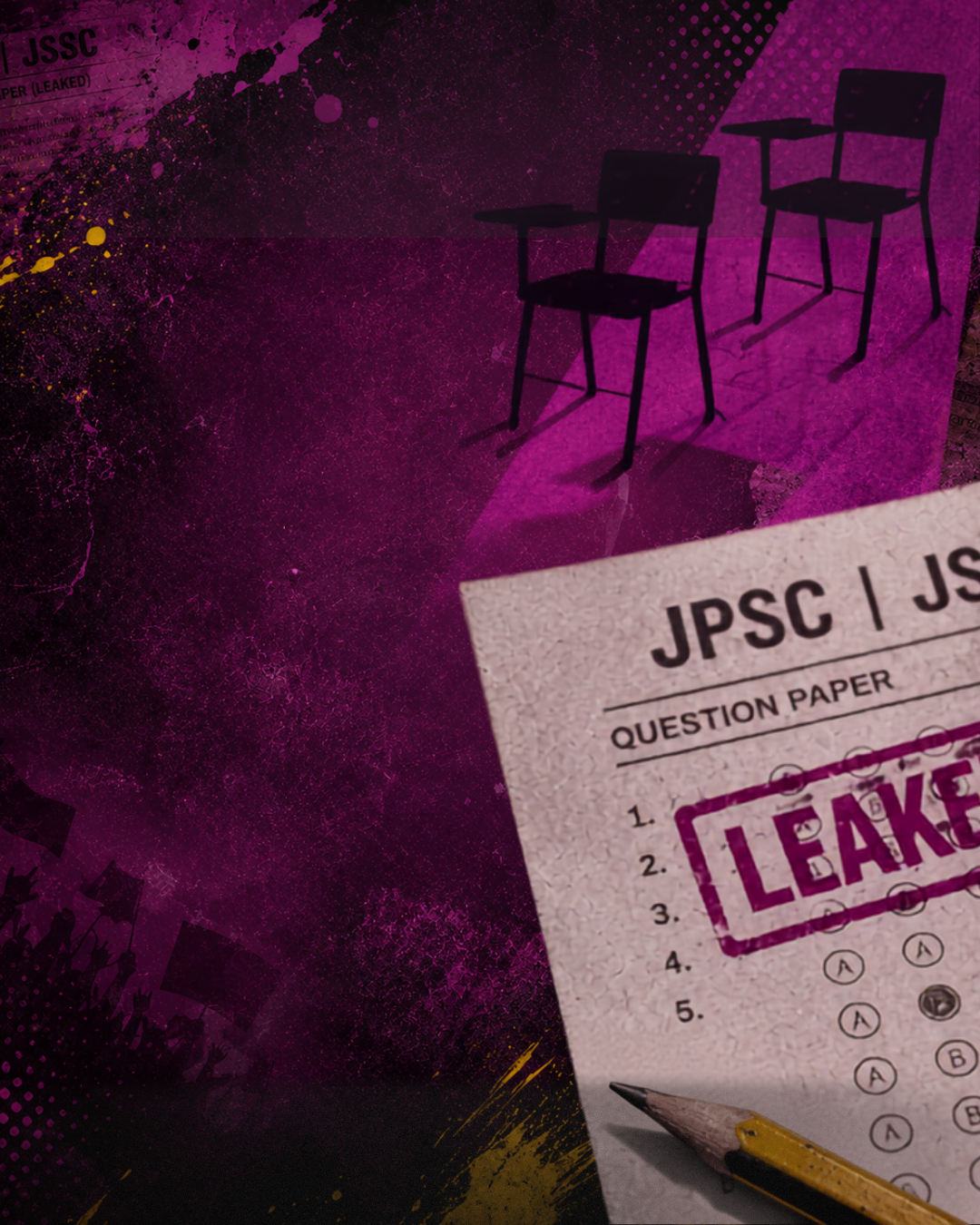
It all began on July 29 2026, when a group of exam candidates sat down at Jaipal Singh Munda Stadium in Ranchi and refused to get up. Their complaint? Simple – irregularities in the recruitment examinations of the Jharkhand Public Service Commission (JPSC) and the Jharkhand Staff Selection Commission (JSSC), leaked question papers with an evaluation process nobody can get themselves to trust, a transparency problem that, on paper, sounds like the kind of thing you’d file a grievance about, not the kind of thing you’d fast over.
However, by August 10, the issue had turned into an issue that is neither small nor procedural. Thousands marched on the state Assembly in Ranchi carrying Indian flags, met by riot police, water cannons, and barricades. Six protesters went on an indefinite hunger strike. One of them was Devendra Nath Mahto, a student leader with the Jharkhand Loktantrik Krantikari Morcha who arrived at the front of the march on a stretcher, nine days into his fast, and told the crowd that barbed wire wouldn’t be enough to stop them. The state government, which had spent the better part of two weeks treating the sit-in as background noise, folded by Sunday night. They were forced to cancel the 14th JPSC preliminary exam, along with the two backlog recruitment tests. The protests led to three JPSC board members resigning under investigation.
It was not enough. Students say they’ll continue until the Combined Graduate Level exam is scrapped too, and until the paper leak investigation is handed to the CBI.
If seen as an isolated event, this story is about constitutional failure, a commission that couldn’t keep its own exam secure, and a government that waited for a hunger strike to reach a stretcher before it moved. That story is true. It is also not an interesting one.
Really, the question here is how a leaked question paper, in 2026, is capable of producing this? How is it capable of pulling thousands of young people into the street, willing to fast, willing to be tear-gassed, over an exam?
The argument starts and ends with something really simple–arithmetic. Every cycle of JPSC and JSSC recruitment draws applicants in numbers that dwarf the seats on offer. The state has approximately 1,00,000 candidates fighting, struggling over 130 seats. Most of those applicants have already spent years and family savings on coaching centres built entirely around the promise of a government job. Ranchi is a hub for families and students for competitive exam prep, draining them of thousands, if not lakhs, of rupees every year. By the time a candidate sits for the actual exam, it has become a question of ROI rather than a simple test, a payout event on a multi-year investment, one with no other liquidity; you cannot cash out a JPSC prep course into anything but a JPSC job, and what’s ironic is that the coaching industry had a projected revenue of 7.3 billion USD while those who pay for it end up with no other recourse.
This is what makes exam leaks categorically different from other forms of corruption. In most institutional failures, the injured party has an option to route around the institution: sue it, shame it, or have an option to take their business elsewhere. The JPSC aspirant cannot.
There is no alternate vendor for a Jharkhand government job. The rage that produces a nine-day hunger strike is not really about fairness; rather, it’s just having been sold a ladder that, on closer inspection, only some people were allowed to climb.
None of this is unique to Jharkhand, which is precisely the point. Zoom out six months, and we see the map fills in on its own.
In Noida, wage protests over garment and factory pay turned violent in April, ending after arrests and tear gas, in a government-mandated 20 per cent minimum wage hike.
In Delhi, a parallel student movement over central examination-related corruption escalated far enough that the Indian education minister resigned; Jharkhand’s protests are explicitly being read against that resignation, a footnote to the capital’s crisis rather than a crisis of its own.
Reservation stirs over government job quotas have punctuated Jharkhand’s own political calendar for years. A 2023 bandh over 100 per cent local reservation in state jobs shut down transport and schools statewide. Different provocations, same structural complaint: the number of people who need a stable, dignified income has not shrunk, but the number of paths to one has.
What’s worth noticing is the costume each of these protests wears. Noida’s was a labour dispute. Delhi’s protest was based on an exam scandal, while Jharkhand’s was more of a recruitment-commission scandal.
Reported separately, they read as unconnected local stories: a simple wage dispute here, an administrative failure there but collected together, they reveal a sinister, single condition: an economy that has largely stopped generating the kind of jobs that used to organize a young life, steady, salaried, state-backed – and a generation still behaving as though that kind of job exists in sufficient quantity, because no one has told them, out loud, that it doesn’t. Every protest, in this reading, is a renegotiation of a promise that was already broken before anyone leaked anything.
The government job occupies a specific psychological position in India that is difficult to translate to economies without an equivalent. It acts like the last remaining institution that still promises something – security against inflation, a pension, social standing, a defensible answer to the question of what a son or daughter has become.
Which is what makes a rigged exam so combustible. It’s not just an unfair test. It’s evidence that the one institution still issuing binding promises has started backdating on them too – that the ladder wasn’t just narrow, it was crooked, and had possibly always been crooked. The years spent climbing it were spent under a false premise. There is a particular, cold fury reserved for the discovery that the last honest system wasn’t honest. Mahto’s hunger strike reads less as a demand for a specific administrative remedy – cancel this exam, investigate that leak – and more as a referendum on whether the promise still means anything at all. You do not starve yourself over a clerical error. You starve yourself over betrayal.
The JPSC-JSSC dispute will likely be resolved in the narrow, technical sense – an exam re-conducted, a report filed, a commission reconstituted with new names on the letterhead. The stretcher will go back to the storage room. What won’t be resolved is the arithmetic: too many aspirants, too few seats, and no alternate ladder. Let’s not forget: a state apparatus that keeps discovering that it can no longer quietly absorb the gap between the promise and the supply. Jharkhand will recede from the national feed, the way Noida did, the way Delhi did before it lent its resignation to Jharkhand’s headlines as a point of comparison. Something else will replace it – maybe a different state, a different commission, but one thing will always remain the same: the arithmetic.