Students on Screen: Why Does Bollywood Keep Making Us the Rebel?
By Tarini Dayal on November 9, 2026
For decades, the Bollywood industry has maintained a fairly decent job in keeping its audience glued to the theatre seats, either by feeding them the repetitive dose of eye candy, or by channelling their strong inner desire to have an intensely heated argument with the person they love, followed by an emotional, rain-soaked confession that makes their heart skip a beat. Surprisingly, it doesn’t really stop there. It’s no secret that Bollywood doesn’t shy away from a bold take on how students are presented on screen, and let’s be honest, those who don’t spiral down the rabbit hole of a love triangle, usually end up as embodiments of change and self-discovery. But does that depiction mirror the reality of students? Let’s deep dive into decoding what version of a student life Bollywood actually wants us to believe.
Starting off strong with Rang De Basanti, featuring an ensemble cast headlined by Aamir Khan, the film outrightly questions the corrupt actions of the government, a central theme that flickers between pre and post-independence India, and subconsciously awakens the idealism of the freedom fighters that the characters, as students, portray as part of an act. This political awakening, in reality, has only just begun with the student protests all around the country regarding the National Eligibility Entrance Test (NEET) 2026 paper leak that triggered nationwide outrage. Despite the film’s ideas of sacrifice, courage, and striving for justice, it only exists as an exaggerated criticism towards the country’s gamble of its citizens for power play. So, to ask the real question, when, in fact, did Bollywood expect students to lay down their lives for their country in the name of patriotism? And that too against the very government that holds the pen to sign off on all its releases?
It must be known that while patriotism is a real tear-jerker inducing topic in Bollywood, because, well, the love pouring for the country is at its highest when chewing on popcorn, the very rebel revolution trends that are being spoken about, have, in fact, managed to subtly influence the citizens’ inner loyalty towards the nation and indirectly channeled it into what we see as the “deshbhakti movements”. Expanding to works such as The Revolutionaries on Prime Video (a contemporary resurgence of the historical colonization of India) to systematic classist wars through masterpieces like Deewaar (a bold introduction of the “angry young man” trend) or even the low-octave, mysterious vigilante (portrayed by King Khan) that fights the justice vs. corruption paradox via a secret-operation underground setting in Atlee’s Jawaan, the common link between such category of media is not their sterile, white-washed portrayal, but their latent positioning as ideological state apparatuses that work as a slow infiltration in the daily system through decades of build-up and emotion. The most prominent and active byproduct of this influence is our annual independence day tradition of “Har Ghar Tiranga” inaugurated by our Prime Minister, Narendra Modi, with the national flag hoisted on the roofs of houses for those fifteen-odd days where suddenly everybody remembers that they need to show their love for the government- sorry, their country. If it weren’t for the residual crumbs of those films that keep our people fed with patriotic fuel, then perhaps the initiative wouldn’t have been successful in its implementation at all. So yes,
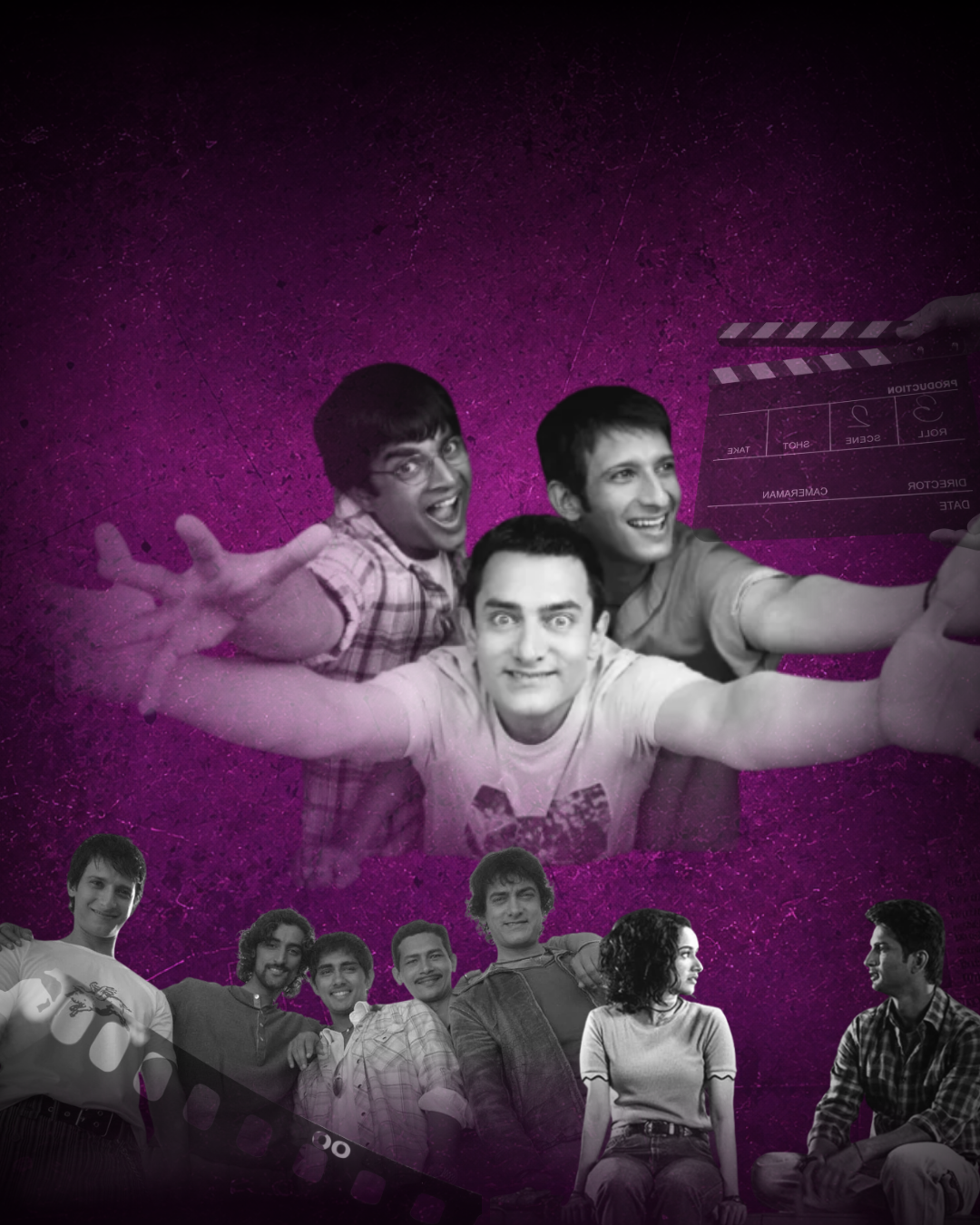
Even Rajkumar Hirani’s 3 Idiots is successful in dramatically portraying the struggle behind India’s famous concept of the rat race, and how, all it takes is simply proving to your parents and your college dean that you absolutely can break away from the vicious cycle of unfair competition and pursue what you love. Throw in some comedic relief, and dialogues that eventually turn into memes (how ironic, right?) to suddenly get the “perfect” recipe on how to escape all the pressure your family pours onto you to etch your brain into thinking that IIT or Delhi University is the only future left. I will always cherish 3 Idiots for its beautiful story about testing the strength of true friendship against the backdrop of an equally strong force that threatens to tear it apart, but we all can admit that the very race it eliminates in the film, is still a prominent matter in our country.
Again, taking the example of the UG NEET 2026 scandal, since it uprooted years of bubbling rage against the National Testing Agency and its ability to consistently have inconsistencies in its testing process, the incident shed light on just how many students and hopeful families were severely affected by the paper leak and its subsequent consequences. This, in turn, showed that the majority of our upper, middle, and lower class population is still entirely dependent on emerging as a winner from the rat race that they enter. For this majority, entrance competitions, which are the epitome of corruption, are their gateways to top-tier colleges, their only option to secure a stable future. And who can blame them? The traditional explanation of securing perfect grades and glorifying science as the sole means of earning a spot on the top ten richest list has been so deeply drilled into the students’ minds, that unfortunately, even Ranchoddas Chaanchad fails to inspire them to follow their dreams instead of doing what they are pressured to do.
And then, we add Chhichhore to the list of the never-ending romanticisation of student struggles. Because, why not? The fresh name only carries forward the ideology of rebellious kids who decide to take matters costing their happiness into their own hands and change their world for the better. This time, they are on a mission to spread the message that failure, sometimes, can also be an option, one that does not ruin a student’s thought-out plans. It is an assurance to them that failure does not dictate who they are, nor does it define their talent or their life. Except they convey this theme to a country like India, where failure, in fact, is very much not an option at all. Once again, the film fails to encourage the real-life students watching about the pros and cons of winning and losing, and serves merely as a passive depiction of unity against the rigid marks-induced mindset that society has instilled in us. And while it was a superhit at the box office, it could not influence students on coping with exam pressure and mental health. We still have multiple cases everyday about student suicides that increase in number during the competitive exam season, which only belies the film’s meaning that our youth is well-versed in coping with stress and failure.
However, there are a couple of new releases that have, in fact, strategized the white-washed, sterile portrayal of student rebels and overturned it into a more concrete, realistic, and raw message that actually has a strong influence on today’s youth generation. “12th Fail” directed by Vidhu Vinod Chopra excels in doing exactly that. The film chronicles Vikrant Massey pushing past his poverty-stricken life, corruption, and social expectations without the use of guns and violence, instead, reclaiming his justice by working hard for his dream, and ultimately, cracking the UPSC exam, is a subtler but more powerful influence in today’s time. No character is a rebel in the film, much like today’s students; they are symbols of hope and success- the same idea conveyed without bold and intense acts of rebellion. Such works bring to light just how strong the film industry can serve as ideological state apparatuses- all they need is more depth in their tone and way of storytelling.
To sum it up, Bollywood films are made for our screens, and the stories that they depict can only exist on our screens. It has always been known for providing an exaggerated and romanticised version of what life can be, especially for young students who feast their eyes for drama that appears on their screen. However, it is prudent not to compare it to reality, because the industry only exists as a glamorous and confident portrayal of how students should behave against society, but it cannot shake the foundation of our society. Truth is, Bollywood keeps on making us the rebel simply because it has no other choice but to keep the views rolling. It has not, and will never understand the student community, because the day it does, the core of everything that Indian cinema bets its money on will cease to exist.