Horoscope Over Hardwork: Why India Is Still Waiting for the World Cup
By Swarnim Sethi on July 14, 2026
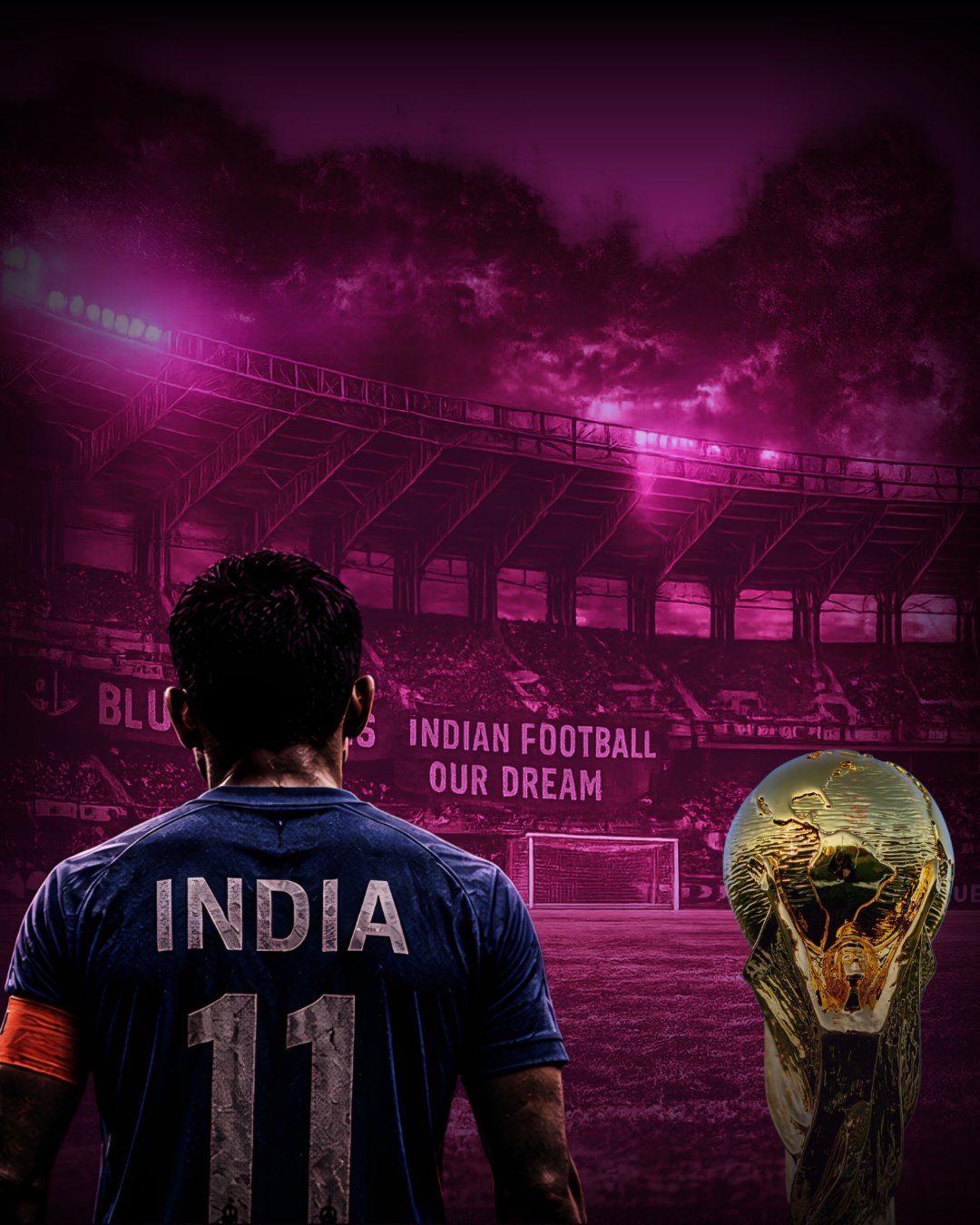
When news broke that the AIFF spent about ₹16 lakh to hire a Delhi-NCR-based astrological firm, officially designated to “motivate” the national men’s football team it became a national talking point.
India has one of the world’s largest youth populations and one of football’s biggest television audiences. During the 2026 FIFA World Cup, an Ipsos survey found that 59% of Indians planned to follow the tournament while broadcaster Zee reported that more than 100 million viewers watched during the opening weekend alone.
Yet, nearly a century after playing its first international match, India has never qualified for a FIFA World Cup.
The problem is not a lack of passion. Nor is it a lack of talent. It is the outcome of decades of administrative failures, corruption, inadequate infrastructure, weak youth pathways, and governance choices that have repeatedly prioritized the wrong things.
Sometimes, almost unbelievably, those priorities included astrology.
In 2022, reports revealed that the All India Football Federation (AIFF) had spent close to ₹16 lakh on an astrology consultancy to hold motivational sessions for the Indian men’s national team before crucial AFC Asian Cup qualifiers.
Former Indian goalkeeper Tanumoy Bose criticized the decision as a distraction, stating that the federation was spending money on astrology while youth leagues were disappearing and grassroots football starved of funds.
The controversy deepened when Minerva FC director Ranjit Bajaj later alleged that the federation had separately spent another ₹25 lakh on an astrologer who not only prepared players’ horoscopes but also advised the head coach on team selection. If accurate, it means that the astrologer’s influence extended beyond motivation into footballing decisions themselves.
Whether one believes in astrology is beside the point.The larger issue is what that money could have funded instead.
After leaving his role in 2024, former India head coach Igor Štimac described Indian football as “imprisoned.”
He said his coaching staff lacked equipment considered standard across professional football, including GPS performance trackers and advanced video-analysis software. At one stage, according to Štimac, the team had to borrow another club’s analytics platform simply to prepare for matches.
According to him, repeated promises from administrators, never materialized.While millions had been spent on astrology, the national team was struggling to access technology that much smaller footballing nations consider routine
Another obstacle is the level of competition in India . Indian national teams spend much of their time facing relatively weaker regional opponents instead of consistently testing themselves against Asia’s elite, limiting their tactical and technical development.
India’s citizenship laws further reduce the available talent pool. Because the country does not permit dual citizenship, several footballers of Indian origin have gone on to represent countries including Australia, New Zealand, Qatar and Congo rather than the Blue Tigers.
The challenge extends beyond boardrooms and federation offices. For Indian football to truly grow, the country’s sporting culture must evolve
Only about 6% of Indians regularly participate in organized sport, well below countries such as China (20%) and the United States ( 25%). Limited infrastructure, inadequate coaching and poor access to facilities continue to discourage participation.
Football also competes with the overwhelming economic dominance of cricket.Parents actively steer talented kids toward cricket over football because of the financial upside, especially the IPL, where even domestic squad players can earn life-changing money. A gifted 12-year-old athlete in India is, on average, pushed toward a bat rather than a ball, purely on economic logic says ranjit bajaj.Until football is increasingly seen as a viable long-term profession rather than simply a sport to watch, India’s talent pool will continue to be smaller than its population suggests
India currently sits around 136th in the FIFA rankings, while Asian nations such as Uzbekistan (52nd), Jordan (63rd), Japan, South Korea, Saudi Arabia, Iran and Qatar have spent the past two decades systematically investing in coaching education, youth academies, sports science and competitive domestic leagues.
Even after FIFA expanded the men’s World Cup from 32 to 48 teams, creating more qualification spots for Asia than ever before, India has failed to close the gap.
Former captain Sunil Chhetri has relentlessly emphasised on the fact that India must first become one of Asia’s top 15–20 footballing nations before World Cup qualification can become a realistic target.
Despite those structural failures,every now and then, Indian football offers a glimpse of what could be One of the strongest examples came this year from Punjab’s Minerva Academy.Competing in the prestigious MICFootball tournament in Spain, a youth competition that has previously featured future stars such as Lionel Messi and Neymar, Minerva’s Under-15 side stunned international observers.
The Indian academy progressed unbeaten through the group stage, eliminated three opponents in the knockout rounds, defeated Liverpool FC’s youth academy 6–0, and ultimately finished fifth among 52 elite academies from around the world.The achievement was extraordinary not simply because an Indian team beat Liverpool’s academy.
It demonstrated that when Indian players receive modern coaching, structured development right guidance and support from an early age, they can compete against some of the world’s best youth systems.
Remarkably, the tour itself reportedly depended heavily on academy founder Ranjit Bajaj mortgaging his own property after fundraising fell short highlighting how private initiative continues to compensate for institutional shortcomings.
India does not lack football fans. It does not lack young athletes.Matter in fact , it does not even lack promising footballers.What it lacks is a system capable of consistently turning those players into World Cup competitors.
Private academies can produce exceptional individuals.
Regional football cultures can keep the sport alive.But neither can replace effective governance.
Until the AIFF starts taking accountability and responsibility to modernizes administration, invests consistently in grassroots football, strengthens domestic competitions, expands coaching education and prioritizes long-term player development over headline-grabbing distractions, India’s World Cup dream will remain exactly that a dream.