Erasing an Identity: The Dangerous Turn in India’s Transgender Law
By Ronita Bhattacharya on March 30, 2026
If you were to ask an Indian what makes them proudest about their country, most of them would say its rich history, and culture. Its “diversity” and “acceptance” towards all, the hospitality and the kindness we show to others, but what about its own citizens? Does this ideal hold true when it comes to the people of its land?
I want you to picture this—you were just a normal citizen of your country and on a random Tuesday, somebody decides you simply do not exist, your right to your identity is taken away from you, who you are, where you come from, slipping right out of your fingertips. Dystopian, right? But believe me when I say that this is now a reality for almost 5 lakhs of Indian Transgender individuals.
The new amendment of the Transgender Persons (Protection of Rights) Act, 2019, threatens to erase, as well as forget, one of India’s oldest identities—The trans persons!
The Transgender Persons (Protection of Rights) Bill, 2026, seeks to change what defines a trans person. The original act stated that, a transgender person is a person whose gender does not match with the gender assigned at birth but the new bill believes that a person with socio-cultural identity such as Kinner, Hijra, Aravani, or Jogta, and a person with variations at birth in characteristics such as primary sexual characteristics, external genitalia, chromosomes, or hormones from the normative standard of male or female body can be identified as transgender. It narrows identity down to biological or socio-cultural categories, excluding trans people who don’t fit those labels and reintroducing the idea of gatekeeping.
The changes also heavily contradict the 2014 case of National Legal Services Authority vs. Union of India, which identified transgender people as a “third gender” and affirmed self-identification, providing them with dignity at workplaces, hospitals, police stations, etc. as a fundamental right under Articles 14, 19, and 21.
But a question that arises now is, why are we so focussed on gender rights and queer identities suddenly. Especially at a time like this—when LPG prices are skyrocketing, the tariffs are higher than ever and the rupee is 6 feet underground, why do we see the need to take away the rights of our citizens?
Our leaders believe that people of India are changing their genders and spending sums of money on HRT for the sake of reservation and benefits given by the government, but I beg to ask, why would anyone, in a country like India, seek to be more marginalized than they already are?
In all of this, we are forgetting that the government loves dictating what we do with our bodies, and it’s unfathomable to the officials that someone has the right to define who they are and express themselves the way they want to express!
And isn’t the new bill just a way of erasing their existence? Moreover, had the socio-cultural identities like Hijra and Kinner not been mentioned in the history of the nation, the present government wouldn’t have created a separate law for them. They, too, would have been erased.
Let’s not forget that the bill was not even discussed with the representatives of the communities before it was introduced and it being passed is unconstitutional since it hinders the fundamental rights of the citizens, violating equality, freedom of expression, right to life and dignity. This should make us shiver because where is our opposition, why is no one speaking up and how was a bill like this one even passed in the Rajya Sabha?
Well, our beloved opposition had walked out of the parliament to show their “mild” distaste for the bill while it was passed with a voice vote, out of the 15 MPs, 11 opposed, a few old government officials deciding what the youth should do to their body.
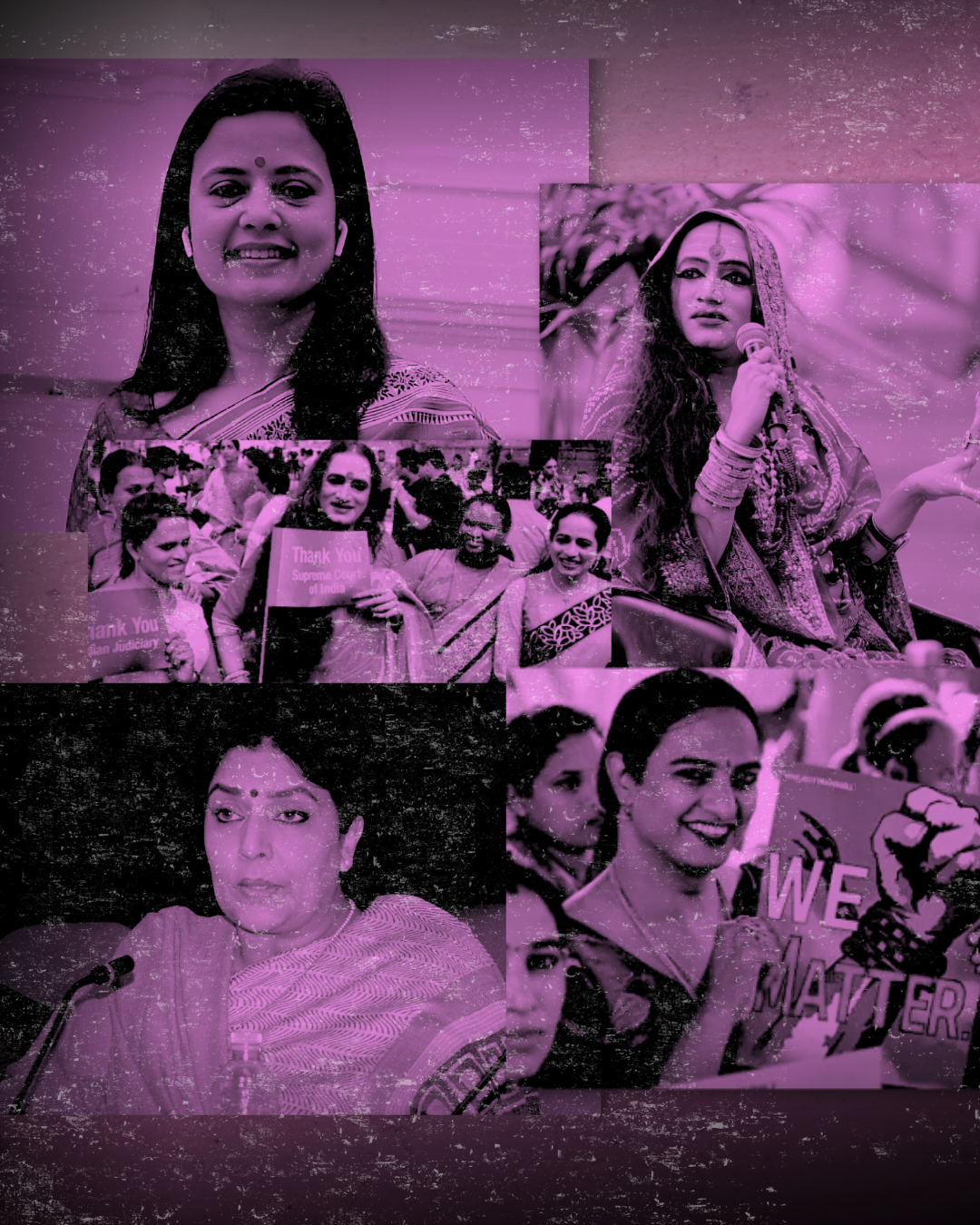
Some of the opposition leaders had spoken up, like Renuka Choudhary, asking the other members of the Parliament the full form LGBTQ and it’s humorous how the people making decisions about us don’t even know where we come from and what our identities are!
Furthermore, history is evidence that bodily rights and rise in authoritarianism go hand in hand. Anti -LGBTQIA+ violence has been on the rise in the past year or so, with Trump administration constantly belittling trans individual, going as far as denying accurate passports to intersex, trans and non-binary individuals by forcing their gender to be recorded as the one assigned at birth as well as barring any trans person from being in the military. Similarly, in a rally last year, the president of Turkey had repeatedly targeted the LGBTQIA individuals, equating their rights to child abuse! Across the globe, we see a pattern—governments tightening control over identity as a means of consolidating power.
But then again, what does all this mean for the transgender individuals of our society? Without legal recognition, these individuals face the threat of losing their jobs, proper medical care as well as proper education, forcing the already marginalised communities further to the fringes of the society. This legal erasure would translate into practical barriers—difficulty in obtaining identity documents, reduced access to healthcare, education, and employment, and increased vulnerability to discrimination and violence. Moreover, by placing the power of defining identity in the hands of the state rather than the individual, the bill undermines personal autonomy and dignity, values that are central to the Indian Constitution.
At the end of the day, the debate surrounding the Transgender Persons (Protection of Rights) bill, 2026 is not just about legal definition or who could be called a transperson, it is about the fundamental question of who holds the authority to define an identity in democracy. By contradicting the principle of self-identification defined in 2014’s NALSA vs The Union Of India, the bill risks undermining the very constitutional values of dignity, equality and personal liberty it is meant to protect.
We are at a time where marginalized communities are fighting for their rights to be represented and accepted, measures like the bill passed threaten to reverse the hard-won progress as well as deepen existing inequalities.
And lets not forget, if they are taking away the rights of the transgenders today, they could also come for the rest tomorrow. Soon, it will be the homosexual community, and then women, and then the lower caste and all of this will go on till nothing but one community remains on top.