Decolonisation Or Selective Memory? India’s Renaming Project Has A Pattern
By Tanushka Rathore on May 17, 2026
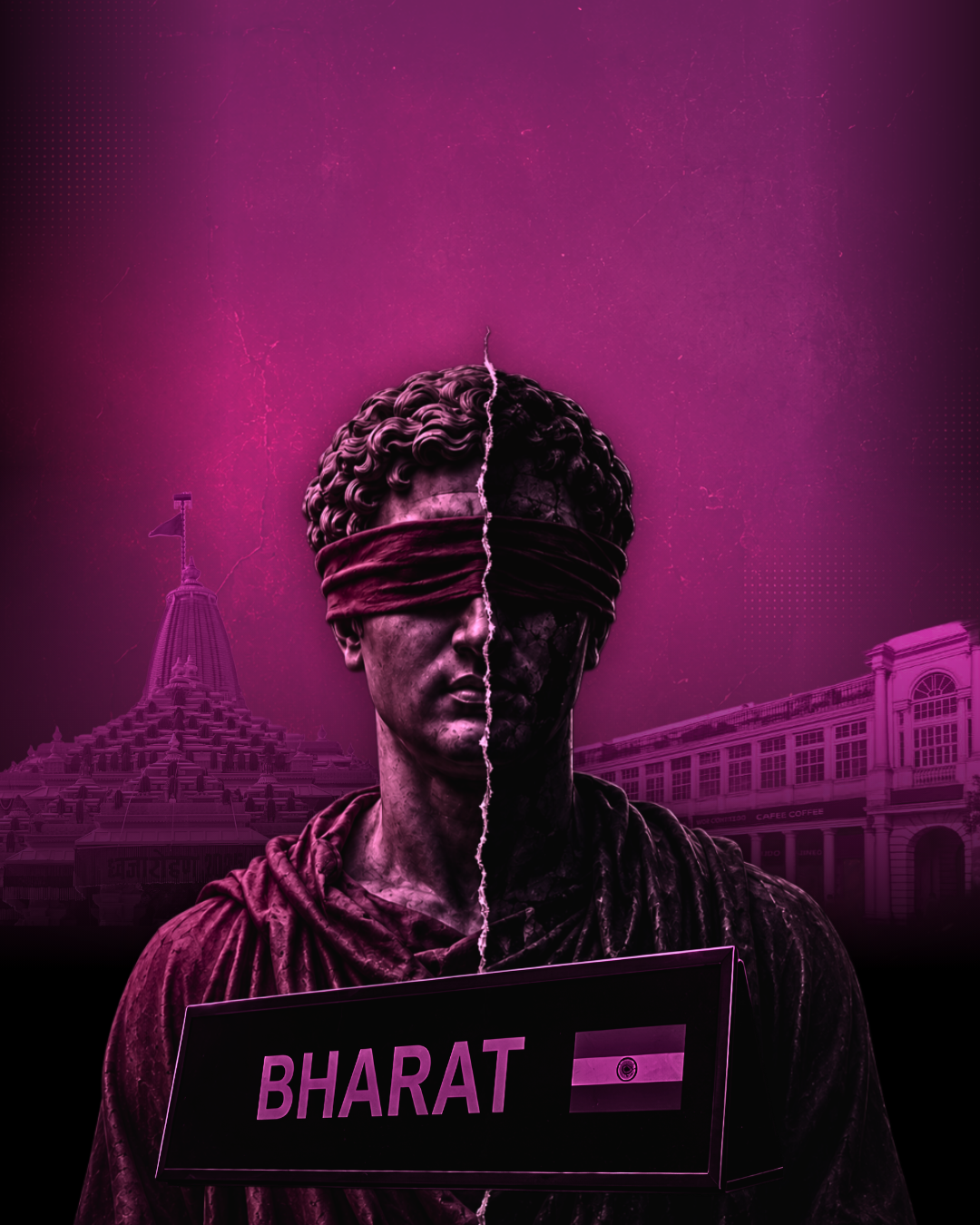
There is a particular kind of power that does not announce itself, neither does it march, nor does it declare. But it does have an impact – power, after all, rarely goes unnoticed. While the Indian government makes it their business to amplify and celebrate things that do not matter, I haven’t put it past them to be quiet when they need to be. And they have indeed proved me right. While everyone looks away, the furniture has quietly been shifting in this house they call “Bharat”, and there is a pattern to it.
Well, I have been observing their furniture, and I have questions.
A small rectangular placard – that’s all it takes. In September 2023, the world’s most powerful leaders gathered in New Delhi for the G20 summit. Cameras rolled, capturing everything, including India’s Prime Minister sitting behind a nameplate. It did not say India. It said, Bharat.
No announcement preceded it, nor was there a constitutional amendment tabled that morning, and yet, through one single action on one of the world’s biggest diplomatic stages, it was a declaration, unspoken but heard loud and clear. That a shift was underway, and for being the world’s largest democracy, this particular brand of change wasn’t waiting for votes.
Now, before we proceed, let us be generous and at least pretend to engage with the official explanation – because yes, there is one, and it’s entirely so charming in its audacity. This, we have been told, is “decolonisation”. An attempt to snatch back our culture from the grubby hands, shedding the names thrust upon it by various uninvited guests who overstayed their welcome by a few centuries. It is, on paper, a beautiful concept, one that is usually accompanied by a biopic with a handsome hero and a patriotic background score.
However, there is just a little problem with it, the selective amnesia it requires to believe. Because if the mission were truly to erase all foreign fingerprints from this land, one would expect a rather comprehensive audit. Colonial-era English names, for instance, remain remarkably comfortable. It is specifically almost surgically the Urdu and Persian names, the ones that arrived with Muslim rule, that are being quietly retired. Which is a curious kind of decolonisation, one that seems to know exactly which colony it objects to. But do go on, the background score is lovely.
It appears India has picked up a habit from our dear old invaders – England. The collective and selective amnesia and the efforts the UK has gone through to erase and forget its colonising past seem to match the amount of effort the Indian government has put into erasing the historical fact that Muslim rulers dominated India at a point in history where the country arguably flourished.
So, I take it on myself to audit, since no one in power seems keen to. The renaming project, when you lay it out, has a very specific aesthetic. Allahabad, founded by Mughal Emperor Akbar, who incidentally named it Illaha-bas, meaning abode of the gods, in reverence of its Hindu significance, a detail that gets quietly omitted from the press releases, became Prayagraj in 2018. Mughalsarai Junction, one of India’s busiest railway stations, became Pandit Deen Dayal Upadhyaya Junction. Aurangabad became Chhatrapati Sambhaji Nagar. Osmanabad became Dharashiv. Faizabad became Ayodhya. Delhi’s Rajpath, the ceremonial spine of the republic, where the nation parades its sovereignty (and technical secularism) every January became Kartavya Path. Even the Mughal Gardens inside Rashtrapati Bhavan, which had existed unbothered since 1929, were rebranded Amrit Udyan. The pattern, as you may have noticed, is consistent. Anything that carries the faint scent of Urdu, Persian, or a name ending in “-abad” essentially must go. The replacements arrive in Sanskrit, in mythology, in the vocabulary of a civilisation that predates the Mughals by several thousand years. A question persists: aren’t the Mughals a part of our history as well? They existed before the English came, and they make up a considerable part of Indian history.
And now for the part that does not make it into the decolonisation brochure. Connaught Place, named after Prince Arthur, Duke of Connaught, a British royal who had absolutely nothing to do with India beyond the accident of empire, stands untouched in the heart of Delhi. Lutyens’ Delhi, named after Edwin Lutyens, the British architect who designed it as a colonial capital, retains the name. Howrah, Bandra, Mount Road, Brigade Road, and the Victoria Memorial – the British left their fingerprints everywhere, and a remarkable number of them are still there, polished and intact. Fingerprints, if I must remind are of – INVASION. Centuries of struggle and fight to free ourselves, and yet, no renaming commission has come for them. No cabinet meeting has found them inconvenient.
But cities are not all; why stop at them? When rebranding, one might as well pay attention to the weapons that arm “Bharat”. India’s missile programme has, for decades, drawn its vocabulary entirely from Sanskrit and Hindu mythology, and honestly, as far as branding exercises go, I am impressed with its thoroughness. Agni, the Vedic god of fire, powers India’s ballistic missile programme, a series of nuclear-capable weapons named after the deity of destruction itself. Prithvi means earth. Akash means sky. Trishul is the three-pronged spear of Lord Shiva. Nag is the divine serpent. Pralay translates, delightfully, as apocalypse. Shaurya means valour. The fighter jet is called Tejas – brilliance, a name personally bestowed by Atal Bihari Vajpayee in 2003, because apparently even aircraft – built on science and physics needs a Sanskrit blessing before takeoff. The Indian arsenal reads less like a defence inventory and more like a very aggressive chapter of the Mahabharata.
Now, to be fair – and it’s a herculean task to be fair here – naming weapons after powerful mythological imagery is a global tradition. Countries have always wanted their missiles to sound like divine punishment. The Americans have theirTomahawk, Trident, and Minuteman. The point is not that India named its missiles after Hindu gods. The point is that when you place those names next to the G20 nameplate (and we must), next to Prayagraj, next to Kartavya Path, next to Amrit Udyan, a picture begins to emerge. Not of decolonisation. Not of a civilisation reclaiming its heritage in some broad, inclusive sense. But of a very specific, very deliberate construction of identity, one in which the symbolic vocabulary of the nation is being quietly, methodically, replaced with a single cultural register. Entirely Hindu. Entirely Sanskrit. Entirely pointed in one direction.
And the missiles, at least, are honest about their intentions. They are called Pralay – apocalypse, and they mean it. It is the subtler renamings that smile while they work.
And maybe the government is right, maybe BHARAT was here before everything else, maybe rightfully this ancient name came before any other names, but here is the thing about reclamation, it matters enormously who gets to decide what is being reclaimed, what gets left behind, and who was not consulted when the decision was made. Because a democracy is not a renovation project undertaken by the landlord while the tenants are asleep. It is, at least in theory, a conversation between a government and the 1.4 billion people it represents, people who speak over a hundred languages, pray in a dozen directions, and carry histories that do NOT all begin in the same ancient text.
The genius of it- and I will give credit where credit is due- is how little noise it makes. Empires used to announce themselves – flags, cannons, declarations of conquest. This comes with a nameplate. A garden renamed. A missile called Pralay. A city that used to be called something else and now isn’t. It is the quietest power grab in the history of loud politics, and it is working precisely because it does not look like one. The nameplate said, Bharat. The missiles are named after gods. The cities are shedding their histories like old skin. And somewhere in the corridors of power, someone is very pleased with how little anyone noticed.
But you noticed. You are reading this. And that, in a political climate that has perfected the art of the quiet shift, is not, nothing. So, as I end, I can only advise one thing – Pay attention to the furniture. It has not stopped moving.