
Certified Chapri: The Privilege of Niche
By Maddukuri Hitasree on May 12, 2026
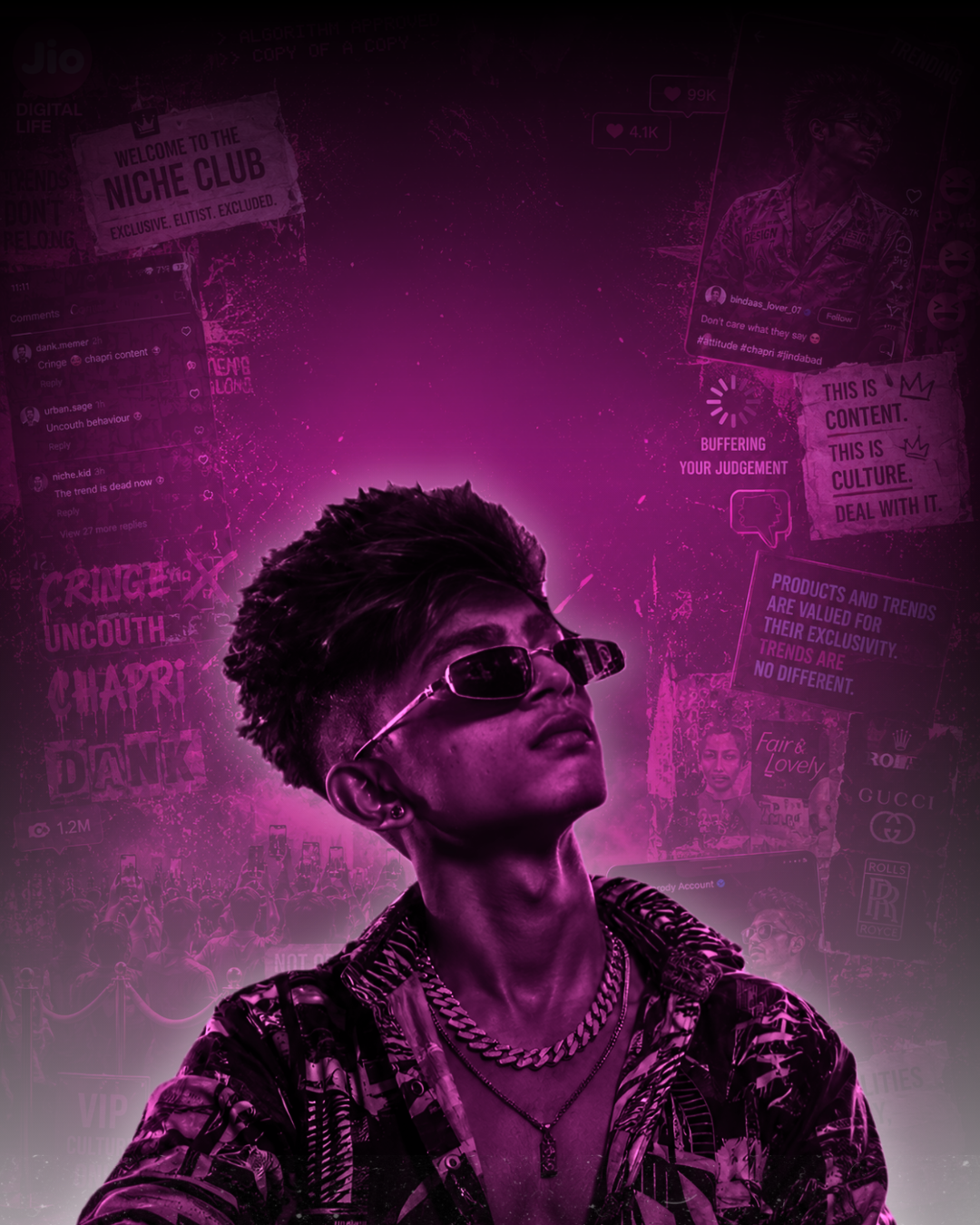
The masses are not excluded by accident; they are excluded by design.
Every aspect of our lives has been affected by social media, right from political campaigns to celebrity endorsements; we have seen it all. May it be the meme wars between rival parties in India, Zohran Mamdani recreating famous Hindi dialogues with the signature “Bollywood swag,” or famous Bollywood actors hopping on the parody bandwagon to recreate uncouth fads. We have applauded them for it all; even though public figures with extensive followings commit to such trends, we do not raise the question of “anti-commodification” or “second order copy.”
Well, the minute a person from a plebian class and a fairly backward background commits the crime of following the trend, we gasp in revulsion and declare the death of the trend. Our actions are completely justified because how dare they?
How dare they think the trends of social media and the fads are all-inclusive?
How dare they innocently hop on the bandwagon of popular trends and recreate them with their own touch and style?
There must be consequences and public shaming for the crime they committed. As a very sincere and morally righteous online audience, we get to police them and label them as “chapri.”
This word, which is a part of the vocabulary starter pack for every chronically online and “dank” user, has a deeper meaning to it. Often used in a negative sense to mock or comicize a certain type of content online, has a deeply classist connotation to it. This certain type of content mainly involves people who come from lesser-privileged backgrounds, people who don’t have access to the same education and opportunities as the middle and upper-class members of society, but these same people have the same access to the internet as we all do…what exactly does that account for? The opportunity for everyone to reproduce the same social hierarchies that exist offline, turning supposedly open digital platforms into yet another arena for exclusion and ridicule. Even online, where everyone is technically given the same stage, people still find ways to divide, label, and look down on others.
The ironic part is that most of these trends such as skinny jeans and ripped outfits, transition and lip syncing reels, gelled out spikes and hair highlights have started off as fads enjoyed by a niche part of the society, soon they gained traction through mass commercialization and celebrity endorsement, however the minute it became accessible to the working poor of our community, we label it “chapri” and completely disassociate ourselves from it.
The explosion of free and affordable internet services in 2016, provided through the “Jio welcome pack,”made the internet and social media accessible to people from various classes. Prior to this, the online humour and trends were safely consumed in a bubble for well-to-do people who borrowed the humour styles from the West, which they deemed to be “sophisticated.”
The affordable internet instantly resulted in the sudden ostracisation of preexisting trends which were now being replicated by the masses- along with the gradual consolidation of the “chapri” classification.
Products and services are valued for their exclusivity; trends are no different. When a trend first emerges on the popular feed, the urbane would take pride in discovering it and labelling it as “niche” (even though the algorithm has circulated the same reel to myriad people). The trend is still celebrated even though it becomes viral; however, it is labelled “chapri” only when it reaches people of the working poor class. This is plain hypocrisy and elitism masked behind “dank humour” and mockery.
Even though we have been sovereign for the better part of a century, we still cannot let go of the colonised mindset, which has seeped into our conscience to perceive it as superior and refined. This is the very reason why Fair and Lovely is a market leader, and brand titans like Rolls Royce, Rolex and Gucci are considered the pinnacle of success. We still strive to fit in and find a place in their exclusionary table, hoping that we will be welcomed without the tag of outsiders. This same mentality has seeped into the media we consume, from movies to the bite-sized shorts on our phones; we cannot truly appreciate or recognise the depth and artistry of the media if it does not have a touch of westernisation. How will we differentiate ourselves from the unrefined and unsophisticated class who cannot meet the complexities of the Western media ? How dare the masses ruin our chances of being kicked out of the Western exclusive table we were never even invited to?
Another subculture which has culminated from this internet culture is the parody or caricaturing of such “chapri” trends. Internet personalities like “Autizmen” and “4bimaari” have built their fanbase by staging skits that parody Indian TikTok trends, which are often labelled cringe and UNCOUTH. However, they are met with praise and a loyal fanbase which considers this humour as niche (ironic, isn’t it?). The very privilege of being included in the niche club depends on your class, societal status and oftentimes your caste too.
Classism and casteism are dismissed as a thing of the past, but microaggressions and ridicule prove to us the harsh reality- wherever there is a community, there will be a class divide, and to quote Karl Marx, “all of history is class struggle.”
Instead of policing and categorising trends (which is ultimately decided by an algorithm in a dingy data centre), the online community should understand that nothing on the internet is ever original. Every meme, every type of humour and fashion style is ultimately a copy of a copy, which has been incestuous of trends previously driven by capitalistic standards. In a space built on repetition, moralising “authenticity” is just another recycled trend; what we call “taste” online is merely algorithmic approval dressed up as cultural authority. Originality online is less an act of creation than a curated illusion , endlessly recycled to serve platforms, profits, and power; to pretend otherwise is not discernment but denial.
Loved how someone FINALLY talked about classism. It was the exact same with chikankari kurtis, once they were accessible to the lower working class, people started labelling it as “cringe” and “embarrassing” to wear! And let’s not forget about the separate lifts for workers, domestic help, food delivery people etc.
Are there more information regarding about this topic for us to research for? Thank you