
Built For Men: Does Nolan Really Have a Problem with Women?
By Hitasree Maddukuri and Shaayon Chakravarty on August 8, 2026
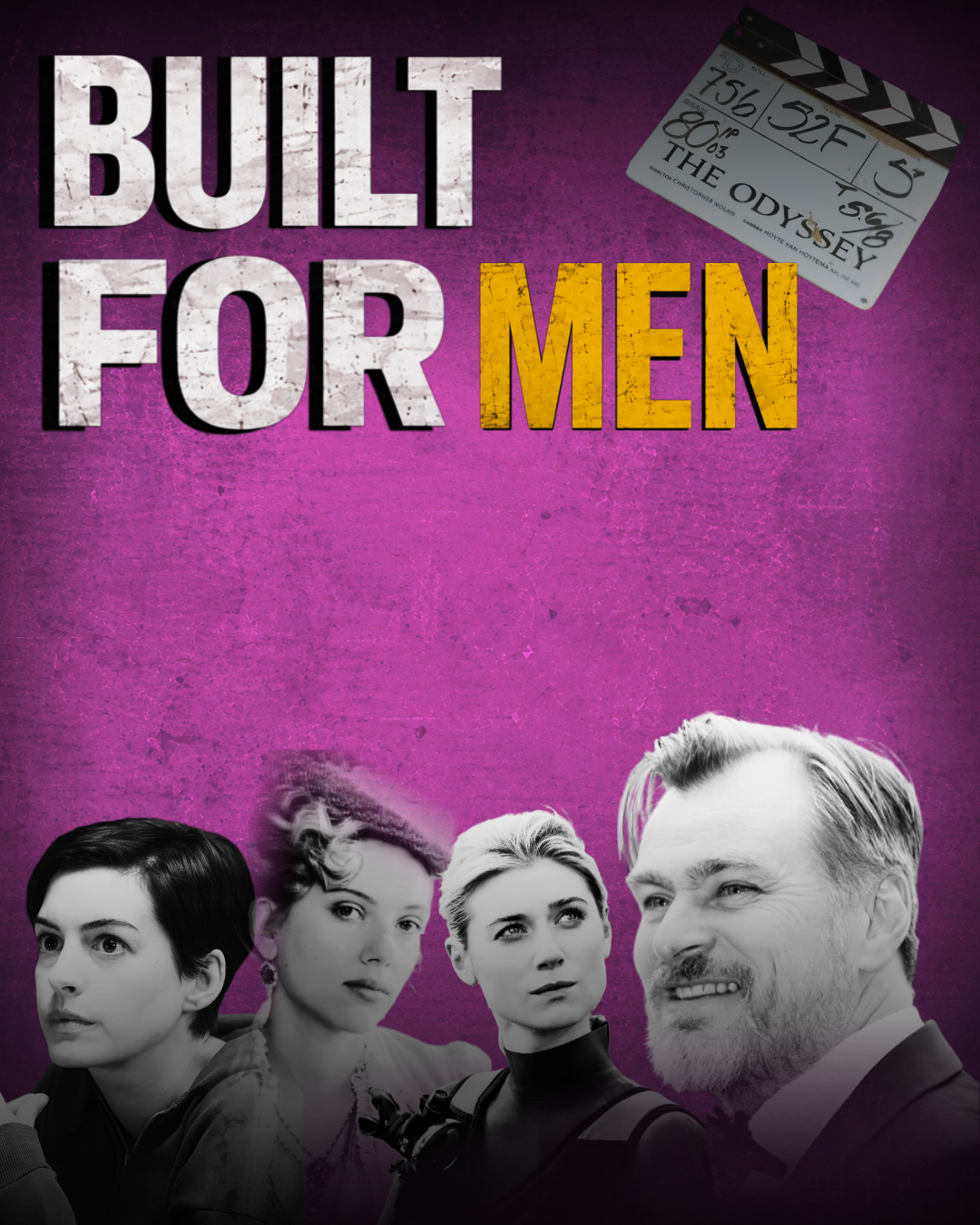
In any conversation about the greatest contemporary directors of Hollywood, the name Christopher Nolan is sure to come up. There are essays and videos galore praising the director for his unique vision and knack for innovation in film. Watch enough YouTube video essays about him, and they’ll have you convinced he’s the best thing to happen to cinema since the invention of the video camera. They’re not totally wrong either; Christopher Nolan is currently the 3rd-highest-grossing director in the world, and his movies cannot be denied as exceptional. His movies are grand in scale, always packed with a punch, accompanied with top-tier acting; but of course, no great director is without faults.
Nolan’s biggest fault, I would say, is his writing. It is often the weakest link in his films, but it’s made up for by the amazing technical quality of his films. But, if you take a deeper look into his movies, a graver problem emerges. Whether it’s Interstellar, or The Prestige, or even The Odyssey, what Nolan truly lacks is a strong female character.
Nolan’s female characters are either a means to an end or a plain archetype. Scarlett Johansson in The Prestige is always at the mercy of the two male leads. Anne Hathaway in Interstellar is motivated by her love for a man that is never seen on-screen. Tenet is notoriously bad at it, with most female characters only appearing for a single scene. But why is this exactly?
Christopher Nolan, at the end of the day, suffers from the same fate most filmmakers do. They write movies for the majority of the audience, which just so happens to be straight, white males. The straight, white male does not emotionally resonate with female characters as deeply as he does with male ones. So, the easy thing to do is to focus on the male characters rather than try to make the viewer resonate with the females. This leads to the female characters being sidelined in a lot of movies. Nolan tends to focus on his strengths in all aspects, which also involves writing characters he knows he can, namely, straight, white males.
This comes through even in The Odyssey, which is an adaptation of a story written 3000 years ago. Nolan’s Odyssey is mostly adapted from Emily Wilson’s translation of the Greek epic, which was the first full English translation of the poem by a woman. This fact makes it even more surprising that in Nolan’s movie, the female characters are so condensed down in favour of focusing on the men. Yes, The Odyssey is a predominately male centric story, but it features few of the strongest female characters in Greek history. In Nolan’s version, however, Calypso and Circe, two of the biggest delays in Odysseus’ journey home, are condensed down. This can only be seen as intentional by Nolan to once again make his job easier and appeal to a wider audience by focusing more on the men and the fantastical parts of the story.
Now to look at the bigger picture, Hollywood, even with its progressive outlook, seems to fall short when it comes to curating a strong female lead. Why does this problem arise? Though there is no definitive answer, the statistic that women account for only 16% of directors among the top 250 domestic-grossing films in the United States — leaving men with roughly an 84% share — might answer this shortfall. Most filmmakers try to connect with the audience by replicating real human experiences on the big screen, whereas the female experience is often reduced to mere stereotypes or blatant mischaracterisation, as is most probably assumed by the cis, white male filmmaker. Emotions such as “revenge,” “sexual desire,” and “rage” are often gendered as masculine; this mentality seeps into the writing, ultimately resulting in bleak characters without the complexities that make them human. It’s not necessary for writers to completely disregard gender while writing roles; however, it feels like the bare minimum to ask that they involve basic research and consult female staff to create a strong female lead who feels human.
It’s not difficult or groundbreaking to produce strong leads with real emotions and complexities; however, the conversation seems to fall silent whenever a character is anything other than a cis male. Directors like Greta Gerwig, David Fincher, and Chloe Zhao have achieved this ‘great feat’ without compromising on the spectacle or the authenticity of the film.
When a coveted director like Nolan, the same director who dedicates himself immensely to technical mastery and conceives bizarre ideas and still somehow makes them work, struggles to portray female characters who aren’t that difficult or different to write, we have a much larger problem than we acknowledge. Women have historically always been reduced to mere accessories or plot-advancing devices, completely devoid of actual complex human emotions. Even though we assume to have come a long way from the past, we haven’t quite gotten rid of the same redundant tropes such as ‘the damsel in distress,’ ‘the protagonist’s wife,’ and ‘the femme fatale,’ which could easily be replaced with better characterisation and research.
A director who can make an audience feel the weight of inverted time or the loneliness of a black hole should have no excuse left for writing a woman who feels like an afterthought. Complexity isn’t the hard part. Caring enough to write it is.

I enjoy Nolan’s films as they often feel like brilliantly engineered products with characters acting as interface components of the system. One thing to note, the anchor of many of his movies are still women, who make the film more interesting, Murph in Interstellar, Ariadne in Inception, Kat in Tenet, they bring the meaning full narrative. I think Nolan’s weakness is probably not “writing women” specifically. His weakness is that he prioritizes concepts, mechanics, and grand themes over deep characterization in general. Female characters tend to suffer more from that choice because they are less often the protagonist in his films.