Are You Wearing the Camera? The Strange Reality of Watching and Being Watched
By Ronita Bhattacharya on September 23, 2026
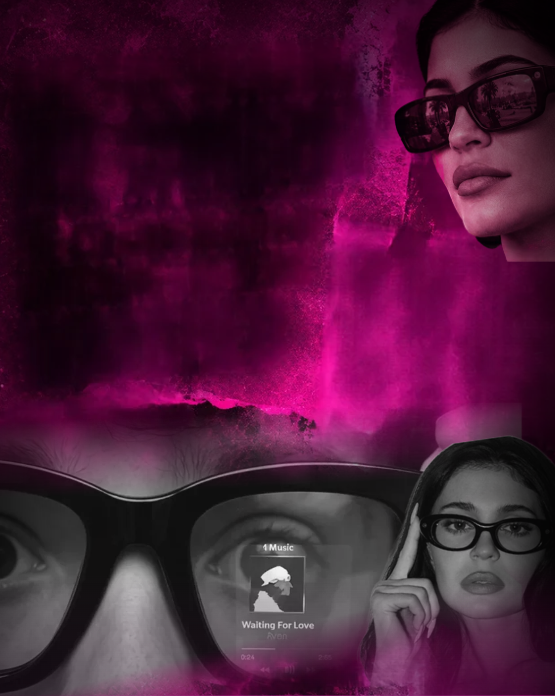
For a few weeks this summer, Kylie Jenner was staring out from bus stops across Silicon Valley, wearing $399 worth (INR 39,900) of Meta’s newest idea about what your face should do. The ad, shot from her point of view, shows a life worth living: a smoothie, pool boy, a stranger applying hand cream for her. It’s more of a performance than an advertisement if you were to ask me. A performance of what the world would look like when it’s performing for you, uninterrupted, below eye level.
What the ad doesn’t show is the version of this that was already happening to other people. By the time Jenner’s face went up, women were finding out that they were being recorded by strangers wearing the same glasses–not modelling them for a campaign, but pointing them at someone, uploading the video before the women in them even get the chance to find out that they have starred in someone’s fantasy. These women can’t consent to something they have no idea about happening– a hidden camera in a glass accessible to all? Who would’ve thought of that?
Then, near Meta’s London headquarters, the posters started doing something the marketing department had never planned for. Walk past it head-on, and Kylie’s face is still there, glossy and shining, but move to the side a little and the skin falls off, revealing nothing but a skull–grey, grinning, with soulless eyes and a caption that might send chills down your spine: “WE’RE ALWAYS WATCHING”
Obviously, it wasn’t Meta who approved that ad; why would anyone dig their own demise? The ad was a spoof created by Everyone Hates Elon, a UK activist association known for turning Billboards into confessions. The lenticular trick, the changing faces, and the emphasis on the glasses are a direct reference to a 1988 sci-fi movie by John Carpenter named “They Live”. The movie is about a drifter who finds sunglasses that let him see what’s actually printed on every advertisement in Los Angeles: OBEY. CONSUME. STAY ASLEEP. John Carpenter called it They Live. Nobody needed sunglasses for this one. You just had to keep walking — or be the one standing still, not knowing you were being looked at.
The glasses have a name — Starfire, Meta’s first line not co-branded with Ray-Ban or Oakley, an attempt to make the hardware look like a lifestyle rather than a lawsuit waiting to happen. Jenner didn’t just endorse them. She “co-designed” a model, which is the kind of verb that means nothing and everything: her face on the box, her taste in the temple colour, her willingness to be filmed being filmed.
But hey! Wasn’t Kylie the one who, in June 2025, went on record to say that she believes privacy is important because she had always been in the spotlight? Isn’t it blatant hypocrisy to go ahead and endorse, even co-design something like Starfire?
The tagline Meta settled on was designed for privacy, controlled by you. Read it once, and it sounds like a promise. Read it again and notice what it’s actually claiming — not that your privacy is protected, but that the design is, as if privacy were a feature of the object rather than a condition of the people around it. Control, similarly, is yours in the sense that you’re the one wearing the glasses. Everyone standing near you got no such offer.
This is the part worth sitting with before the movie references start doing the heavy lifting: nothing here was hidden. The tagline was printed on the ad. The camera’s LED light — the one meant to warn bystanders they’re being recorded — is a real feature, and also, reportedly, one Meta has explored making optional on future models. The company didn’t lie so much as phrase things in a register where the lie and the disclosure are the same nineteen words. If you’re thinking it’s a marketing failure, it’s not; it’s how the product was intended to work.
It’s worth stopping to ask what They Live is actually about, because while Everyone Hates Elon borrowed its imagery, the argument? Not quite.
The film isn’t about surveillance. Nada’s sunglasses don’t reveal that someone is watching him — they reveal that someone has been talking to him, constantly, in a frequency he’d been trained not to consciously hear. OBEY. CONSUME. MARRY AND REPRODUCE. The aliens underneath the billboards aren’t a surveillance state; they’re a ruling class, dressed as executives and newscasters, running the world’s advertising as a kind of anaesthetic. It’s a film about Reagan-era consumerism and class war wearing a horror movie’s coat. The threat is persuasion, not observation. Nada doesn’t discover he’s being watched. He discovers he’s being managed.
Which makes the skull-faced Jenner poster a slightly strange fit for its own citation. The activists weren’t accusing Meta of hiding subliminal commands in a billboard — they were accusing it of hiding a camera in a pair of sunglasses. That’s not obedience through persuasion but obedience through surveillance, much like in 1984, in which the characters had learnt to regulate themselves because they knew they were constantly being watched, through their TVs, their neighbours and almost any creature and machine and of course, there was a poster constantly reminding them that “Big Brother is watching”
Back at the bus stop, we realise nothing about it was concealed. The tagline was printed in full. The skull was always underneath the skin, waiting for the angle to change, a truth Meta printed alongside the lie and trusted you not to read both at once. That’s the part 1984 gets right where They Live doesn’t: Nobody needs a telescreen when the surveillance comes with a co-designer credit and a smoothie in frame.
Somewhere between the ad and the skull is a woman who found out she’d been filmed the way most people find things out now — secondhand, after the fact, from a friend forwarding a link. She never got to choose an angle. She just became one.
The joke Everyone Hates Elon made with a bus stop poster is that you have to move to see the truth. The uncomfortable part is that most people don’t. They don’t have to. The ad was never lying to them. It just told them a version of the truth that photographed well, and let the rest of it stand where only the person underneath the glasses would ever have to look.