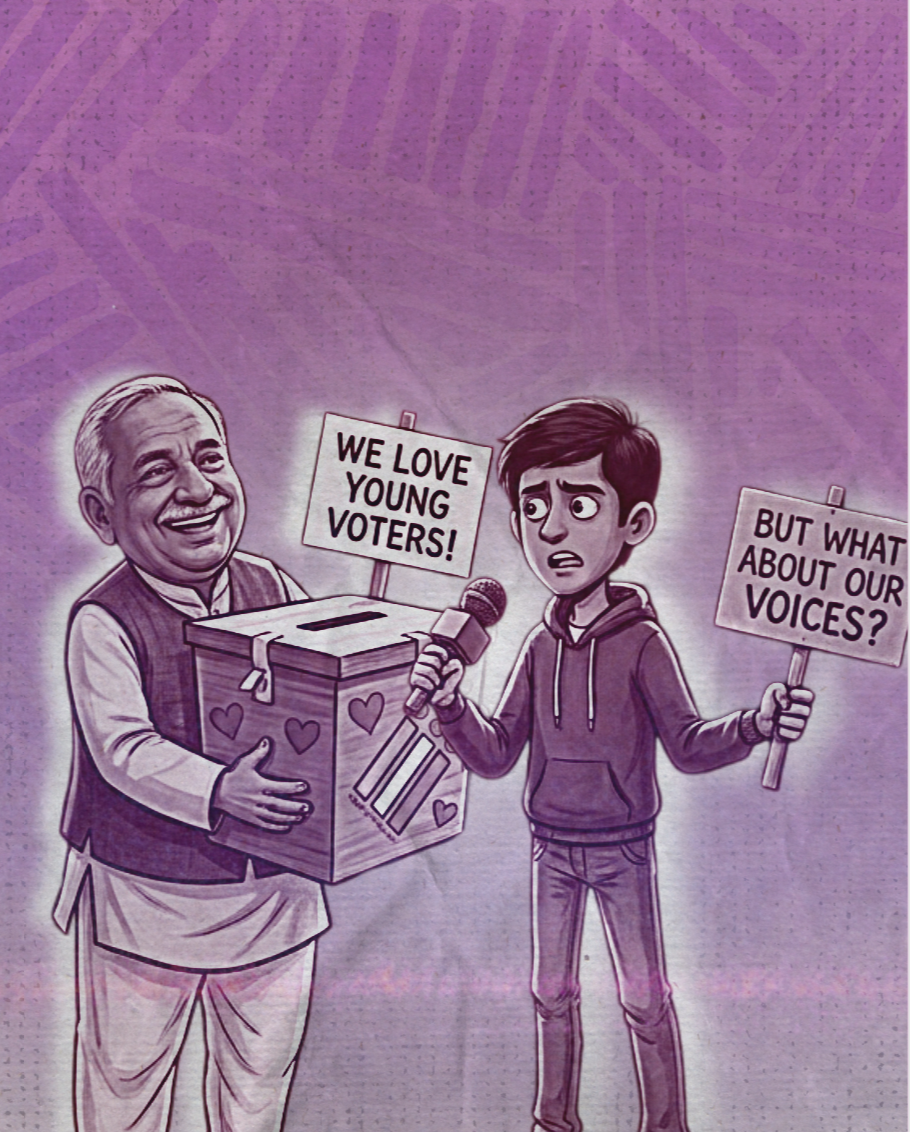
Why Political Parties Love Young Voters but Fear Young Voices
By Aadrita Nandi on January 19, 2026
Imagine: It is election season, and your university does not look like itself.
Colourful banners with intriguing political party symbols hang near the gates, not officially inside campus, but close enough to be seen every morning. Someone from a political party’s youth wing is handing out pamphlets outside the canteen. A speaker discusses opportunities, jobs, and how young people will shape the future of the state. If you are part of campus politics, you recognise this language. It appears every few years, right on time.
Inside the campus, the notice board tells a different story. There is a circular about maintaining discipline around the campus. Another issue is prior permission for gatherings or campaign meetings. A reminder that political activity should not disrupt academic life. The banners stop at the gate. The enthusiasm does not cross the boundary.
This split is not new, but during election season, it becomes impossible to miss.
With assembly elections underway in Maharashtra and upcoming in West Bengal, political parties have intensified their outreach to young voters. Colleges and universities are treated as reservoirs of first-time voters who are politically literate and tech-savvy enough to encounter, interpret and circulate political messaging through social media, making them politically valuable. At the same time, many campuses remain managing spaces for student politics. Every vote is welcome, but this management space is quite complicated to continue with.
India’s youth population makes this contradiction structurally important. Voters between 18 and 29 form a substantial part of the electorate. Political parties know this, which is why youth-focused messaging avoids controversy and leans more towards promises such as employment schemes, skills, start-ups, and the future. Young people are addressed as individuals who are about to make serious political choices. If you haven’t felt the weight of such impending decisions on your shoulders already, you haven’t really experienced being around campus politics.
So here’s campus politics for dummies — or anyone who hasn’t been around it. This is where future politicians cut their teeth. Student leaders join youth wings of real political parties, run in university elections, organise rallies, and build networks that often extend far beyond campus gates. It’s about campaigns that matter, votes that count, and experience that can launch a political career. Every poster, every vote, every event is practice for the bigger stage after all. And if you’re paying attention, you might see a future politician’s ambition forged in real time.
Student unions, protests, and campus debates are, of course, collective and visible. They are shaped by immediate concerns like fee hikes, representation, safety, and ideological disagreement. They are harder to predict and harder to manage. Historically, they have also made governments uncomfortable.
In Maharashtra, that discomfort has a long memory. Student politics in the state once carried real influence, but also real violence. The murder of student leader Owen D’Souza in 1989 marked a turning point. In the years that followed, student union elections were banned across universities. For nearly twenty-five years, students did not elect their representatives. Administration replaced participation.
When elections were reintroduced under the Maharashtra Public Universities Act in 2016, they returned with limits. Political party symbols were barred. Campaigning was tightly regulated. External political leaders were not allowed to participate. In this way, the state did not reject student politics outright, but rather reshaped it into something safer, quieter, and easier to control, as it involves such young hearts.
West Bengal offers a different example, but arrives at a similar outcome. In many Kolkata colleges and universities, student union elections have not been held since 2017. Despite repeated references to the Lyngdoh Committee guidelines and interventions by the Calcutta High Court, polls remain postponed. As a result, while union rooms still exist and political influence remains visible, what is missing is formal, elected representation.
A student politician from Jadhapur university, Kolkata, who asked to remain anonymous, told me during our brief interview that,“politics hasn’t disappeared from campus,” he said. “It’s just not in our (students) hands anymore. During elections, parties want us to feel powerful. We are told to read more, increase our understanding of politics, debate with each other and stuff like that. But on campus, we’re mostly told to stay quiet.”
Administrations defend restrictions using familiar reasoning. Campuses are educational spaces, Protests disrupt academics, Safety and order matter, etc., etc. These arguments are not without merit; they do have their own reasons. Universities are not meant to function as permanent agitation sites. At the same time, students do not lose their constitutional rights at the campus gate. The line between regulation and suppression is often drawn quietly, so subtly that it comes under the image of being a university’s disciplinary mandate.
Election campaigns avoid this tension entirely. When political parties speak to young voters, they do so at a distance from institutions. The interaction is controlled, time-bound, and largely symbolic. Voting is encouraged because it is necessary, no questions asked. Campus politics, though, asks for space, continuity, and disagreement. It does not switch off after polling day. What emerges is somewhat of a pattern. Youth participation is welcomed when it is predictable. It becomes uncomfortable when it organises itself independently.
This does not mean students stop being political. In the absence of formal platforms, politics shifts shape. Informal groups replace unions. Online spaces like WhatsApp groups or Discord Servers replace formal assemblies.
With elections concluded in Maharashtra and West Bengal moving closer to theirs, young voters will continue to be addressed as decisive. They will be told they matter, that their vote carries weight. But the unresolved question lingers: will they ever be truly trusted to exercise power in the institutions where they first grasp its realities, or will their political energy only be welcomed when kept at a comfortable distance? The answer may shape the future of both Indian democracy and its next generation of leaders.