The dangerous art of doing your job: Raghav Chaddha and the embarrassingly low bar of Indian politicians
By Tanushka Rathore on March 11, 2026
There was a time when asking questions and holding the government accountable was just regular governance. Today, it apparently qualifies as a rebellion. If so, I suppose I am a rebel of the highest order, because every time I see the thunderous applause currently following Raghav Chadha of the Aam Aadmi Party, I find myself doing the one thing politics seems to have forgotten how to tolerate: asking a question of my own.
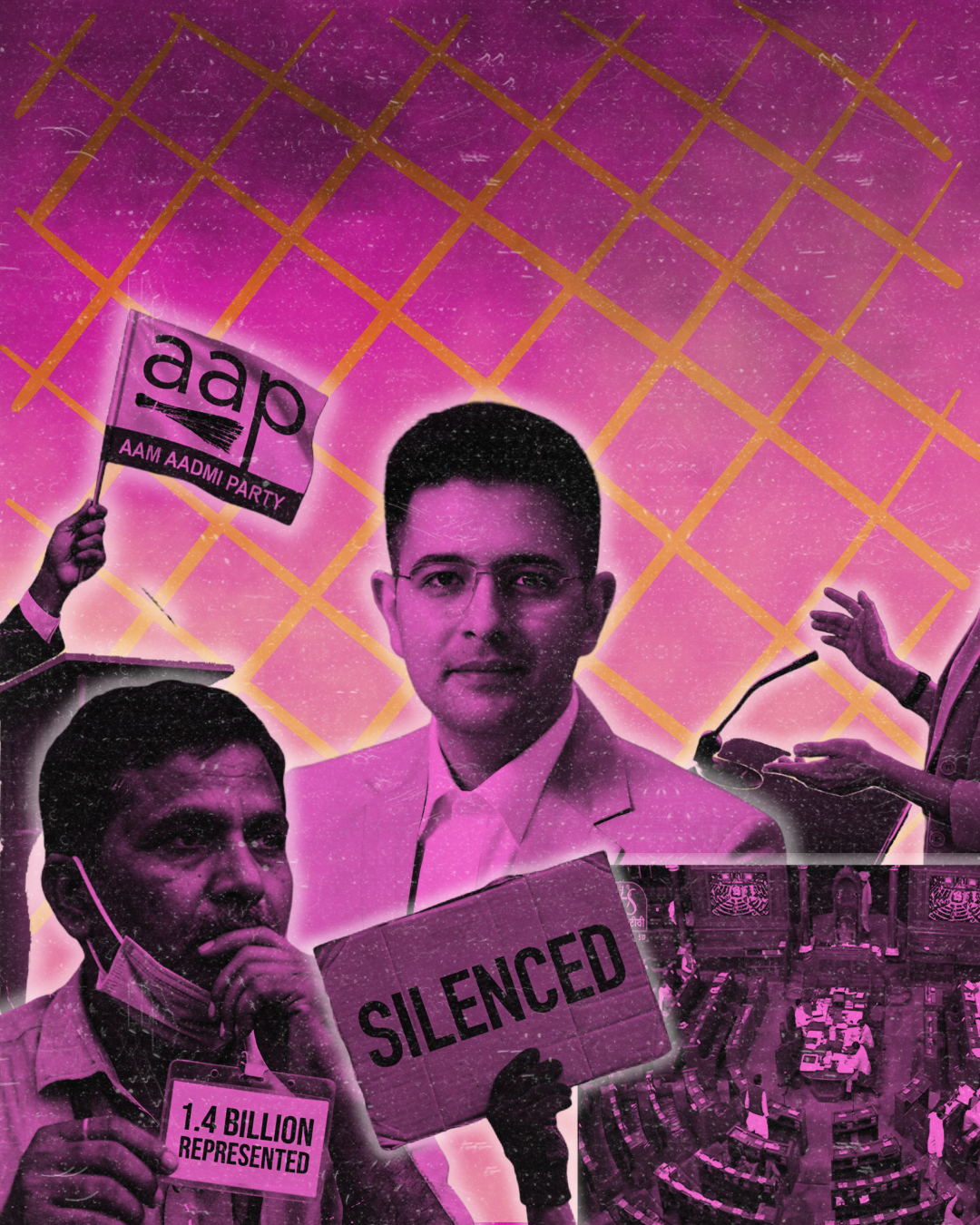
Mind you, it’s not to say Raghav Chadha’s applause is undeserved; after all, he does what most politicians have forgotten is their actual duty: standing up in parliament and asking uncomfortable questions. From repeatedly questioning the government on the rising prices of petrol and diesel to asking the logic behind the steep prices of goods at the airport, he has indeed stood as a voice of issues that are otherwise drowned in political hubbub, as it is, his voice has cut strongly through the usual political choreography of speech and slogans that takes place inside the great chambers of Rajya Sabha. Every session, he questions (as a politician should), clips of it go viral online, and suddenly Chadha appears less like a parliamentarian and more like a rare species of activist. He is an elected representative who remembers that his job description includes scrutiny, and for that, he is celebrated. This really sheds light on a broad trend of politicians in this country; the bar of expectation must be buried underground somewhere, because I very well cannot see it. So, as uncomfortable as it might be, the question really is not why Chadha is being applauded; rather, it is why doing the bare minimum of democratic accountability is such a big deal in the world’s biggest democracy.
Let’s move to the uncomfortable part, if Raghav Chadha is noted as an anomaly within politicians, for actually doing his job. The logical follow-up question writes itself – What exactly is everyone else doing?
A seat in the Rajya Sabha is hardly just a decorative artefact; with a strength of only 245 members and a term of 6 years, it is not by any means just a seat to sit quietly in and enjoy the lavish view of a hall filled with politicians. It is, at least in theory, a seat in a forum designed for scrutiny, debate and discussions for the betterment of the country. As is, the textbook definition of a member of Rajya Sabha, but in this country with the longest written constitution in the world, barely anything ever goes by theory. So, as an observer, it is my opinion that the reaction to Raghav Chadha is less appreciation and more of a collective astonishment, almost as if the institution itself has forgotten what it was built to do. So when basic acts of political scrutiny look like an act of heroism, it says less about the hero and more about the stunning level of mediocrity in the room he stands in, a room that just happens to be one of the two major decision-making platforms of the country. I say this with no particular malice – just confusion of someone trying to locate the baseline of our politicians and their duties.
Speaking of the collective amnesia of rules, applause in Indian politics is rarely without consequences. In this particular case of Raghav Chadha, back in 2023, the then 34–year–old politician was suspended for 115 days, on grounds of “gross violation of rules, misconduct, defiant attitude and contemptuous conduct”, taking to X, he questioned and rightly so, “Why was I suspended? Was it because I questioned them?” On paper, the charge was technical: allegations that Raghav Chadha had included fellow members’ names in a motion without their consent. A procedural misstep, the kind that parliamentary rulebooks are built to regulate. But politics, as mentioned before, rarely operates only on paper. Because if “sticking to the rules” were truly the sacred principle at work here, the halls of Parliament would look very different. The institution is hardly unfamiliar with disruptions, theatrics, and behaviour that stretches the definition of decorum to its breaking point. Yet suspensions of this scale tend to appear rather selectively, almost as though the rules suddenly grow teeth only when someone becomes inconvenient enough to notice. And that, naturally, raises a question far more interesting than the rule itself: was this really about procedure? Or is asking questions, on a platform built and designed for said questions, not fit the bill anymore?
And hence, one might see this consequence as a warning shot; it’s not radical or dramatic censorship of those who stand to ask accountable questions, but it is a display of power, in the most subtle and effective of ways. And if the cost of a politician doing his job is a suspension long enough to last a parliamentary season, one has to wonder what message that sends through the corridors of the parliament.
And in a political culture already allergic to accountability, even a subtle lesson travels fast. Because if asking questions begins to carry penalties, the safest strategy for survival becomes painfully obvious: stop asking them.
As it is, a population of 1.4 billion Indians really cannot gather in a hall; they indirectly choose these 245 members to be their voice, and if politicians decide to stay silent as a survival strategy, in a hall that has long forgotten its purpose, well then, the meticulous mathematics of representation will have failed the public. Because when the members of Parliament fall silent, it’s not really a political debate coming to an end; it’s the voice of a whole country that does not reach the microphone. And I may not be a political expert, but I know this: democracy does not work like that.
As I wind down to the conclusion, it is perhaps a very unsettling one. The real question is not whether Raghav Chadha asked too many questions inside the Rajya Sabha; it’s why those questions sounded unusual in the first place. Why does accountability feel disruptive in a chamber designed for scrutiny? And if a Parliament built to question power now finds questions inconvenient, then the real scandal is not the man who asked them, it is the institution that no longer expects them, and when that is the kind of parliament that resides in this country, what does it really say about the public?
So here we are: a Parliament where one-man asking questions becomes viral content, a suspension is a weapon of silence, and silence continues to pass for stability. They are the facts of the room. The rules, the applause, the punishments and the deafening silence. They are all right there in plain sight. If a question can shake Parliament, imagine what an answer might do. The proof is on a silver platter; connect the dots for yourself, but I will say this: if history teaches us anything, it is that democracies rarely die with a bang; mostly, they fade into silence, and history is rarely kind to rooms that choose silence over courage.