Server Error: Credibility Not Found – The AI Summit That Exposed The Operating System
By Diva Ajmera on March 15, 2026
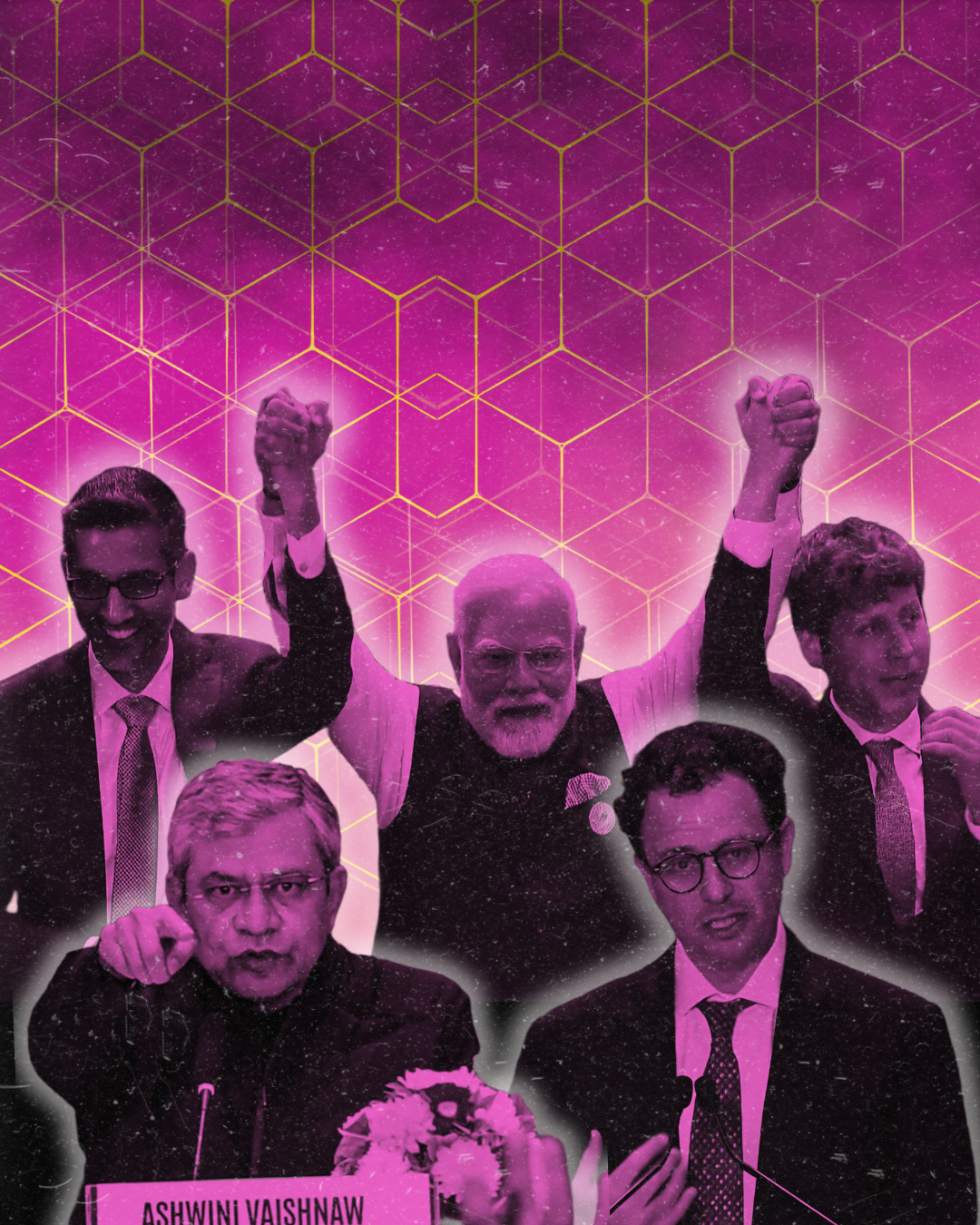
On 16 February 2026, India opened its doors to the world’s most powerful artificial intelligence companies. The AI Summit 2026 was established not just as a pivotal moment for digitisation but also as a testament that not only was India catching up in the global AI race but was also ready to take charge of it. The optics were grand, the guest list? Just as impressive, the messaging was unmistakable: this is Digital India. And then reality logged in. Or at least, it tried to.
Because what happened at the Summit was less technological leadership and more chaotic college event. With a budget of approximately Rs. 120 crores, the summit managed to go from internet connectivity problems to digital payment problems to mismanagement to the Galgotia University episode along with the unrehearsed act put up at the closing ceremony with rival CEOs Sam Altman and Dario Amodei, showcasing itself in a light that is far from the one desired.
And because this is India, of course political rivalries can’t be far away.
Members of the opposition turned up not to engage, not to question policy, not to debate AI regulation but to stage disruption. Slogans were shouted. Shirts were removed. “PM is compromised” echoed through what was supposed to be a forum about algorithms and artificial networks. In front of global delegates, India managed to export its political rivalry instead of its technological competence.
But that’s not it because when Prime Minister Narendra Modi made his appearance, India experienced embarrassment at its highest level with optics becoming a priority for our leader.
Booth owners were asked to vacate their own stalls. Hours were dedicated to carefully staged photo opportunities and during this restricted window, at what was advertised as a highly secure, internationally significant technology summit mind you, a Bengaluru-based startup, NeoSapien, reported that its patented AI-enabled wearable devices had been stolen.
Innovation was being photographed while innovators were being robbed. The symbolism writes itself.
Now, to be fair because credibility requires fairness, the summit did stabilise after its rocky start. Management took corrective measures. Panels brought together the bigs of the AI world with researchers, venture capitalists and startup founders to debate everything from AI governance and ethical regulation to infrastructure development and the future of generative models.
Discussions ranged from India’s role in the global semiconductor and AI supply chain to the responsibilities of governments in regulating rapidly evolving technologies. Startups that had travelled across the country and even from different major powers like the US, China, Russia, the UK, France, Israel, Canada, Saudi Arabia, and the EU finally had the opportunity to pitch their work to investors and industry leaders.
Students and young developers attended sessions where leaders from some of the world’s influential AI leaders such as Julie Sweet, Shantanu Narayan, Sundar Pichai and of course Sam Altman and Dario Amodei spoke about what the next decade of machine intelligence might look like. For many participants, the summit delivered something valuable to their futures: exposure and a glimpse of the ecosystem in which they hope to build their careers. There were genuine exchanges about AI’s future, its frameworks, and India’s potential in the global intelligence supply chain. The second half of the event functioned far more smoothly than the first.
But first impressions are currency and we spent ours carelessly.
Our Union Minister for Electronics and IT, Ashwini Vaishnaw, described the summit as the biggest AI gathering in the world, highlighting its energy and organisation, while offering a brief apology for any inconveniences that were faced on the first day. The apology was polite and measured but it was also insufficient.
Because what went down at the AI Summit 2026 was not just a list of logistical problems. It was a glimpse into the widening gap between recital and portrayal.
India absolutely has the talent to lead in artificial intelligence. It has engineers, entrepreneurs, researchers and ambition in abundance. What it cannot afford, however, is to confuse optics with capability. Hosting global summits is not about spectacle. It is about systems. It is about proving that your infrastructure can carry the weight of your ambition. You just cannot demand global confidence while displaying domestic chaos.
This contradiction becomes clearer when we put India’s ambitions against its realities. The chaos in our country is far too high on a domestic level for us to be looking at this level of leadership and while I do not say we can’t achieve what we are planning, it looks entirely too hypocritical to be wanting to touch the skies when our roads can’t even be cleared for an ambulance to pass through.
The ruling government appears eager to position India as a digital superpower. The opposition appears equally eager to undermine any moment that could politically benefit the ruling party even if that means damaging India’s international image in the process. In the crossfire of this rivalry, the country itself has become collateral. An AI summit that should have been a showcase of national competence shouldn’t have become another arena for political chest-thumping and disruption.
If India intends to compete with nations that treat technology as strategy rather than spectacle, it must remodel itself. AI leadership is not declared, it is demonstrated. Through seamless infrastructure, disciplined execution and respect for innovators. Through security that functions even during photo opportunities. Through diplomacy that is coordinated, not improvised, because the world is watching and it does not grade on enthusiasm, it grades on delivery.
The AI Summit 2026 was supposed to signal India’s arrival into the future. Instead, it exposed how uncomfortably attached we remain to our administrative reality.
This is not to dismiss the genuine progress India has made in digital infrastructure over the last decade. Nor is it to deny the potential that exists within its startup ecosystem. It is precisely because the stakes are so high that the criticism must be equally sharp. We cannot afford self-congratulation when self-correction is the need of the hour.
If India continues down a path where optics outrun infrastructure and political theatrics overshadow technological seriousness while apologies substitute accountability, the shadows cast by other nations’ progress will grow sharper until we are thrust into pitch darkness.
The tragedy of the AI Summit 2026 is not that it went wrong. It went exactly as a country obsessed with optics and allergic to accountability would. Artificial intelligence may define the next century. But if this is our operating system, we’re not leading the future. We’re staging it.