
Reclaiming the Canvas: Dalit Art as Subversive Culture
By Nihira Pillai on January 21, 2026
India has long been structured by the caste system embedded within Hindu society, which is still operational and actively continues to discriminate amongst the various caste strata that it defines. The community located at the bottom, beyond the precincts of this caste hierarchy, is that of the Dalits. Rooted in the Brahmanical belief that their bodies, occupations, and presence were polluting, they have been enduring social segregation and discrimination through religious, social and customary practices since time immemorial.
The term Dalit means ‘oppressed’, ‘broken’ or ‘crushed’. In the twentieth century, Dalit transformed from a descriptive label into a collective political identity rooted in assertion rather than subordination. Originally, Marathi social reformers such as Jyotiba Phule used the word to describe communities excluded from the caste system. Their aim was to forge a pan-Indian identity that signalled both shared experiences of exclusion and active resistance, rather than passively accepting the categories imposed by colonial or upper-caste discourse.
Dalit labour has historically been positioned as the lowest form of work within the caste hierarchy, deemed as socially degrading and devoid of dignity. Their narratives have largely been shaped by privileged upper-caste groups as repressed and marginal. However, this portrayal is undergoing a significant shift as it is being actively challenged by the very people it aims to suppress.
Contemporary Dalit art is moving beyond its long-standing association with ‘marginality’ and ‘tokenistic inclusion,’ positioning itself instead as a subculture with its own aesthetic and cultural identity. Today, their art is not merely representational; it is a reclamation of identity marked by refusing sanitisation and embracing material memory.
In order to understand the essence of this article, we need to first understand what a subculture is. Subculture refers to a group or community of people sharing distinct values, norms or beliefs that exist within the dominant society but challenge or resist elite values and power structures. It mainly uses art and aesthetics (usually music, fashion, style) as mediums to counter the dominant societal frameworks. Subcultures are not merely different, they are political and attempt to call out the unsettling dominant systems of authority, power and taste.
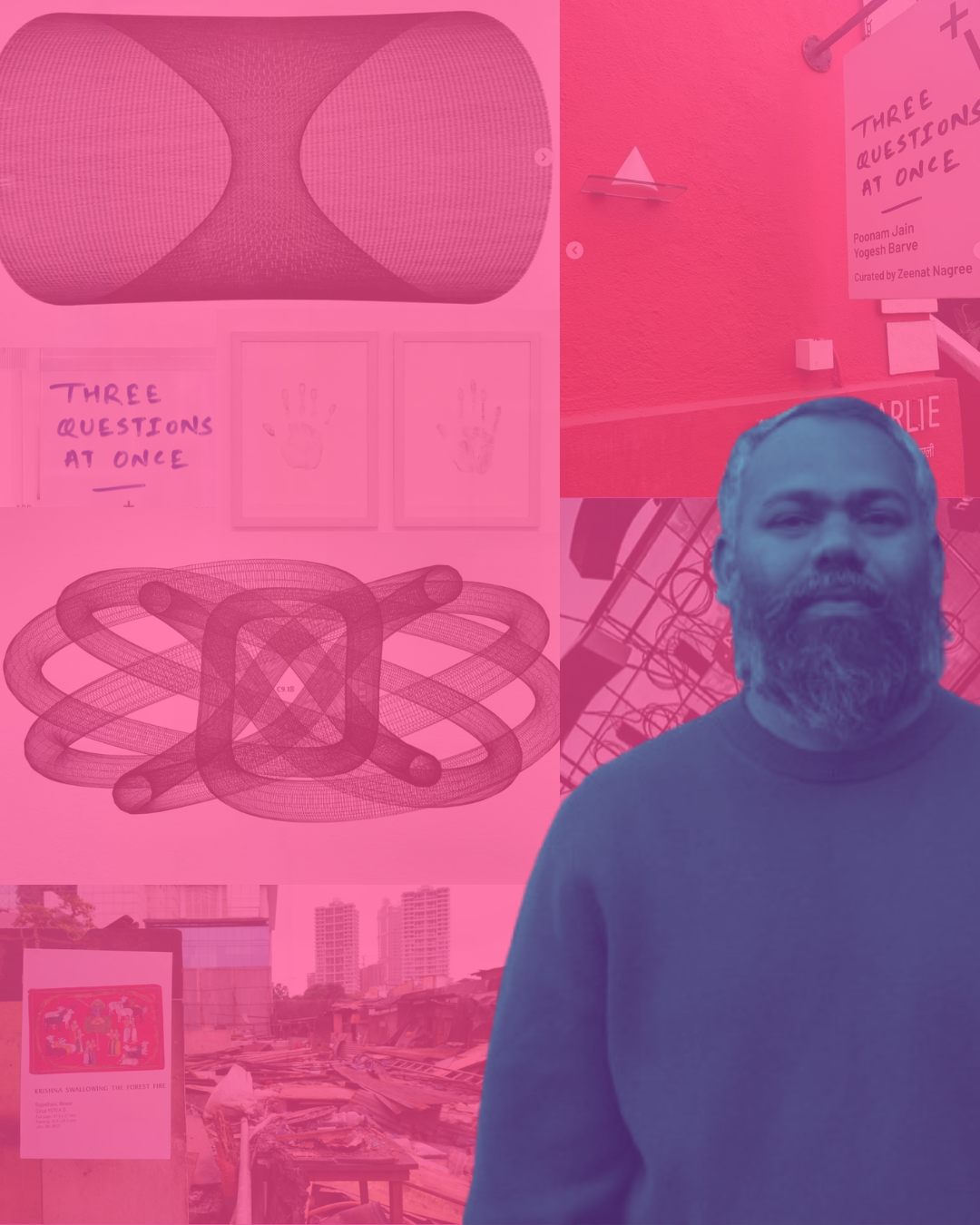
In doing so, Dalit art today does not seek assimilation into elite taste. It challenges the very structures through which taste is produced and maintained. This shift from marginal representation to subcultural assertion is visible in contemporary art spaces. For instance, at the 16th edition of the India Art Fair (IAF), 2025, Mumbai-based contemporary artist Yogesh Barve’s art installation, I Am Not Your Dalit, made headlines across print and art publications.
Inspired by James Baldwin’s works, Yogesh’s installation uses Ambedkar’s writings displayed on suspended LED tickers, confronting caste discrimination and the erasure of marginalised histories. Reimagining everyday objects like LED tickers from railway stations, the work critiques how important social and historical texts, such as Ambedkar’s, have faded from public consciousness. It further offers a platform for highlighting issues of access to education, technology and marginalised histories.
This digital installation rejects the consumable label of ‘Dalit suffering’ through technological disruption. Rather than providing emotional or aesthetic comfort, the deliberate disruption compels one to reckon with the history of the Dalits. Situated within a commercial art fair, Barve’s art poses as a work of subculture as it does not seek validation, but instead questions the conditioned ways of viewing.
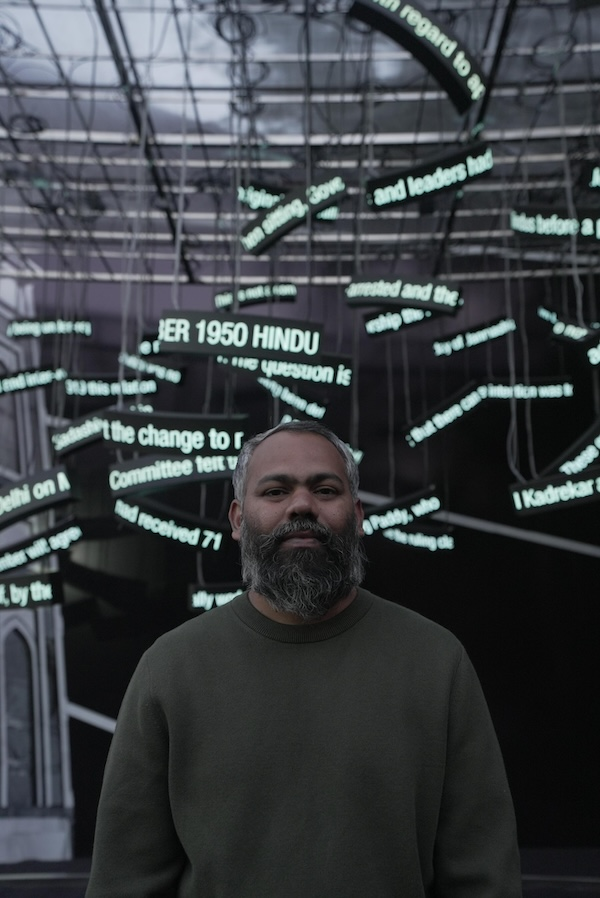
Portrait of Yogesh Barve. (Image courtesy of Art & Charlie & the Artist)
While Barve’s work disrupts elite viewing conditions through technological fragmentation, other Dalit artistic practices reclaim power through materiality itself. Chamar Studio is one such prominent example. The Mumbai-based sustainable fashion brand, founded by Sudheer Rajbhar, was born as a result of the 2015 governmental beef ban destroying jobs of leather workers from Dalit and muslim communities in India. Historically, the Chamar community was degraded because their profession involved working with animal hides. The brand not only empowers the Dalit workers but also reclaims and redefines the casteist slur Chamar, which refers to ‘leather worker or tanner.’
Sudheer and his team of artisans create bags using recycled, cruelty-free materials. Their primary material, Caucho, is a rubber-derived sustainable alternative to traditional leather that captures the feel and texture of leather.
The Hindustan Times
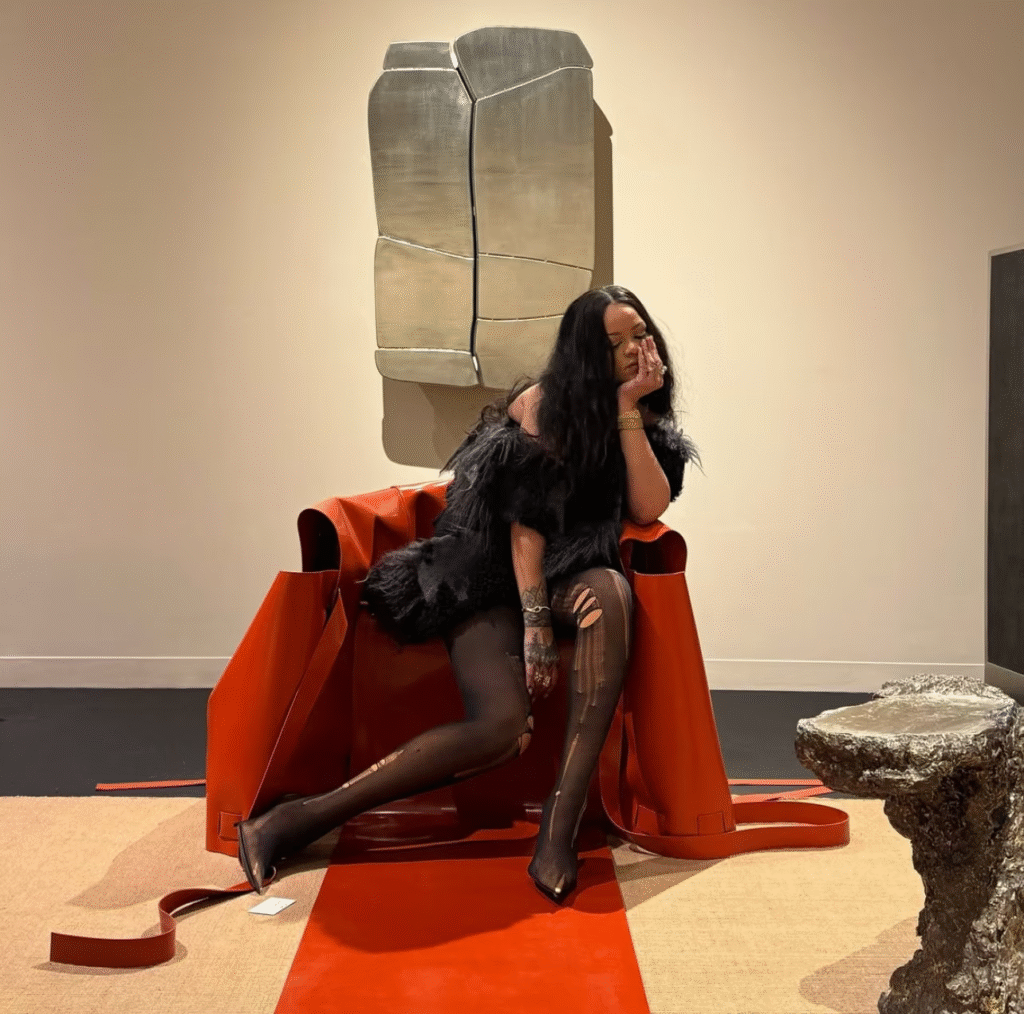
The brand gained global traction when pop star Rihanna sat on a sofa crafted by Chamar Studio at the Miami Design Exhibition in 2024. It was a turning point for the Dalit community when people started recognising Chamar Studio as a luxury brand. The shift from being outcast because of their work, to being recognised globally for their craftsmanship, echoes the story of Dalit subculture as it treads on to redefine a generational casteist insult into pride. It does not ask to be absorbed into mainstream design culture but challenges the conditions under which design culture assigns value.
Another thing that sets Chamar Studio apart is that it functions on a profit-sharing model, returning up to 50% of its income to artisans through the Chamar Foundation, prioritising collective ownership over extractive production.
Against this reclamation stands Prada’s Kolhapuri chappals controversy, where Dalit craft is extracted, stripped of caste history, and rebranded as luxury. In June 2025, Prada got into trouble when it launched its new line of footwear that bore a striking resemblance to the ‘Kohlapuri Chappals’ handcrafted by the Indian artisans belonging to the Dalit community of leather workers (Chamars). The brand failed to credit the local artisans whose crafts it borrowed, resulting in heavy backlash. Consequently, the global fashion brand issued an apology, and a team from Prada met the artisans and shopkeepers in Kolhapur to understand the process behind crafting these footwear.
Prada exposes how elite, global actors often assume ownership. Material memory becomes rebranded into ‘heritage’ or ‘timeless craftsmanship’, while in reality, the memory carried by the material is that of social oppression and exclusion. This highlights how elite taste continues to profit from caste labour while erasing caste history. This is where reclamation and subculture become a necessity, rather than a choice of aesthetic.
In this sense, Dalit contemporary art does not aim to be accommodated within the mainstream. It exposes the caste blindness embedded within it. It seeks to resist discrimination by transforming its long history of suppression into a narrative of control and assertion. Dalit art is paving the way for a new narrative, a new outlook and a new legacy to be perceived with its prevailing ‘broken’ identity.
By mobilising material memory, refusing sanitisation, and asserting ownership over both labour and narrative, Dalit subculture positions itself as an unsettling force, one that makes visible the invisibility of power structures, the elite culture has long relied on.

Glad to see a well researched perspective on dalit subculture…great work