
#ProudRandi: Hashtag Activism or Tone-Deaf Trend?
By Keya W on November 26, 2025
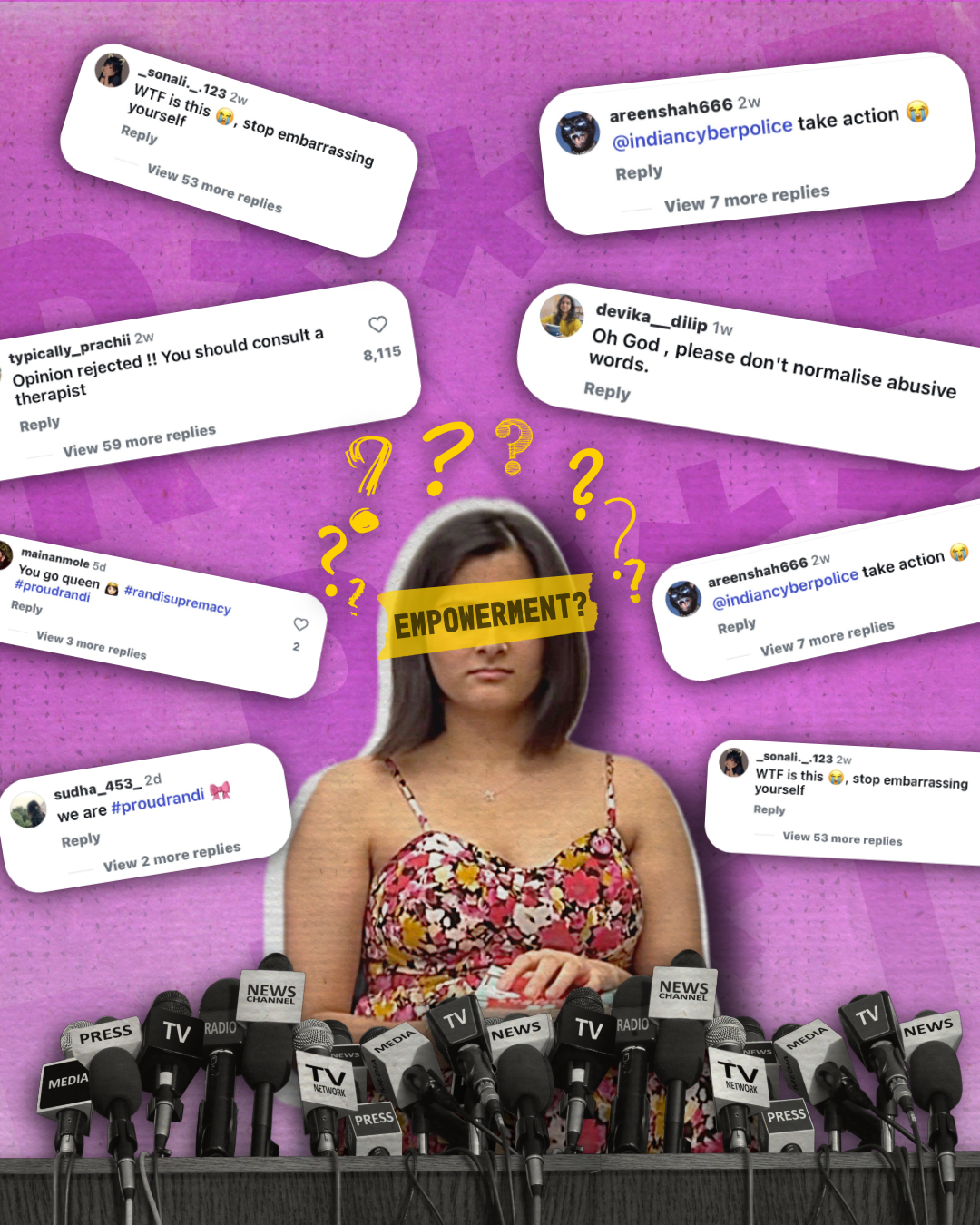
Divija Bhasin is a counselling psychologist and a content creator (@awkwardgoat13) with more than 500k followers on Instagram. A reel she posted on the 8th of October unexpectedly pulled her straight into the line of fire where misogyny, trolling, and the internet’s shifting moral boundaries collided, prompting a debate that is still making waves on the internet. Divija aimed to start a movement named The Randi Movement. She added #ProudRandi in her bio the very same day, encouraging thousands of women and girls to do the same, in a way of reclaiming the age-old slur that men toss at women online with alarming ease.
The term “Randi” is a derogatory Hindi word that refers to a woman, often implying that she is a prostitute or sexually promiscuous. In today’s day and age, with the convenient cloak of anonymity that the internet allows a user to wrap themselves in, this word keeps being thrown around by men, for any woman that doesn’t meet their standards of an “ideal woman,” basically any woman with even a hint of agency (eye-roll). The origins of this slur can be traced back to the Sanskrit word “randh,” which means to have sexual intercourse. Over time, it has evolved to describe women who engage in sex work. An entire term aimed at a marginalised community, at women who have been engaging in this occupation for years, a system built and sustained by horny men, a term thrown around and encouraged by the very same men.
Historically, in many parts of North India, sex work was associated with certain lower-caste or Dalit communities, often forced into the profession. So calling someone “randi” isn’t just “sexual shaming,” it also invokes caste hierarchy and social purity politics. Many academics call it a casteist slur, not just a misogynistic one.
So now, what exactly did Divija Bhasin do wrong? In her Instagram reel, Bhasin has mentioned how she gets called “randi” every day in her comment section, DMs, etc. Being called a slur on a daily basis, simply for existing as a woman online, can definitely take a toll on someone’s mental health; Divija, as a mental health creator, has voiced this frustration very well, loud and clear. But does this daily struggle give her and thousands of other privileged, upper-caste women and girls on Instagram the right to “reclaim” this slur? Yes and No. Let me explain; On one hand, this is a commendable move made by Divija, where she opened up her platform for women and girls to share their experiences of being called slurs like Randi, Chinaal, etc. Bhasin also shared that when she asked her 5.22 lakh followers on Instagram to share their own experiences of being called the R-word, she was shocked by the responses, one of which came from a woman who said her father had called her the R-word when she was just six years old. In an interview with NDTV, when questioned on why she was reclaiming a word tied to struggles very different from her own, Divija shifted the blame to men who call her this slur in her comment section every day, “I’m not the one normalising this, it’s the thousands of men who have normalised this slur by using it on every woman they see online,” she said. Divija’s seemingly tone-deaf response proves that her heart is in the right place; however, her actions are not. Divija is partly right; reclamation is empowerment. It not only allows young women to turn shame into solidarity but also helps to remove fear from online harassment. However, this leads us to my next point in question: can agency be built on someone else’s oppression?
Sex workers who carry out their professions in the poor parts of the country, who are forced to confront the social baggage and verbal violence of this slur every day, do not have the luxury to “reclaim” this word. For many of these women, this word comes with real consequences, humiliation and judgment. This slur has been used to police women’s behaviour, morality and agency for many years. Yes, this does not erase the weight of the slur that also has to be carried by women on the internet, but by adding #ProudRandi in their bios, these women are erasing the violence faced by lower-caste sex workers on a daily, perhaps, hourly basis. What privileged women term as “confidence” and “empowerment” can actually feel like ignorance for women who carry the heavier, offline weight of this slur. Basically, turning a slur tied to decades of misogynistic trauma into a trend can feel like dismissal.
At the end of the day, a huge chunk of “internet activists” seemed more concerned with tone-policing Divija, dissecting her delivery, trolling her, and nitpicking every word, while the issues this debate should have uncovered slipped quietly out of frame: the exploitation of sex workers, the casteist roots of the slur, and the every day unfairness that keeps these women unprotected and unheard. The internet picked an easier target, a privileged woman who misspoke, instead of confronting the systems that make the slur possible in the first place.
This is exactly where the internet’s selective morality becomes impossible to ignore.
All of a sudden, when it comes to dragging a woman online, people are experts on caste politics. But it is important to remember how the same people go silent when it is time to hold men accountable for the every day verbal violence they dish out without consequence.
The system that allows this slur to exist is still thriving, still protected, still untouched. The debate became a spectacle along with a way to feel righteous without doing any real questioning. The outrage was loud, but the analysis itself was shallow. And until we grow the spine to interrogate the structures behind the slur instead of the easiest woman to criticise, we will keep circling the same drain and calling it discourse.
I just finished reading your article, and I had to reach out to thank you. You gave a voice to something so many women experience in silence. The way you articulated was both powerful and deeply relatable. It’s a relief to see this issue brought into the light with such clarity and empathy. Thank you for using your platform for this.i m so proud of you all . Keep it up .
This is such a wonderfully written piece! And very true to Khojbeen’s tagline, I’ve personally not heard of this incident before. It was an intellectually stimulating yet easy read ! Though I questioned the direction of the article in the first half, the “can agency be built on someone else’s oppression?” line really set things in tone for me, and indicated how much care and research has gone into this. Great job and can’t wait to read more :))