Inside the 2026 UGC Equity Guidelines: Law, Fear, and the Student Backlash
By Shivanya Anurag on February 1, 2026
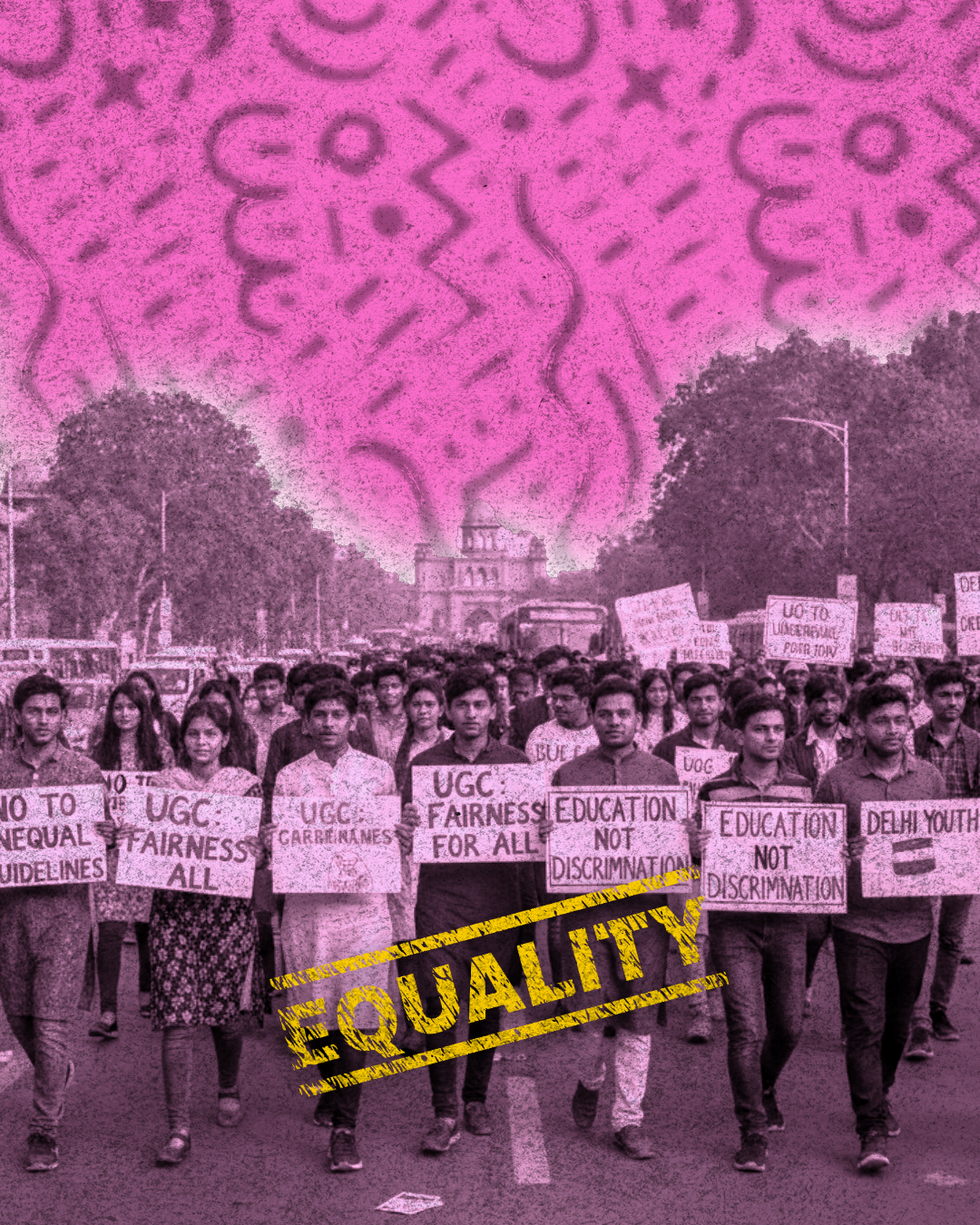
On January 13th, 2026, the University Grants Commission issued a notification, officially known as the Promotion of Equity in Higher Education Institutions, aimed at strengthening the 2012 guidelines. The Supreme Court said that these guidelines are not being implemented by the universities, and there is no fast-track action. The revised guidelines came into existence in response to the 2019 PIL filed by Radhika Vemula and Abeda Tadvi, mothers of Rohith Vemula and Payal Tadvi: Two students who lost their lives to suicide driven by caste-based discrimination.
So the new bill, available for the public to read on the official UGC website, aimed to resolve this. But this bill was met with nationwide protests so vast that it led to the Supreme Court ordering a stay on their decision and asking the centre to redraft it. The speed of this response surprised many. Since when, people wondered, did protests lead to such immediate institutional action?
So if the bill was meant to strengthen equity in higher education, why were students protesting so fiercely?
The protestors, who are from the general category, said they felt “unsafe” and “excluded”. Because of the new bill, they could end up in jail within 24 hours of when a complaint is lodged, and the complaint could possibly be fake.
But that’s simply not the case. Let’s break it down.
The new guidelines didn’t just suggest implementations but turned them into actual laws.
Along with the Scheduled Castes and Tribes, the bill protected Other Backward Classes, Economically Weaker Sections, Persons with Disabilities, and Women from explicit and implicit discrimination. It aimed to combat discrimination based only on caste, race, religion, place of birth, disability, and gender.
Under the bill, Equal Opportunity Centres were to be established to receive complaints of discrimination and to raise awareness about such issues. It also required universities to establish equity committees and squads, led by the college head.
A key rule set was the strict time limit on complaints. The committee was mandated to take action within 24 hours and complete a detailed investigation report within 15 working days. The aggrieved person could also appeal to an ombudsperson (appointed under the UGC) if not satisfied within 30 days.
The 24-hour action mandate was criticised by protestors, who argued that it effectively amounted to detention without trial and would lead to injustice in fake cases. But all the guidelines said was that the equity committee must “meet” within 24 hours to take “appropriate action”, which does not equal detention.
The protestors also argued that the new guidelines could result in increased discrimination against students from the general category, as the committee does not mandate their representation. When in reality the committee needed to comprise of 9 essential members: the Head of the Institution who would act as the ex officio Chairperson, three Professors/Senior Faculty Members of the HEI, One Staff Member, other than a teacher, two representatives from civil society having relevant experience, two student representatives and the Coordinator of the Equal Opportunity Centre who shall act as the ex-officio Member Secretary. The committee was required to include mandatory representation from SC, ST, OBC, women, and persons with disabilities (PwD). This fundamentally negated the demand for general category representation, as the women and PwD representatives did not have to be from a particular caste.
As for the issue of fake cases, let’s understand how the procedure would work. Say, I, as a scheduled caste person, feel discriminated against, and I go to this equity committee to file a complaint. The committee now has to hold an emergency meeting within 24 hours and complete a detailed report in 15 days, which will be compiled after thoroughly going through witnesses and evidence. In this timespan, they do not need to take any other action. Only if, after completing this process, the committee concludes that the complaint is valid, are disciplinary measures initiated against the accused. At the university level, this is the full extent of the committee’s authority. A case would only be referred to the police if it is deemed severe enough to warrant legal intervention. If a complaint is found to be false, it constitutes a punishable offence under Section 248 of the Bharatiya Nyaya Sanhita (BNS), 2023, which deals with the criminal offence of making a false charge with intent to harm another person.
There is no law within the Constitution that has not, at some point, been misused to falsely accuse an innocent person, as this is an unfortunate but inevitable limitation of any judicial system. This bill was no different. Protesting against the possibility of false cases at the very inception of the law reflects a deep-rooted fear rather than an assessment of its actual functioning.
The reservation debate is decades old, and the general student’s plight at its hands is no secret to anyone. While this rage can be sympathised with, as the reservation system has been used time and again as a political weapon at the cost of their young futures, why is it making them look away from the realities of discriminated communities? Why are the general category students so afraid of letting them have the rights they should never have had to ask for in the first place?
Posts and stories online are flooded with “Why always the general category?” “Who will speak for our rights?” “What if we are discriminated against?” are truly tone-deaf remarks coming from a different place of rage altogether.
Caste-based discrimination would not vanish even if reservation was to be magically removed today. It has existed for centuries, and so has the pain borne by communities. Yes, the education system is flawed, and general category students should not have to give up their entire lives just to be able to get into a decent government college. They should not have to be driven to a mental state where amputating themselves seems like the path to success. Yet, it is time we recognise that discrimination continues to occur openly right before our eyes. Lives are lost, and dignity is denied, not because it is invisible, but because we choose not to acknowledge it.
I write “we” today as a general category voice, hoping that one day I can write “we” not by caste or category, but as humans, students, and Indians.