Desensitised by Design: When Human Tragedy Becomes Another Passing Moment in Our Social Media Feeds.
By Rehet Walia on November 17, 2026
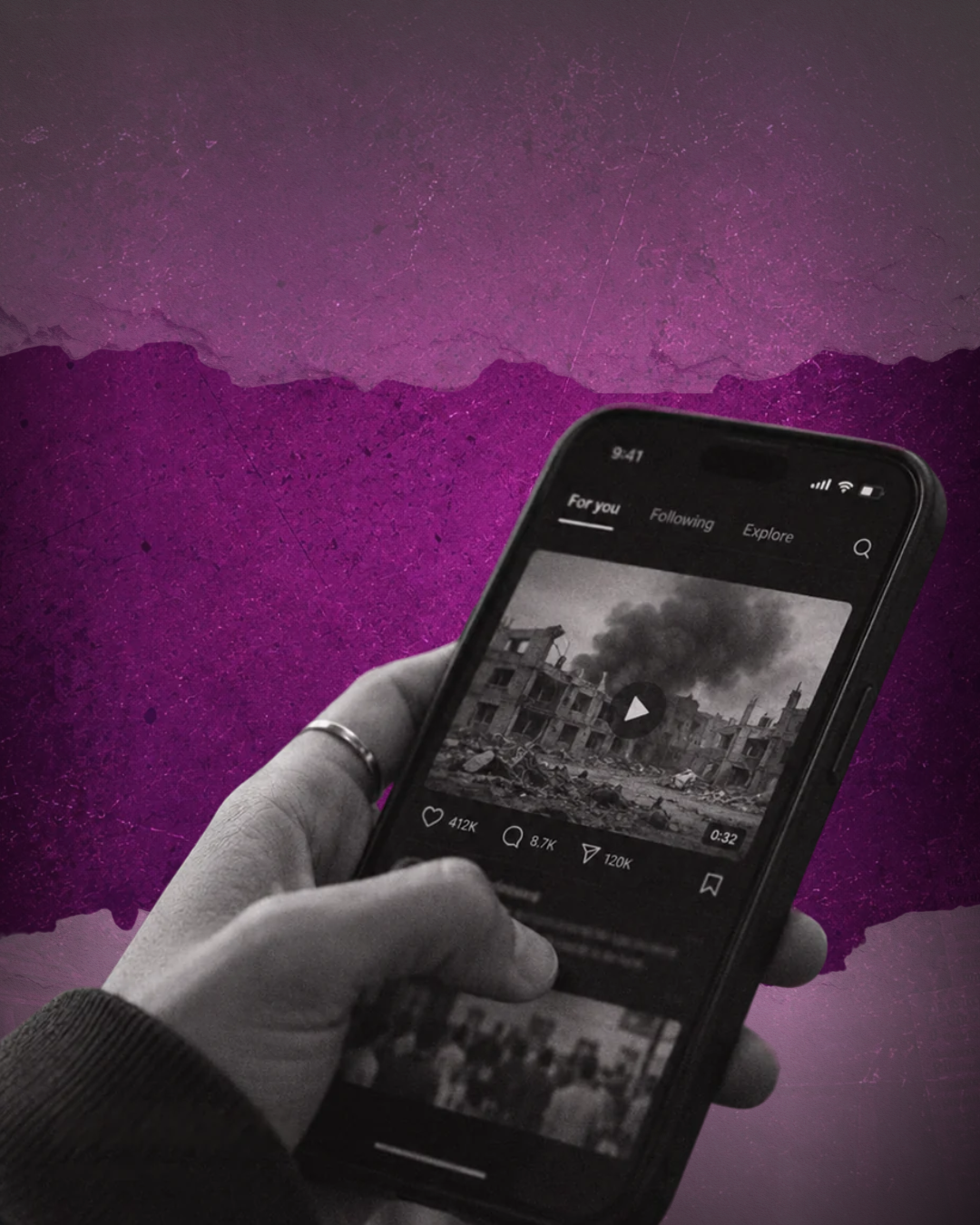
We are conditioned to consume what we should be feeling.
Most people assume that they’re in control of what their social media feeds them. However, social media platforms use algorithms that shape most of what we see. These algorithms rely on subtle cues to predict what might catch the viewer’s eye. Whether it’s a brief pause, a replay, or scrolling past it slowly, it is all interpreted as interest.
Over time, the content becomes increasingly intense, and more distressing, graphic videos feel less unfamiliar. From fight videos to hate comments, violence is omnipresent online. Eventually, we either start relating to the content or find gratification in it.
In a way, there is an aspect of on-screen violence which is liberating for many people. It provides an outlet for their anger, so they consume such content in excess. It can strike off as curiosity, release, or simply entertainment, but eventually it takes away the shock effect of it all.
The protests that were underway in India offered a real-time example of exactly this. Any instance of an outbreak, turmoil, or assault that took place during the protests was first covered on social media platforms like Instagram and X, and then, maybe, by media outlets. So, at some point, we stop treating these instances as news, and with repeated exposure, we even stop treating them as an issue. A similar case that highlights this is the mockery surrounding Jensen Huang’s extramarital affairs. The internet is now flooded with memes of NVIDIA’s CEO resigning and AI edits of him and Alice Huang, an alleged Chinese spy. Amidst this controversy, no one actually held Huang accountable for having not one but two extramarital affairs because, again, we have stopped treating issues like issues. It is all about what makes the best headline now. This is precisely what desensitisation is.
The phenomenon is not entirely new. In psychology, this reduced emotional response to repeated exposure is known as desensitisation. While the concept has its roots in psychological research, it has also been studied in the context of media consumption. Researchers Craig Anderson and Brad Bushman (2001), for instance, examined how repeated exposure to violent media could reduce emotional sensitivity towards violence. On social media, however, this process takes on another dimension. Users are constantly exposed to disturbing videos, graphic imagery and accounts of human suffering, often without actively seeking them out. When such content becomes a regular part of everyday scrolling, what once caused shock or discomfort can gradually begin to feel ordinary.
Now, imagine not only having repeated exposure to graphic media, but also having a rebound from it.
One minute, you are watching a reel about a war somewhere in the world. You see the plight of a helpless family as a result of the aftermath of the war, or the destruction of infrastructure. These videos may evoke feelings of anger, frustration, or sorrow, but are you actually able to process them? No, because the next reel is of your favourite influencer with another GRWM or a conspiracy theory with new and juicy evidence. That transition between feeling grief and then giddy happens in approximately 2 seconds. So now, this inability to feel is eating away at your empathy. The algorithm doesn’t care that you were horrified by the last reel. There’s another one waiting.
Now, one can chalk it up to the fact that we are structurally unfit to make an impact, or that it’s just how social media works and to disengage with such material altogether, but that is precisely the problem. There is a difference between protecting ourselves from constant distress and treating other people’s suffering as inconsequential. This phenomenon is a never-ending loop. You are constantly exposed to violence, you watch a rebound reel, you eventually stop empathising with cruelty and then you don’t want to even try to speak up against what is objectively wrong. Additionally, you cannot break this cycle until you start processing what you feel. That anger and frustration are quite literally what will lead you to make an impact.
Another reason behind this apathy is the meme or “dark humour” culture. The most basic example of this is the memeification of disturbing instances like the release of the Epstein Files, incidents involving Sean “Diddy” Combs, or accusations against politicians who have a history of sexual assault. Instead of treating these matters with the seriousness they deserve, the internet has turned them into memes. Consequently, people tend to become indifferent to topics of sexual assault and human trafficking. In the process, conversations about real victims and their experiences risk being reduced to punchlines. To dismiss everything under the umbrella of dark humour is simply immoral. But who draws the line between humour and disrespect? Every individual naturally has different moral standards, so who decides what is morally wrong? This grey area between blurred lines of morality is exploited, and as a result, more memes are produced in the name of entertainment.
Ultimately, these patterns suggest that human emotions are widely being driven by technology. It is changing how we process, respond to, and assign meaning to human experiences. The internet will continue to turn reality into spectacle, but we must ask ourselves where we draw the line between consuming content and acknowledging the human lives behind it.
Because a celebrity scandal and human tragedy should not be treated with the same significance.
The disturbing part of it all isn’t what we see; it’s how little it disturbs us.