The Currency of Displacement: The hidden cost of the Ken–Betwa River Linking Project
By Ronita Bhattacharya on July 30, 2026
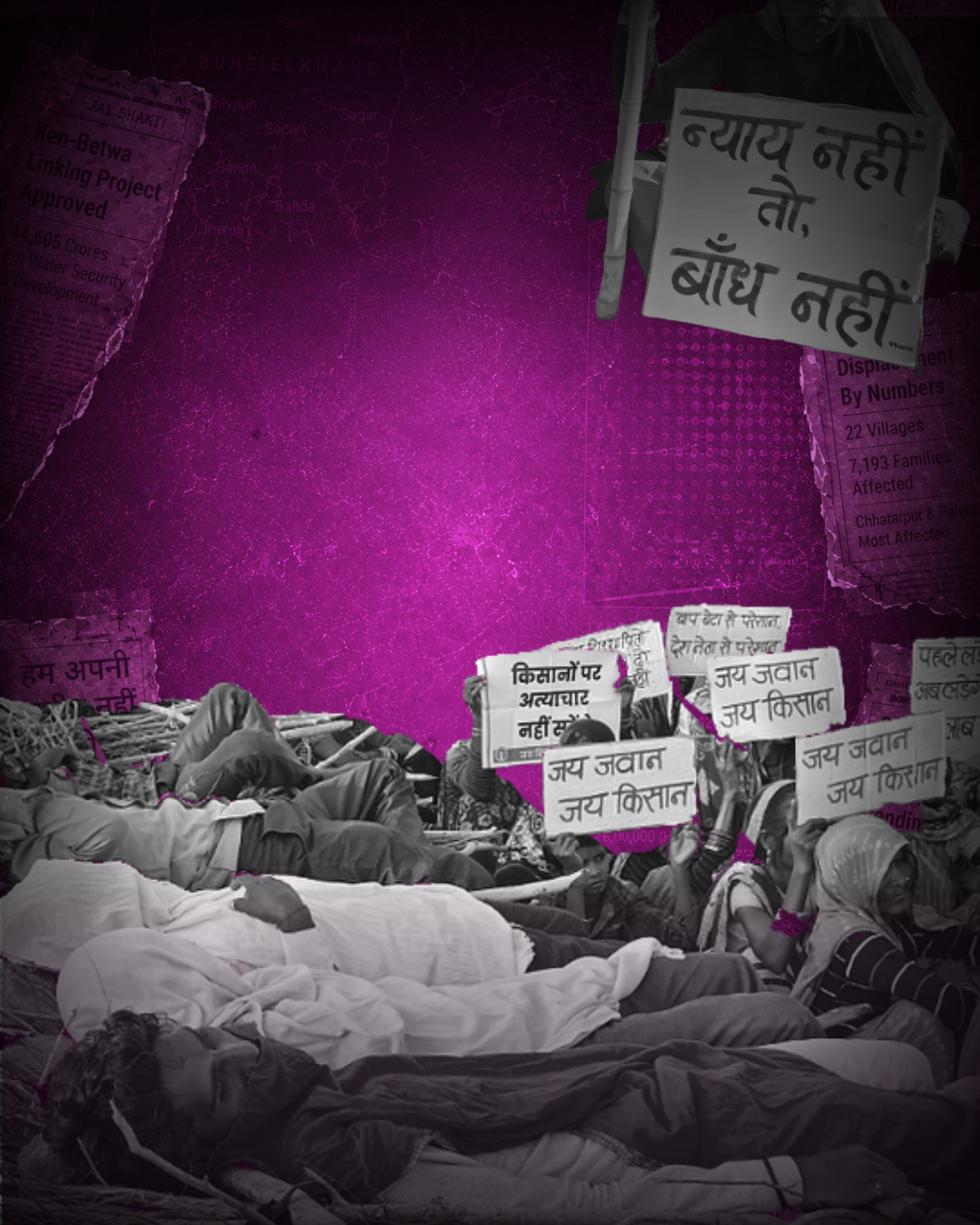
On April 5th, 2026, people of the Chattarpur District of Madhya Pradesh laid down on the Ken river, their faces smeared with mud, as if arranged for their own funeral with just one statement on their lips, “Nyay do ya Maar do” . Thousands gathered along the river, setting down a chitta andolan, a symbolic protest on the pyre to show that they were willing to lose it all. The mud borrowed from the river, the leaves on their heads from the trees that feed them. There is a special kind of dignity in staging your own death to represent the land that feeds you.
The number that made it necessary was 44,605 crores. In December of 2021, the Ministry of Jal Shakti approved the Ken Betwa Linking Project with the promise of bringing water to the drought-prone areas of Madhya Pradesh and Uttar Pradesh, claiming the project to be “crucial for the water security and socio-economic development of the Bundelkhand region”. The project boasts agricultural growth, drinking water, hydroelectricity and drought management for these districts while also providing compensation to those affected by the project but this is just one side of a coin. While the Jal Shakti creates a rosy image, the ground reality is starkly different.
The cost, when it appears at all in government arithmetic, is filed under a different category: land acquisition, resettlement, “project-affected families.” The Daudhan Dam is expected to displace around 5,288 families in Chhatarpur district and 1,400 families in Panna district — though by the time the first phase’s full scope was tallied, that figure had climbed past 7,000. Approximately 7,193 families were asked to surrender land their families have worked for generations, in exchange for a number denominated in lakhs per acre. It is worth sitting with the mismatch: the government’s number is a rate of return; the villagers’ number is a unit of erasure.
There is a consistent dance that happens with how the state absorbs dissent without conceding anything to it, and Ken-Betwa, by mid- April 2026, has performed it several times over.
The protest happens, villagers on pyres with mud on their faces which forces officials to
show up and give them a window to have their grievances heard.
The protest recedes, not because an action is being taken but because it’s been given a deadline to believe in.
As the days pass, the demolition process resumes with bulldozers destroying ancestral homes.
The promise given was simple; a compensation of Rp. 12.5 lakh per acre along with an additional 6 lakhs for a house and while it sounds generous, and progressive, it’s just a veil for corruption and inequality. The same clause that promises the amount says nothing about who gets paid first, who gets paid half, and who gets nothing at all! Generosity here is just a number, not rehabilitation.
Land titles, like most things in Bundelkhand, run through male names, so a woman who has spent her life in a house does not appear as a claimant when that house is priced and paid for. Defying the local customs that expect them to stay hidden behind a “ghunghat”, these women lie down on symbolic pyre with their identity coming upfront, to make a claim the paperwork had no column for!
This reveals another reality, the fact that the compensation was made with frugality in mind, instead of accountability. It was built to price land, and not to account for who actually depends on it. A rehabilitation package can be generous in its stated rate per acre and still fail almost everyone it was written for, simply by asking the wrong question — whose name is on the deed — instead of the one that matters, who will have nowhere to go.
And soon, it turns into a cycle that repeats after every protest, the response to every grievance is an assurance, a window, and then the work resumes with no solution. The fresh survey promised in April is, by July, still being promised. Is this really incompetence or is it just delaying the result, since that is cheaper than actual resettlement, and a population that has already staged its own funeral once is not an infinite resource to be spent staging it again.
Additionally, the project also raises a concern of what gets irrigated, and what drowns. When you lay the numbers flat, a simple arithmetic shows up which states that while Madhya Pradesh is bearing most of the costs, it’s also reaping the most benefit against Uttar Pradesh but that’s just surface level.
Focus on the districts and one will find the asymmetry in compensation. The land that gets irrigated sits in the far west of uttar pradesh; Tikamargh, Damoh, Sagar, Datiah, Shivpuri, Banda, Mahoba, Jhansi, Lalitpur, all in the drought registry of Bundelkhand. The land thats forgotten and drowned sits in just two districts, Chhatarpur and Panna. Between them, they contribute nothing to the irrigation total and receive, in exchange for roughly 7,193 families’ homes, a place on the list of things the project was named after.
A farmer receiving the Ken-Betwa water will likely never learn the name of the villager that had to give up his livelihood to fund someone else’s.
On the morning of 19th July, 2026, at 5 a.m., police reached the banks of Barana river and cleared the seventeenth day of a protest that had, by then, run through most of the vocabulary of Bundelkhand’s resistance–jal satyagrah, chita andolan, faansi satyagrah, with the movement leader, Amit Bhatnagar, on hunger strike for 11 days. The explanation given by the officials was the river itself–the rising levels due to monsoon, a safety risk with the protestors camped under the bridge, and while the officials deny detaining anyone, witnesses say that Amit Bhatnagar was taken against his will, and forced into a hospital.
While it is tempting to end here on a note of defeat, we must look at the pattern; the movement will regroup, as it has every time since 2023, and stage some fifth or sixth iteration of dying symbolically in public because dying literally, or simply disappearing quietly into a resettlement colony, has so far been the only alternative on offer.