The Law Left the Door Ajar, and Called It Pride
By Ronita Bhattacharya on June 29, 2026
June is recognised as Pride Month, which means, every year in June, India’s metropolitan cities boom with vibrant rainbows, solidarity, and performative allyship with the LGBTQ+ communities, while the discrimination of the other eleven months goes silently unaddressed. As the privileged metro elites wave their flags, a trans woman from a tier-2 city is denied a job, a gay couple is disowned, and a queer teenager learns that being someone else is safer than living their truth.
But how can such discrimination exist in a country whose legal framework boasts inclusivity and diversity?
While the 2018 ruling of Navtej Singh Johar vs Union of India affirms the right to identify one’s sexual orientation as an intrinsic facet of democracy, decriminalisation alone did not translate to inclusive family law recognition. LGBTQ+ individuals now live in a society where, while their existence isn’t considered entirely illegal, it still coexists with a form of social exclusion. LGBTQ individuals are still discriminated against when it comes to adoption, or “settling down” in traditional terms. The Juvenile Justice Act of 2015 defined a couple as a “married man and woman”, instantly disqualifying spouses of the same gender, while giving the privilege of adoption to single LGBTQ+ individuals. Furthermore, the non-recognition of marriage isn’t just a failure of providing dignity but also a symbolic gap, triggering a chain of concrete deprivations.
A same-sex partner has no automatic right to inherit property unless explicitly stated, unlike heterosexual marriages, where the death of one partner means the next of kin is the other partner. Non-heterosexual individuals also cannot apply for joint loans, nor can they make medical decisions on behalf of their spouse in an emergency.
This forces us to focus on the structural irony of our constitution: while we make laws that appear inclusive on the surface, the ground reality is alarmingly different. The discrimination isn’t a single law or a single ruling — it’s interlocking. Each gap reinforces the others.
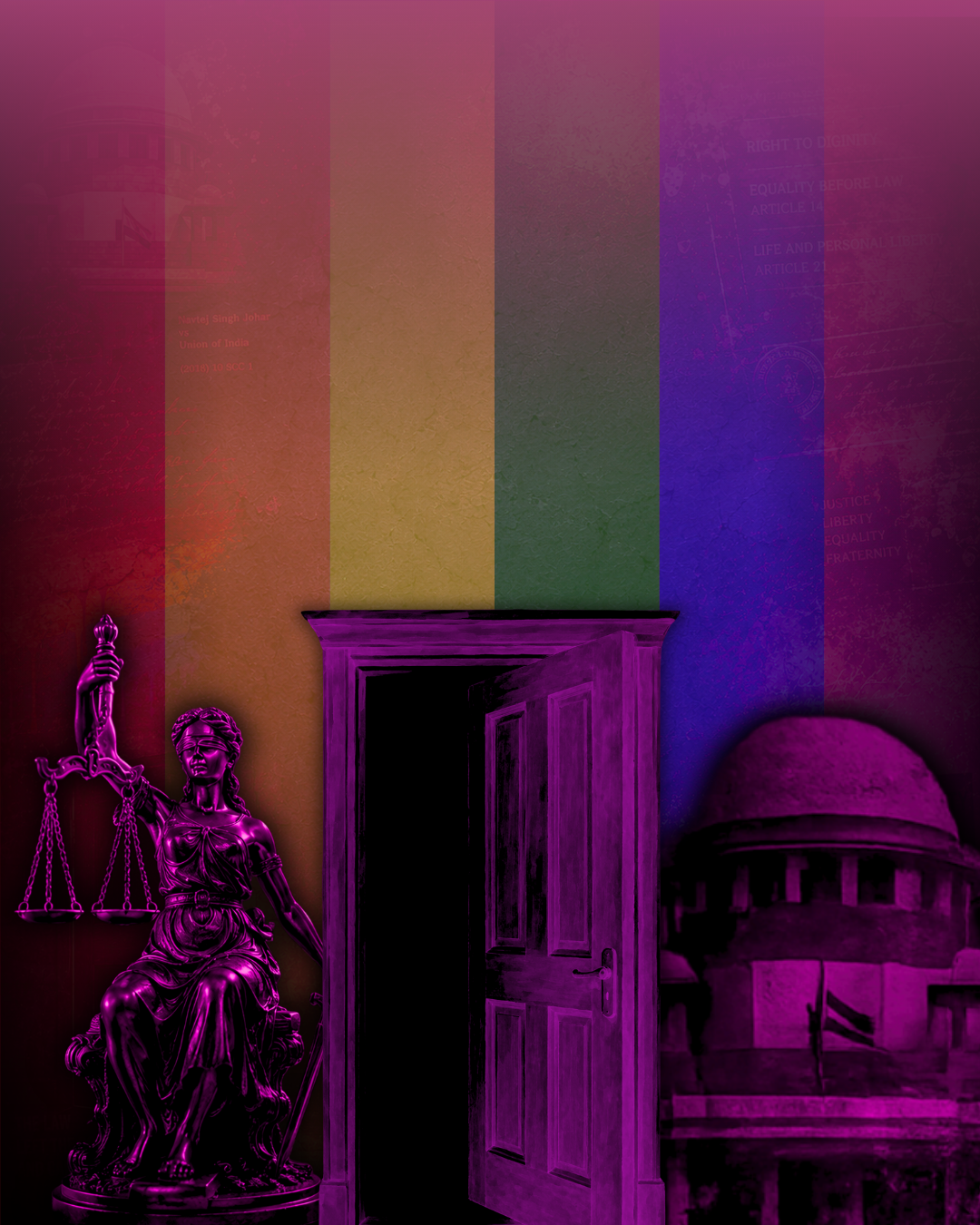
In 2023, the Supreme Court also stated how the legal framework and inclusion of non heterosexual couples in special marriage act would be under the parliament’s domain, and Solicitor General Tushar Mehta argued on behalf of the Central government that 160 laws would be affected just by mentioning spouse instead of “man and woman”. And so, the door wasn’t slammed shut; it was simply, and politely, passed on to someone else, with no guarantee of whether it will be opened again or not.
And while we are on the subject of laws, let’s recall the regressive law passed earlier this year. The 2025 amendment to the Transgender Persons (Protection of Rights) removes section 4 (2), which guaranteed the legal rights to a self-perceived identity according to the landmark NALSA judgement. The amendment threatens to take away the rights of lakhs of trans individuals to identify themselves, stripping them of their self-respect and dignity. So really, how far does the inclusivity go?
And all of this is just the exclusion engineered by the judiciary. The social reality is no better if we were to talk about the perpetual societal exclusion and the discrimination faced by queer people living in India.
According to a 2023 survey by HumSafar Trust, 52% of respondents had faced workplace discrimination while 40% faced family violence. Additionally, a 152-page International Commission of Jurists report documented Human Rights violations against LGBTQ+ communities in family homes, workplaces, and public spaces–including harassment by authorities.
The discrimination doesn’t stop offline; rather, it’s heightened online since the perpetrator receives the veil of anonymity. Recently, the Cockroach Janta Party’s spokesperson, Vijeta Dahiya had posted on his instagram account dismissing queer individuals, labelling them as circus, which amplified the transphobia amongst a lot of supporting youth. The post came as a betrayal to the Indian queer community since a lot of such individuals supported CJP and their movement towards a better government. Ultimately, you cannot scream inclusivity and then whisper hatred towards a marginalised community.
Furthermore, an individual was trolled online for wearing a saree to a CJP protest as a queer individual, and another, for wearing a crop top as a trans man. The trolling plumbed new depths, to the point of these queer individuals coming online and releasing statements to protect themselves. And that begs us to pose the question of “When will the constant bullying and trolling of marginalised communities stop?”
At the end of the day, the onus doesn’t just fall on the perpetrators but also on these platforms that provide a stage for such nuisance. According to an investigative study by GLAAD, META failed to remove anti-trans content from its platforms, even though they violated its own policies on bullying and harassment. These posts labelled trans individuals as “mentally ill” and mentioned sensitive topics such as “conversion therapy” and “conversion therapy camps”. At least, 98.4% of the hate speech on META platforms go unnoticed by their policies because of India’s diversity. As unbelievable as it sounds, India is a country with 22 official languages, and when the hate comments are in different languages, they manage to bypass the META guidelines.
India’s LGBTQ+ community has been told, repeatedly, that progress is coming — through verdicts, through Acts, through Pride Month hashtags. But progress that lives only in courtrooms and corporate campaigns is not progress. It is permission to exist, quietly, on the margins. Until the law protects rather than performs, until platforms are held accountable in every language, and until a trans woman in a tier-2 city has the same rights as anyone waving a flag in Mumbai — Pride Month is just a calendar event.