From Parasite to Political Front: India’s Youth Did Not Take the Insult Lying Down
By Tanushka Rathore on May 23, 2026
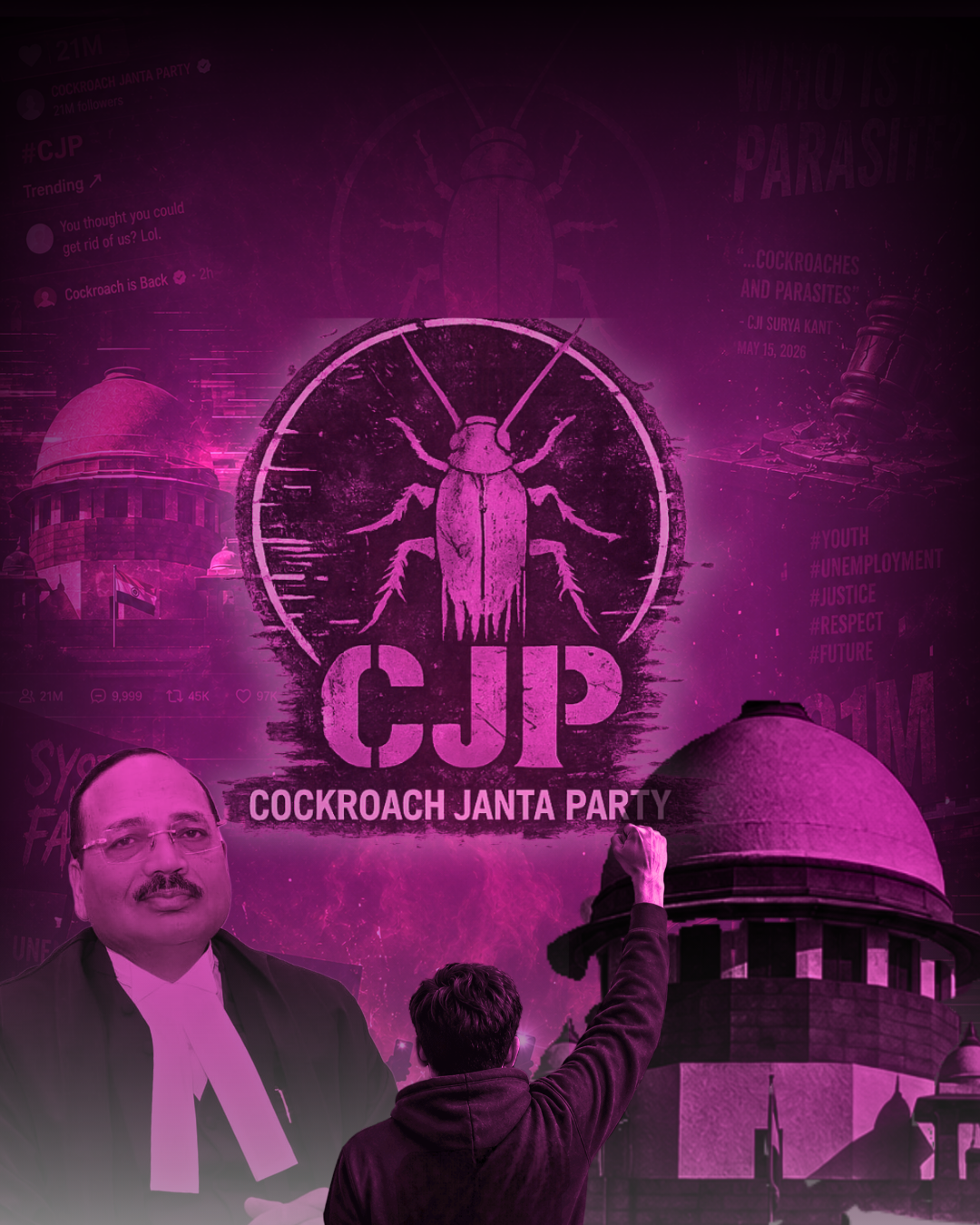
There is a particular kind of miscalculation that only the truly powerful can make, the kind where you look out at a generation of frustrated, unemployed, politically aware young people and decide that the best thing to do, from the bench of the Supreme Court of India no less, is to call them “cockroaches”. I have been following this country’s politics long enough to have stopped being surprised by its audacity. And yet, on May 15, 2026, Chief Justice Surya Kant managed it, a huge feat, I must admit, comparing unemployed youth to parasites and cockroaches in open court, presumably under the impression that this would discourage them. So much for knowing your audience. It did not. It organised them. And I, for one, have been watching with great interest ever since.
Within 24 hours, Abhijeet Dipke, a 30-year-old political communications strategist and Boston University student who had once worked with the Aam Aadmi Party, had built a party. Not metaphorically. An actual party, with a name, a manifesto, a website, an Instagram page, and eligibility criteria. To join the Cockroach Janta Party, you must possess some extremely rare skills – you must be unemployed, lazy, chronically online, and able to rant professionally. Within days, over 350,000 people had signed up. The Instagram page crossed 21 million followers, surpassing, for the record, both the BJP and the Congress. The movement that a chief justice accidentally started had, in the span of a week, become one of the most followed political entities in the country. As somebody who professionally writes. No, you simply cannot write or make this up.
And yet, here we are.
Now, before we proceed, let us pause to appreciate the irony on the table. The Chief Justice of India called unemployed young people cockroaches and parasites. The same young people whose unemployment rate sits at 9.9 per cent nationally and 13.6 per cent in urban areas, not because they are lazy or unambitious, but because decades of economic mismanagement, a failing education system, a NEET paper leak that nobody has been held accountable for, and a job market that simply has not kept pace with one of the world’s youngest and most educated populations have left them exactly where they are. The system failed them. The government failed them. And then a representative of that very establishment looked down from his elevated bench and called them parasites. The audacity is, genuinely, breathtaking.
Somewhere in the corridors of power, very important men in very expensive kurtas are huddled around a table trying to figure out how to dismiss 21 million people as a meme. They will call it frivolous. They will call it foreign-influenced, and indeed, the CJP’s X handle was already withheld, and questions about Pakistani and Bangladeshi followers have been raised with suspicious urgency by people who have never once shown this level of concern about bot farms during election season. They will say it is just Gen Z being Gen Z, chronically online, easily distracted, and will forget about it in a week. They have been saying some version of this about young people for thirty years, and they have not updated the script once, which tells you everything about how seriously they take the population they are supposed to represent.
Suddenly, concerns of negative social media influence will plague the country, and CJP will be called a “trend.”
The response to the X handle being withheld? A new account, titled Cockroach is Back, says, “You thought you could get rid of us? Lol.” The cockroach, as a symbol, was extremely well chosen.
The CJP’s manifesto, described with magnificent self-awareness as secular, socialist, democratic and lazy, is not entirely a joke, and that is precisely what makes it interesting. It demands a ban on post-retirement Rajya Sabha seats for chief justices, because the revolving door between the judiciary and the government has been spinning long enough that someone finally thought to name it. It calls for 50 per cent reservation for women in Parliament without increasing the total strength of the house, a demand so reasonable it is embarrassing that it needs to be made. It wants a 20-year ban on political turncoats. And it calls for the cancellation of licenses of all media houses owned by Ambani and Adani, to make way for a truly independent media. The website states, with admirable directness: “We are not here to set up another PM CARES, holiday in Davos on the taxpayer’s salary slip, or rebrand corruption as strategic spending. We are here to ask loudly, repeatedly, in writing, where the money went.”
Say what you will. The homework has been done.
Dhruv Rathee has expressed interest in joining. Prashant Bhushan has offered his support. Anurag Kashyap, Kunal Kamra, Konkona Sen Sharma, Dia Mirza, the list of names grows daily. The movement is loud, it is sharp, it is funny, and it is angry in all the right directions. It is also, and this needs to be said, being dismissed by large parts of the establishment purely because it was started by a Gen Z person on Instagram, built with AI tools in 24 hours, and communicates primarily through memes. As though the medium invalidates the message. As though the fact that it is entertaining means it cannot also be serious. The ignorance required to look at 21 million people joining a movement in a week and conclude that it is not worth taking seriously is, at this point, its own kind of political statement.
I must say, it is classic of the Indian government to think that communicating on social media is “not serious” communication. After all, decades of corruption and cover-up have entirely erased their concept of clear and transparent communication.
Now. Here is where I put down the confetti and pick up the question nobody wants to ask at a party.
This country has been here before. Not with cockroaches, specifically, but with the energy, the viral momentum, the celebrity endorsements, the feeling that this time something is genuinely different. We felt it with the anti-corruption movement of 2011. We felt it with the early days of the Aam Aadmi Party, which, incidentally, is also where CJP’s founder cut his political teeth. We know how that particular story continued.
The CJP has 21 million followers. It has a manifesto that reads better than a lot of actual manifestos. What it does not yet have is accountability, a structure, or a clear answer to the very pointed observation “It is a section of the urban middle class suddenly discovering that the system they watched brutalise others for years can humiliate them too.”
That is not a dismissal. It is a demand that the movement be honest with itself.
A generation that is rightly furious at being governed by people who were never scrutinised deserves better than to repeat the pattern with different branding. So by all means, join the swarm. The anger is legitimate. The demands are real. The moment is genuinely alive.
But keep your eyes open. Ask the questions. Hold this movement to the same standard you are holding the one it is standing against. That, more than any manifesto, is what separates a revolution from a rebranding. Because blind support, however well-intentioned, is still blind