The Devil Wears Prada 2 and the Death of Art
By Keya Waghmare on May 19, 2026
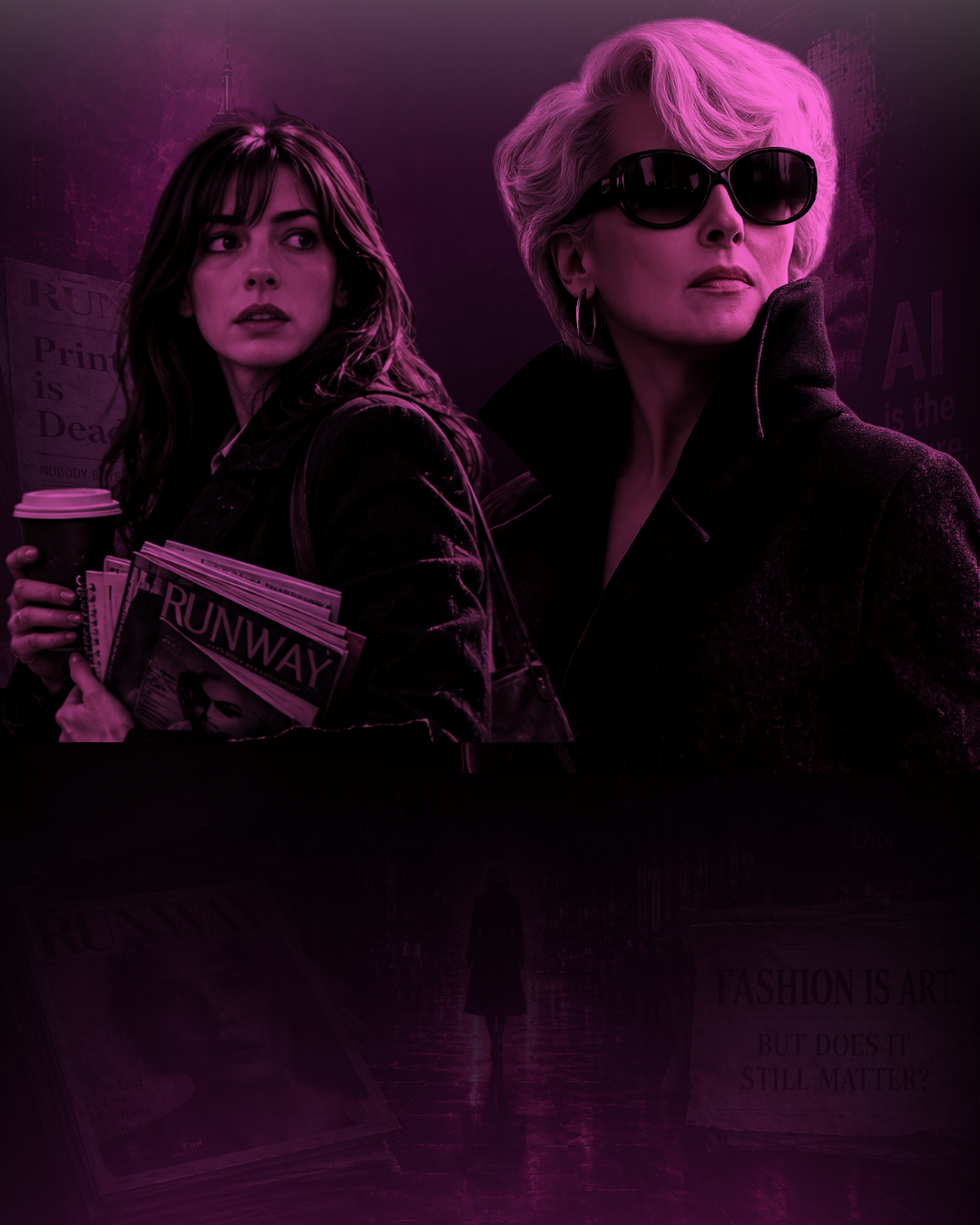
When I walked into the theatre to watch The Devil Wears Prada 2, I expected a nostalgic return to the early 2000s, with a romantic New York backdrop and perfect skylines. Instead, I found myself leaving the theatre with a gnawing uncertainty: Is art redundant in today’s age?
This film has done a great job at highlighting modern-day anxieties surrounding billionaires, Ozempic, and, of course, AI. These developments have consistently been discussed in passing, making them feel like a way of life that the art and fashion industries have now been forced to coexist with.
The Devil Wears Prada 2 is barely a sequel to its 2006 predecessor; it is a bold inversion of the same. This film presents a stark contrast; fashion magazines and runway shows are no longer overly romanticised fever dreams, we are no longer living in the grainy, rose-coloured 2000s rom-com, we are now in the real world- experiencing layoffs, office politics and budget cuts alongside Andy Sachs. This is a world where the possibility of AI taking over our jobs might just become reality, and art is treated as a swappable commodity, because what can’t AI do? Right?
The Week’s review directly says the film “swaps couture for code” and asks what happens “when taste is no longer the ultimate authority.” It frames the movie as defending human taste, editorial instinct, and artistic judgment against data-driven systems.
The film starts with Anne Hathaway’s Andy Sachs at an award show, 20 years later, getting laid off over text; what follows is a brief monologue where she talks about redundancy in the field of journalism and how easily replaceable journalists have become in today’s technological age. The concept of redundancy isn’t just a tiny bit in the first scene; it is actually a recurring conversation throughout the film. Emily (Miranda’s assistant in the first film) has now left the fictional Runway magazine and has done what a lot of fashion journalists have turned towards now: working in-house at a brand, in this case, Dior.
In a particularly haunting exchange, Nigel discussed with Andy how print is no longer a relevant option. “You must know that Runway stopped being a magazine many years ago. I mean, we still have a book, but practically nobody buys it. We are digital. We are downloadable. We are streamable. We’re in the ether.” This exchange perfectly describes the technological transformation of print publications into scrollable pieces of content that rely on the algorithm for traction and engagement.
Nigel describing the fall of Runway from glossy editorial institution to “content people scroll past whilst they pee” felt like a personalised threat to everyone hoping to work in media, because truly, this is now a lived reality for many of us. Watching a mainstream film articulate journalistic anxieties so casually was deeply frustrating, yet it was handled remarkably well — because what other choice are we left with? We are forced to adapt.
The first film put Andy in a position that “a million girls would kill for.” The film pitted “real” journalism against fashion journalism, questioning its apparent “superficial” nature. The Devil Wears Prada 2 sheds that romantic cover: the job that a million girls once would have killed for is now on the brink of collapse. In the sequel, couture is no longer viewed through a suspicious or dismissive lens; it is appreciated, and journalism is unified against big tech moguls and AI. The movie adopts the idea of “Fashion is Art”, and how art is meant to adapt, change and integrate, yet it never backs down. The first film, through Miranda, proved that Fashion is the marriage of art and retail, the second showcased the significance of the former in an ever-changing world.
Lost somewhere in the endless algorithm, fashion itself becomes the victim. Cue a montage of Andy desperately sipping coffee and churning out articles to satisfy internet metrics — views, and likes — for Runway.
Andy’s character becomes especially important in this transformed world because she is neither entirely cynical nor entirely resistant to change. Unlike Miranda and Nigel, who mourn what journalism and fashion once were, Andy represents the generation forced to survive within the algorithm. She adapts, compromises and keeps moving.
The film’s anxieties surrounding automation finally culminate in one particular scene, it was Benji Barne’s exchange with our Devil, Miranda. Benji Barnes is the tech billionaire and Emily’s new beau– he functions as the film’s embodiment of Silicon Valley logic. At some point in the same scene, Benji says that fashion will no longer need “models or locations or even designers” because “it’ll all just be AI.” This moment was especially chilling because in one sweeping sentence, Art has been dismissed as if it’s just some inefficient production cost.
In the second half of the film, Meryl Streep’s stoic character is shown crumbling under pressure for the very first time. Miranda, who used to symbolise derogatory elitist systems and fashion gatekeeping, is suddenly seen defending craft, taste, culture and artistry in the face of tech giants, AI and whatnot.
The scene that immediately follows this exchange is a high-angle wide shot of Miranda walking through the streets of Milan, dwarfed by towering fashion advertisements and luxury storefronts. The lonely expanse covering the screen is almost bleak.
There’s another meta-layer to this film: it repeatedly and not-so-subtly keeps contrasting “content” with “art.” Benji sees fashion media as reproducible output; anyone and anything can make fashion, can contribute to centuries of culture and history. Nigel and Miranda see fashion as a product of human judgment, obsession, and taste.
Perhaps the film’s greatest anxiety (and mine as well) is not if machines will learn how to create, but that the world has already started treating creativity as something replaceable. Yes, AI can now imitate art convincingly, yes, media is now driven by algorithms, numbers and metrics- but when did we stop caring about the difference? When did Art turn into survival?