Is Every Choice Feminist? The Politics Behind ‘Her Choice’
By Hitasree Maddukuri on March 8, 2026
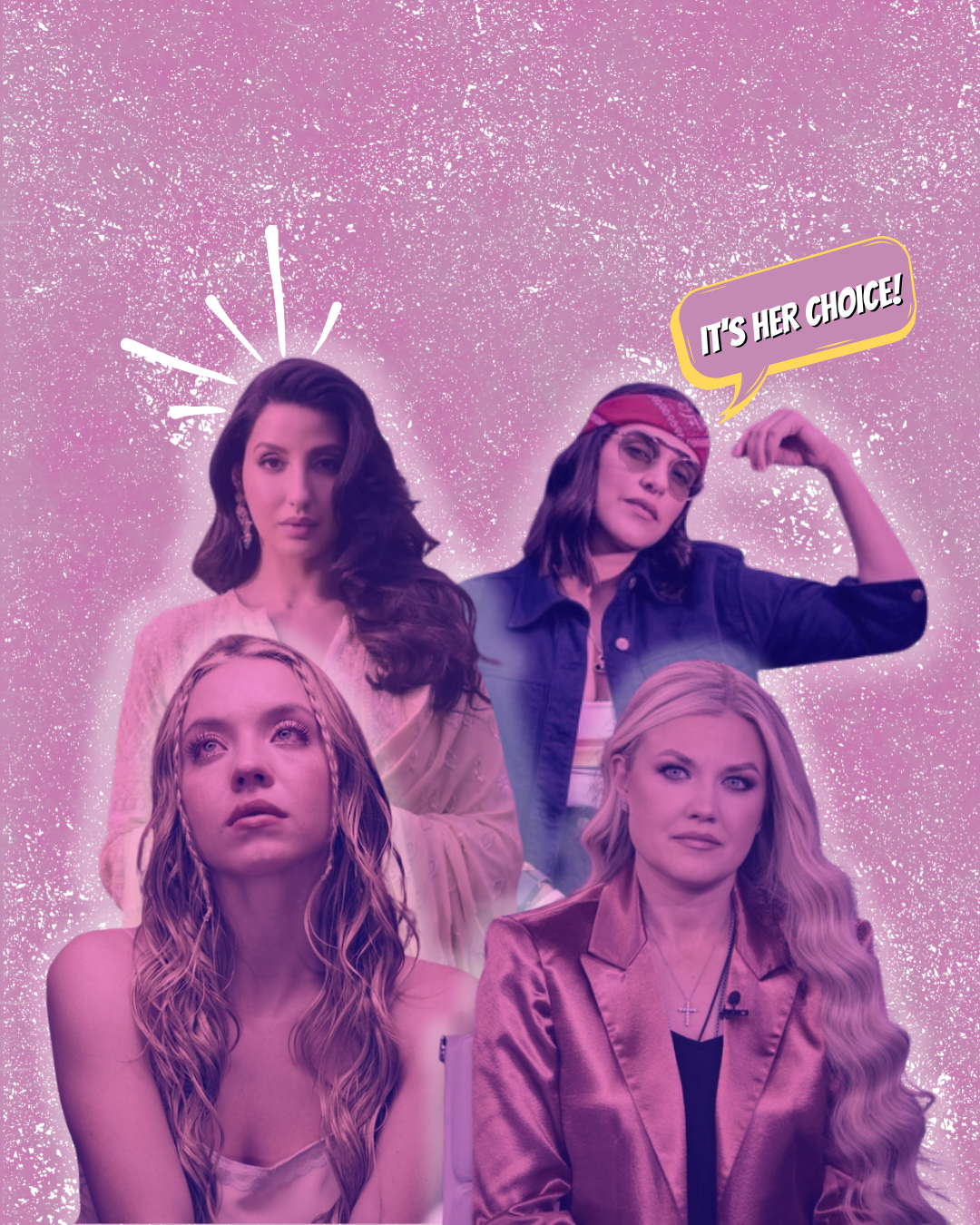
In today’s segment of “Twin It to Win It”, find the similarities between Sydney Sweeney, Kim Kardashian, Erika Kirk, and Nora Fatehi. This list may seem odd, but all of the above personalities share a similar trait in common.
Ding ding ding, Yes, you guessed it right- they are all feminist icons! All the above personalities have made strides in their own sense and proved that the epitome of feminist struggle is to follow one’s own will. Wait, that doesn’t sound right, hold the script- let’s delve into history to get better context.
Even though your incel keyboard warrior might encompass the idea of feminism as anti-male propaganda, however feminism started its first wave with the suffrage movement in the early 19th and 20th century, the second wave with the women’s liberation movement (which campaigned for legal and social rights for women) in the 1960’s, and the third wave of the 1990s; with the continuation of, and a reaction to the perceived failures of well, second-wave feminism.
Before this article turns into a history lesson, let me quickly boil it down for you: feminism is the belief in and advocacy of the political, economic, and social equality of the sexes, expressed especially through organised activity on behalf of women’s rights and interests. To make it even easier for our readers, feminism highlights women’s agency, viewing empowerment as the freedom to direct one’s own life through equal opportunities.
Now that all of us have a clearer understanding of feminism (hopefully), let’s reconsider these personalities: Sydney Sweeney built her brand around by performing to the male gaze and appeasing the marginalizing narrative; Erika Kirk, as chair and CEO of Turning Point USA, promotes traditional gender roles and actively advocates against basic gender rights such as abortion and healthcare; Nora Fatehi is celebrated for her eroticized performances and provocative stage presence.
So, who is the primary audience of the aforementioned women?- Men
Who will be the main patrons of such achievements?- Men
Who decides the success of such achievements?- Men
At first glance, it may seem empowering that these women profit from patriarchal structures by leveraging male attention. Some might call it poetic justice—turning the tables on a system that excluded them. However, equating this success with feminist progress confuses profit with collective liberation and misrepresents what feminism aims to achieve.
Let’s hit the brakes for a second. The “go girlboss” version of feminism is often sold as the ultimate dream, but it’s actually the opposite of what feminism stands for. Feminist ideals, morals, and principles are far too complex to be reduced to a single, convenient narrative, especially one packaged and pushed by conservative male capitalists.
Feminism, shaped by historical struggle, seeks to dismantle patriarchy and achieve social, political, and economic equality. It emphasises women’s autonomy, freedom from restrictive gender roles, equal access to opportunities, and—through intersectional thought articulated by Kimberlé Crenshaw—recognises that gender oppression intersects with race, class, caste, and sexuality. To make it simpler, feminism seeks to break the already existing patriarchal system rather than conforming to it; it seeks to protect individuals from all genders from discrimination against their caste, race, gender and nationality, and it champions the minority struggle.
When a celebrity performs, idealises, and profits from the male gaze and an idealised, gender-conforming image, their success does not advance feminism; instead, it pushes the struggle backwards. Their success is not a collective win but a selfish motive reigning over, disguised as empowerment. When Sydney Sweeny sells her bath water, the Kardashians earn billions by altering their bodies and setting unrealistic beauty standards artificially, or Erika Kirk consolidates herself in US politics while advocating against basic gender rights. These should not be proclaimed as milestones in feminist progress. However, let’s call it what it really is: self-serving opportunism—less a fight for collective liberation and more a calculated move to cash in, chasing profit and personal gain while dressing individual ambition up as progress.
Let me put on my 14 y/o Andrew Tate fan hat for a second- Some might say, ‘These women know what men want, so they’re just playing the game, we gotta respect the hustle.’
Well, even though they are destroying their sense of self and diluting what feminism is, they are only concerned about the monetary gains in the short term; they are not accounting for the detrimental social and cultural effects it might have in the long term. So I say make the player accountable and destroy the game.
As Neha Dhupia once said, “It’s her choice.” Let’s dissect this so-called agency of choice, which has been earned through years of struggle by women before us. All the aforementioned women come from a place of privilege; they have been given the privilege of choice, hence they are deluded to disparage the real-life consequences of their decisions. When a little girl from Iran, who is stripped of her basic rights, a Dalit woman from India who has been the target of systemic abuse for generations, or a 15-year-old widow who was forced into child marriage, who will tell them that their agency isn’t universal freedom but privilege in disguise, cushioned by class and race?
Finally, if we recapitulate all the points, we can draw a final conclusion- all the women mentioned before claim not to be feminists while benefiting from the feminist struggle. Individual choice cannot be elevated above the collective struggle that made that choice possible.
It is necessary to question the actions of such celebrities; we must also understand where these choices stem from. We are very quick to judge and draw our pitchforks for a witch-hunt. History has proven to us how women can be called out and dragged because society deemed them to be a negative influence, blaming them for owning their sexuality or daring to challenge the stereotype . Feminist Struggles such as The “Free The
Nipple” movement, a global, decade-old campaign advocating for gender equality, body positivity, and the de-sexualisation of women’s bodies by opposing the censorship of female nipples; and the “Me Too” movement, which was a social movement and awareness campaign against sexual abuse, sexual harassment and rape culture. These are examples of how the spirit of feminism actively advocates and strives to challenge the existing structure and create space for the underrepresented communities in the mainstream media.
We must be an active audience and understand the underlying motives and agendas which have been pushed to make a woman think her individual agency is her own free will and not years of patriarchy and internalised misogyny. We as women are always put in a tough spot; it’s unfair how we must second-guess our every decision and choice, thinking about its implications and connotations. It’s unfair how we have to carry the burden of our freedom by upholding every value and moral right down to the mundane tasks we do; it is much easier to carry the precious burden than let it be stripped away. Even though women are always expected to carry and uphold additional responsibilities, we as modern women owe it to our ancestors for the simple freedoms we enjoy and champion them forward for the women after us. What we inherit as freedom, we must defend as responsibility.
Personal freedom means little if it comes at the expense of the collective struggle that created it.