Rewriting the Script: Is Bollywood Aligning With a New Cultural Order?
By Nihira Pillai on February 22, 2026
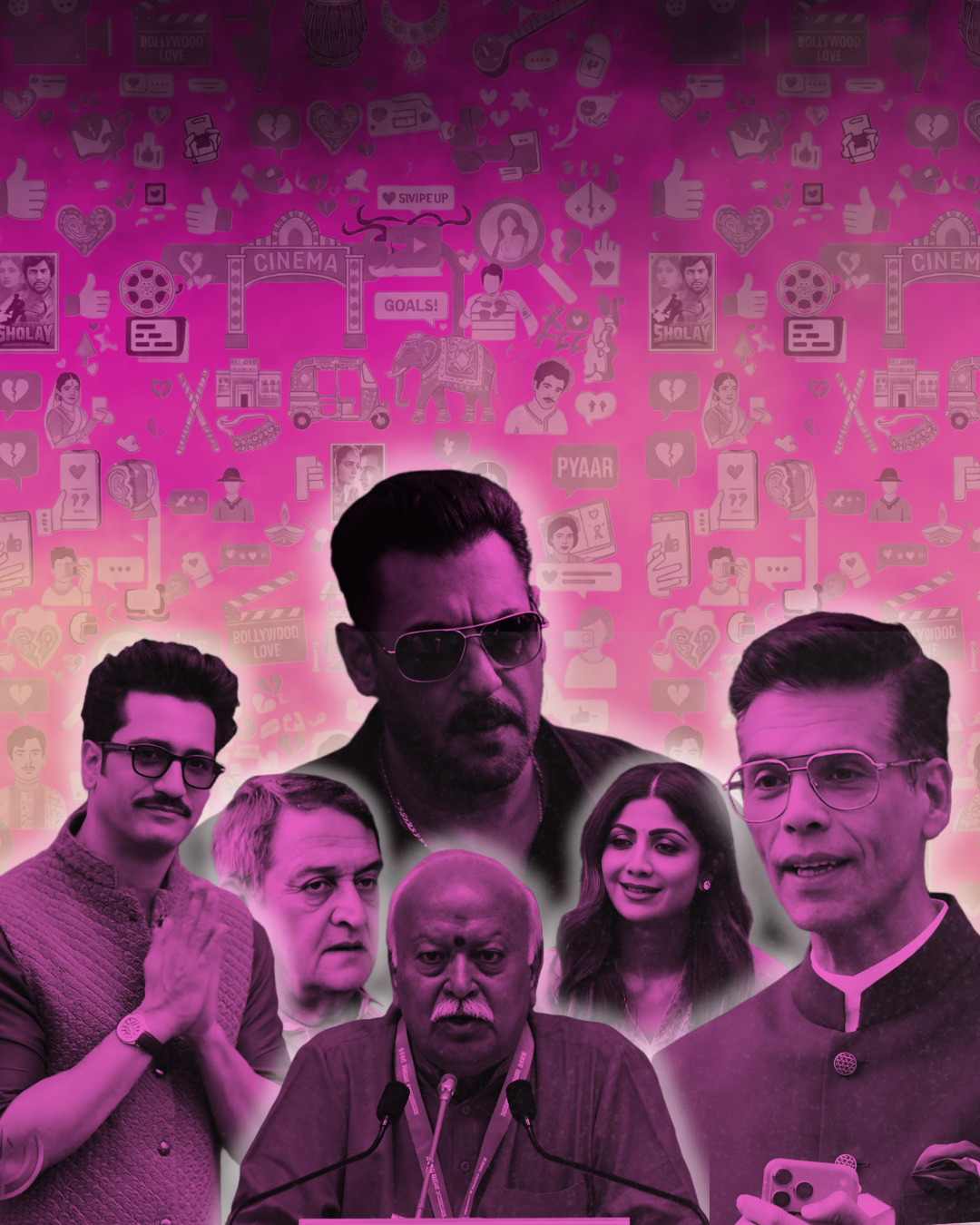
On February 7, 2026, the Rashtriya Swayamsevak Sangh (RSS) hosted a two-day centenary celebration at Mumbai’s Nehru Centre Auditorium. The event drew widespread attention as Bollywood actors and filmmakers, including Ranbir Kapoor, Salman Khan, Subhash Ghai, Vicky Kaushal, Karan Johar, and Akshay Kumar, graced the occasion.
Headed by Mohan Bhagwat, the RSS is an Indian right-wing Hindutva volunteer paramilitary organisation. He is the progenitor and leader of a large body of Hindutva organisations called the Sangh Parivar. The current ruling political party, Bharatiya Janata Party (BJP), is also a part of the Sangh Parivar.
Bollywood’s presence at the 100-year RSS celebration must not merely be taken at face value as a celebrity affair; it sends across a strong message about the political alignment of the industry. So, what happens when popular Hindi cinema joins hands with a politically right Hindutva organisation such as the RSS? “Patriotic” and “nationalist” propaganda films like Dhurandhar, Chhava, 120 Bahadur, Border 2, Ramayana, among others, are not just mass-produced and released; they are amplified, marketed, and celebrated in ways that increasingly suggest that to belong nationally is to belong to a certain religious identity.
This can be comprehended from the choice of actors and filmmakers who were invited to be a part of the event. Vicky Kaushal, who through his films like Uri- A Surgical Strike, Chhava, Sam Bahadur, Raazi, has built a screen persona rooted in state-centred patriotism.
Similarly, Akshay Kumar, having interviewed the Prime Minister himself, along with his set of films like Kesari, Airlift, Baby, and Padman, has constructed a ‘social reformist’ identity for himself.
Also present was Ranbir Kapoor, the ‘Ram’ of the upcoming film Ramayana, directed by Nitesh Tiwari (who was also present at the event).
So, what does this mean? When the big names of Bollywood publicly align themselves with a pro-Hindu political organisation, it positions Bollywood within the light of propaganda films, distancing it from being an independent cultural force and placing it as an extension of the State-centred ideology.
It suggests that the power to influence the films being made and the ideologies being propagated through these films lies, to a great extent, with these political bodies. This leaves little to no room for films that belong to a different line of thought. This, in turn, suggests that there is little room for the people with opinions/beliefs that the State wishes to dismiss, leaving India far from a democratic state.
Another figure who gained attention for his presence at an event organised by a right-wing Hindu organisation was Salman Khan. The controversy erupted when Shiv Sena (UBT) MP Sanjay Raut questioned whether Khan’s participation was driven by “coercion or conviction.” Accusing the RSS of anti-Muslim politics, Raut claimed the organisation was using Khan—a prominent Muslim figure—for optics, either to mask ideological biases or boost attendance, The Statesman reported.
An important point to note in this regard is that Salman Khan is set to star in the patriotic film ‘Battle of Galwan’, which is based on the India-China clash of 2020, wherein the actor will be portrayed as Colonel Bikkumalla Santosh Babu, an Indian Army Officer who significantly contributed to the war. Which makes Khan an even greater symbol of significance- a Muslim man playing a Hindu army officer in a nationalist film, aligning with the State’s ideology.
This pattern shows a preference for stars whose public identities already resonate with themes of nationalism stemming from films that are almost always extremist and share pro-Hindu ideologies. However, someone who is a small exception to this view is Karan Johar. His presence was a shocker not just for the public but also for the industry fraternity. A filmmaker often identified with liberal, urban cinema, Karan Johar doesn’t exactly fit the ideological space of the RSS. On one hand, he is producing social reform movies like Homebound and Rocky Aur Rani ki Prem Kahani, and on the other, a three-part movie franchise deeply rooted in Hindu mythology like Brahmastra. Against this backdrop, one wonders if his presence at the RSS is a survival strategy or ideological alignment.
By integrating the stars of Hindi cinema, RSS not only attempts to reach out to a broader audience but may also, if not already, play a role in influencing the broader narrative of “nationalism” through films. This new RSS- Bollywood dynamic may introduce a shift in the cultural narratives of Indian cinema, especially those pertaining to nationalism, religiosity, and political ideology.