Love in the Age of the Algorithm
By Tanushka Rathore on February 15, 2026
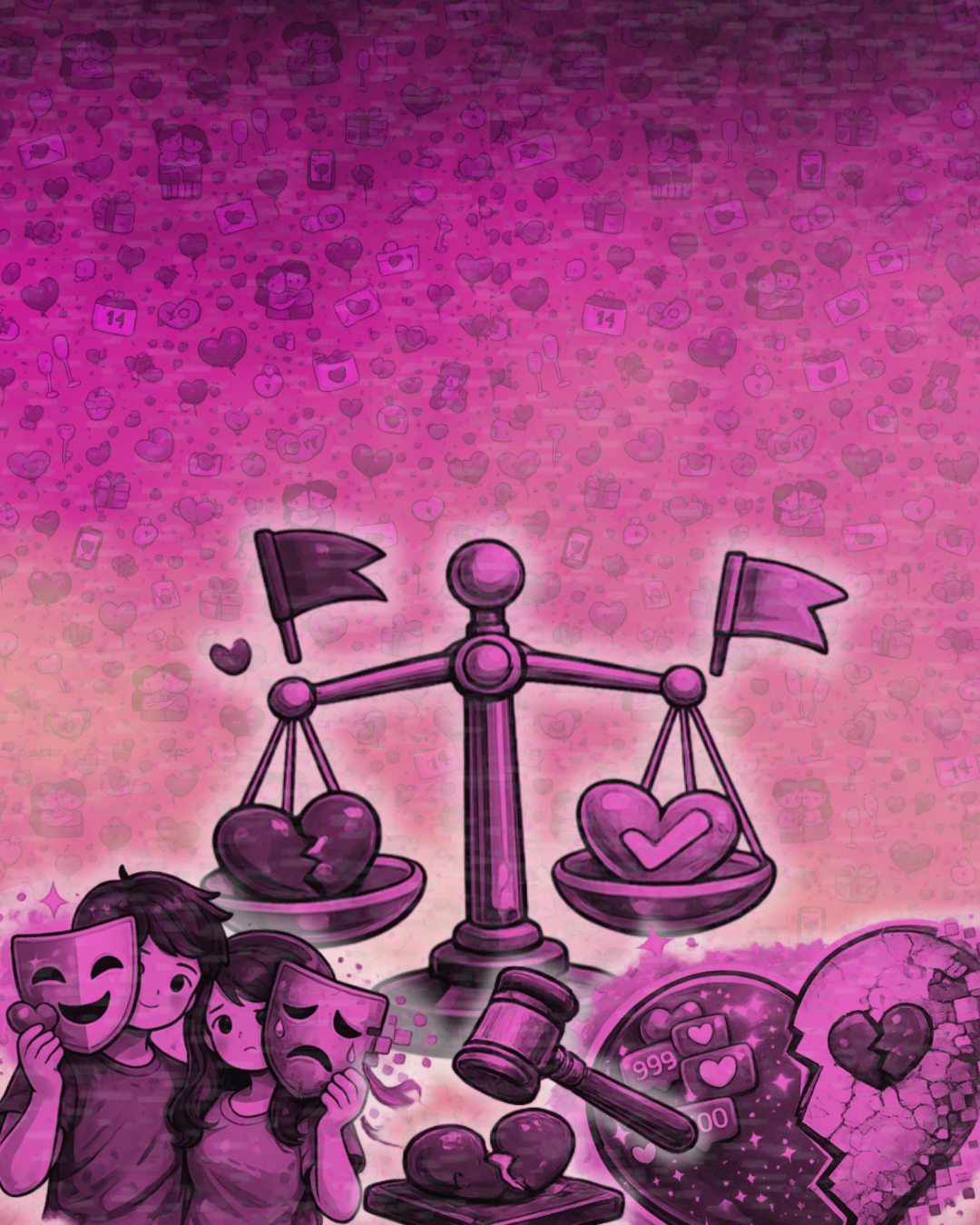
It appears to me that in this era of social media and Influencers, almost anything can be packaged, romanticised, and sold. Or perhaps, the real product is not love, but the audience who believes everything on the screen to be true, or at least something worth aspiring to. As it is, I know I am not the only one whose feed is perpetually filled with couples staging romantic devotion or curious netizens passing judgment in the comment section. So, in the spirit of Valentine’s Day – a holiday that now feels more like a content category – it may be worth asking: what exactly are we celebrating?
Somewhere along the way, love has evolved. I wish I could say it’s for the good, but its evolution has mostly to do with how it now seems to be the most trending genre on social media everywhere. And in this revolution of love, authenticity seems to be suffering the most. Relationships are no longer raw, heartfelt and evolving dynamics between two people. They are carefully scripted moments, shiny and polished, designed for the internet’s approval.
However, to say that this is entirely the work of influencers and trends would be convenient, but false. The truth is, this dynamic works because on the other side of the screen sits the most supreme panel of judges to ever exist – netizens. Armed with 30-second clips and zero context, they dissect relationships with surgical confidence. A harmless interaction becomes “emotional cheating.” A disagreement becomes grounds for collective outrage. The comment section no longer reacts; it presides. Youth doesn’t just consume these narratives, it participates in them, delivering verdicts on strangers’ intimacy as though love were a public institution rather than a private experience. And in this participation, the youth also develops their own definition of love, heavily influenced by what they see on the screen – and yes, that is a problem.
Perhaps one of the most fascinating developments in this digital romance economy is the rise of the red flag – green flag binary. The whole concept of either an action is entirely right, romantic and morally correct, or it is absolutely wrong and deserves to be called out. There is little patience and understanding of real emotions or of the grey areas where relationships live. And when the comment section declares someone a walking red flag, influencers rush in to defend their partners like attorneys in a public trial, offering clarifications to strangers who were never part of the relationship to begin with. It is a strange spectacle, entertaining? Yes. Concerning? Also, yes. But here is the uncomfortable truth: the final judgment of a relationship cannot, and should not, belong to spectators. It rests with the two people inside it. Outsourcing that authority to an audience does not make youth more aware; it simply makes love more performative.
But, most important to note, would be the impact and effect it has on the youth. You see, with every passed judgment and every relationship displayed so closely on social media, young people start to absorb such frameworks as defaults. Expectations are no longer built slowly through lived experience; they are pre-installed through content. Grand gestures are normalised. Conflict is dramatised. Imperfection feels like failure. Compromises do not make the aesthetic cut, and hence are rarely shown on screen, and so a new generation grows up with that particular mindset of a “perfect relationship”, where compromises simply do not exist. Hence, they measure real partners against algorithm-approved templates, comparing private moments to public performances and then, to no one’s surprise, it does not live up to their high expectations, expectations that might just be based on something that is not real and is just a performance to begin with.
What makes this culture even more unsettling is the emotional investment the youth places in relationships that were never theirs. Defending people they have never met, accusing actions that were never really targeted towards them, and even mourn break ups as if they were their own. The rise of parasocial intimacy means that curated romance feels communal — almost participatory. A whole element of voyeurism enters the equation, but then also is eliminated because participation is not even simply spectating anymore; it’s the maximum interaction a screen allows. When influencer couples thrive, hope trends. When they separate, cynicism does. A private decision between two individuals somehow becomes collective heartbreak. And in that over-identification, youth begins tying its own belief in love to the stability of relationships it only ever witnessed through a screen.
And so, it’s so imperative that I ask (because clearly the youth is not) – who exactly are these influencers we treat as relationship authorities? What qualifies them to become benchmarks for intimacy? A curated feed is not a documentary. A couple with good lighting and matching outfits is not proof of emotional depth. And yes, when Kristy Sarah gets divorced, the comments are filled with – “I don’t believe in love anymore”. Why? When did strangers with ring lights become the final evidence that love either exists or collapses? The truth is uncomfortable: we never knew their relationship. We only knew what was edited, uploaded, and monetised.
So finally, this Valentine’s Day, as roses are filtered and the captions drafted, perhaps the real question is not who posted what, or which couple passed the internet’s moral audit. The question is far simpler, really: what exactly are we celebrating? Love, or its performance? Now, I enjoy a performance, but when it takes over a whole generation, and frames the way they look at a personal feeling, it puts the whole algorithm of love under a lens. Because if romance now requires an audience, a verdict, and a trending sound to feel legitimate, then maybe what we are applauding every February is not love at all but a production. And youth, knowingly or not, has become both its most loyal audience and its most eager performer.