Regency Romance, Modern Burdens: Inside The Bridgerton Paradox
By Tanushka Rathore on January 28, 2026
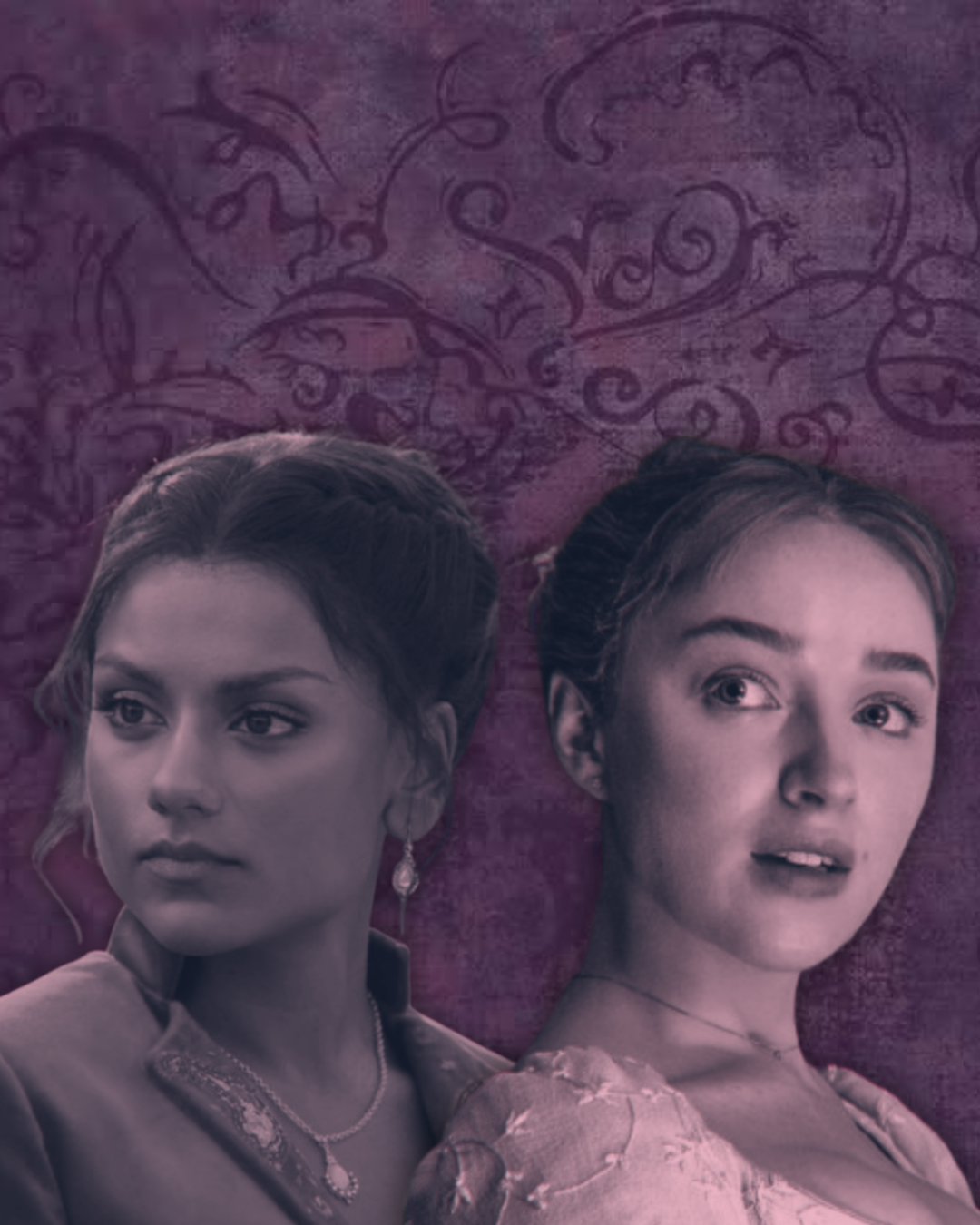
Dearest gentle reader, while this author does not claim to be Lady Whistledown, it would indeed be remiss not to borrow from her, the keen eye and sense to smell what lurks beneath the silk and the jewels, and as you should know by now (as you always do), very much like her, I am a critic by trade, and my knives are always sharp.
The ballrooms are ready to glitter yet again as Shondaland’s Bridgerton prepares to waltz back into the public’s eye with another glamorous season of regency romance. The ton is already abuzz, the gowns will be grander, and string quartets will once again whisper Taylor Swift’s melodies. And as it is, yet again, the show’s massive fanbase will drown the internet in applause, and I hope, like always, that it will be well deserved. But whilst you swoon, rightly so, it would be my job to flash the spotlight where it rarely goes. Whilst Bridgerton has my utmost respect for reimagining a historically white genre with unapologetic diversity that echoes loudly, after all, it has never lacked charm or ambition. In this world of lavish romance and progressive promise, there is a pattern that is so deep-rooted and frequently repeated that it cannot be overlooked.
It has come to this author’s notice, that under the silk veils and bejewelled mask, there is a quieter engagement at play, wherein some characters are asked to carry the heavy weight of responsibilities, meaning and consequences, while the others, to put it simply, are invited to fall in love. Therein lies the paradox.
For those of you who are loyal fans, do not walk out yet – this is not a call for exile, nor for the quartet to stop. Bridgerton remains a sumptuous delight, its pleasure indeniable but it is precisely this attention and importance that the show gets that urges us to look deeper, closer. For every boundary it breaks, another reforms quietly under the chandelier glow, asking some characters to endure more, restrain more, and explain themselves more, whilst others are permitted the indulgence without any restraints: same gowns, unequal weights.
At the heart of this paradox lies a question that the ton rarely dares to ask: Who is granted grace, and who must earn it the hard way? In Bridgerton, grace is not a common commodity, not at all, it is rather rare to come by, as a matter of fact. Some characters are allowed to be impulsive, even foolish, and are still ushered gently toward romance, forgiveness, and narrative softness. Others, particularly women of colour, are written into the story with an expectation of endurance stitched into their very introductions.
Kate Sharma arrives not as a woman allowed to desire, but as one already weighed down by responsibility, sacrifice, and restraint. She comes with a shiny gown like any; however, long before she is even permitted longing, she must prove her selflessness. Her love story is a slow march through guilt and duty, every step earned. Daphne Bridgerton, by contrast, is granted the luxury of discovery. Her missteps are treated as innocence, her wants as charming confusion rather than transgression. Both women anchor their seasons, yet only one is allowed to fall in love without first justifying her presence. Hence, Kate works the whole season to earn what Daphne holds in her dainty palm from the first episode, solely because she is a woman of colour. I shall further my claim by bringing in The Queen of England herself.
This imbalance does not conclude with the romantic leads; it is stitched into the very bones of the ton itself. Queen Charlotte, fierce and immovable, is never simply allowed to exist; she must always mean, must always be symbolic. Every glance and silence she holds is weighted with representation, progress, and the burden of historical reimagining. Her power is absolute; she is not only the queen, but she is a woman of colour, whose throne grants power to people of colour all over the country. That pressure is in itself heavier than her crown, yet her interior life is defined by solitude and duty, a crown that gleams but never quite sparkles or glows. Frivolity is a luxury she is rarely afforded. Lady Danbury, on the other hand, heads the society as its moral compass, forever correcting, guiding, and stabilising the world around her. Her sharp remarks, like her gaze and the tap of her cane gets the ton in line; such is the presence she commands. She is sharp, composed, and unfailingly responsible, yet never permitted the messiness of vulnerability or the indulgence of desire. These women are formidable, indispensable, and commanding. And yet, therein lies the cruelty: they are not allowed the small (culturally large) freedom of being ordinary. In Bridgerton, women of colour are asked not just to inhabit the world, but to justify it, bring balance and present a perfect picture of it.
And then there is Simon Basset. A duke, a heartthrob, a romantic ideal, yet never simply allowed to be any of those things. From the moment he rides into the scene, he is not just another duke; he comes wrapped in a cloak of silence and depth. His love story is not a song and dance into the sunset, but a sanctioned journey through pain, shadowed by parental cruelty, obligation and emotional repression. Where others stumble into love, he must earn it through suffering. Even in triumph, his depth is demanded as proof. In Bridgerton, even when men of colour are allowed desire, it arrives wrapped in trauma, as though depth must always precede delight. Not a formula applied to, might I add.
And if this author may be so bold (which I always am) as to whisper what polite society prefers to ignore, this pattern persists not because Bridgerton lacks awareness, but because it reflects a larger habit in prestige storytelling, one that too often confuses representation with responsibility. Characters of colour are written as symbols of progress, tasked with embodying dignity, while white characters are granted the very expensive freedom to be indulgent. It is a safer brand of progress, progress nevertheless, the kind that reassures rather than unsettles. In its eagerness to prove that inclusion works and that it has woven it so expertly into the story, the narrative quietly limits the very characters it seeks to elevate. Because progress, after all, is easiest to applaud when it behaves itself.
And so dearest gentle and clever readers, as the melody of the violin comes to an end, one must ask what kind of romance truly defines progress, because as we all know, love in its truest form is messy, reckless and indulgent, and by a broader view, the audience loves to see exactly that. Yet in this perfectly poised world, not everyone is granted such luxuries. Some step out with the weight of history on their back and poise in their posture. As selective as they are, until the ton does not learn to grant not only grace but ease to all its members alike, I am afraid the dance is unfinished. One can only hope that this latest season loosens its grip. For progress, dear reader, is far less impressive when it comes with conditions and even less romantic. And as always, this author will be watching. Knives polished, quill ready.