
When Politics Goes Viral: Zohran Mamdani and the Aesthetics of Power
By Keya W on December 24, 2025
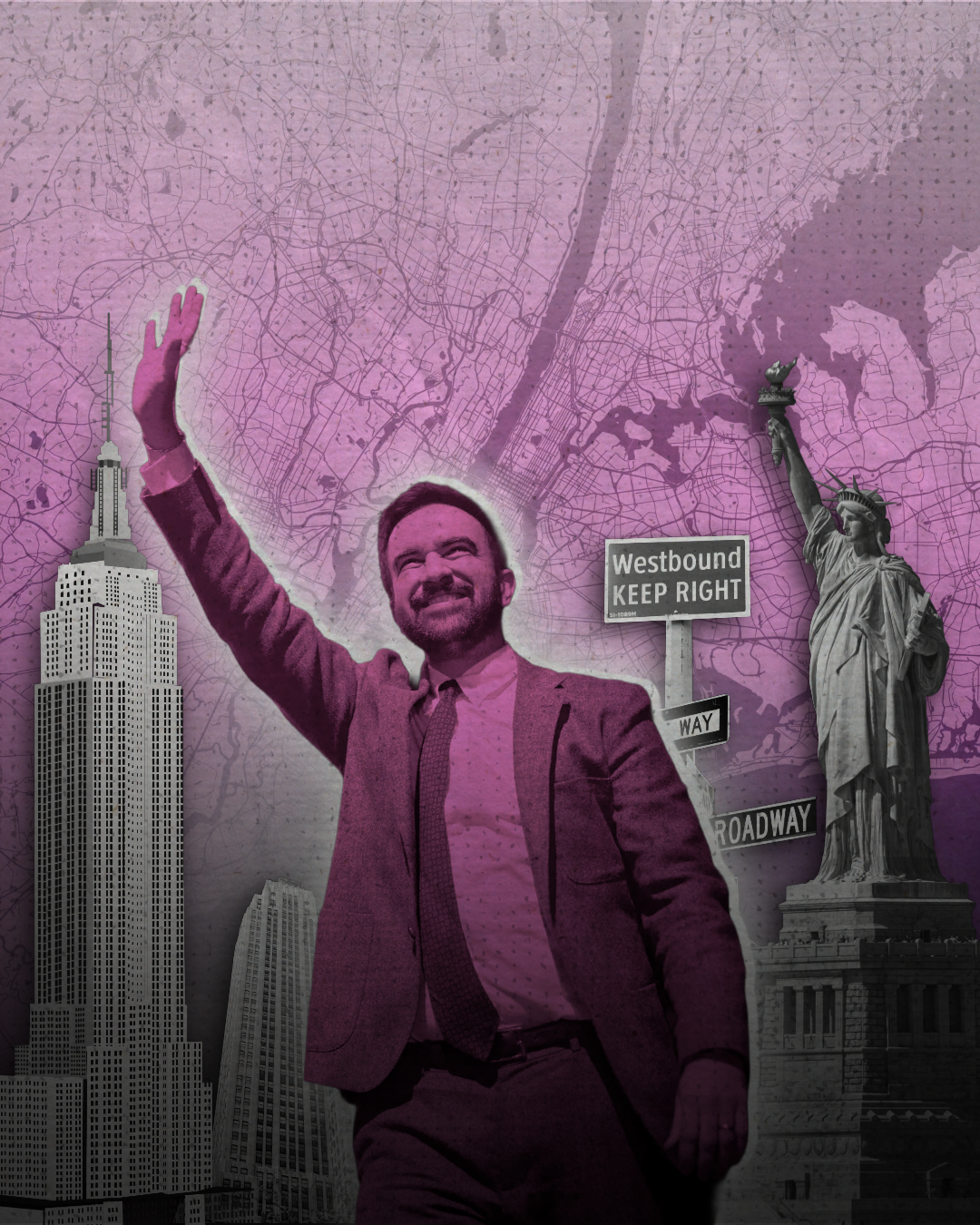
On November 4, 2025, Zohran Kwame Mamdani stopped being just another mayoral candidate and became something else entirely. New York State Assemblyman, longtime housing organiser, and democratic socialist, Mamdani emerged as one of the most unexpected political figures of the year. To his supporters, he is New York City’s half-Indian, half-Ugandan messiah; possibly a symbol of hope in a political moment many feel has offered very little of it.
Mamdani started the mayoral election race as an underdog, with polling at less than 1% in February. By June, he had won the primary with nearly 60% of the vote, after running a successful campaign dedicated to mobilizing grassroots support.
So, what exactly is it about NYC’s latest mayor, and why are so many people head over heels for him? Is it his socialist charisma? His toothy smile? Or is it simply the timing, a moment when American politics, still reeling from the Trump years, is ready to latch onto every ray of hope, as if it’s their last lifeline?
Mamdani is running on a left-wing populist agenda– committing to rent freezes, city-run grocery stores, free public transit, and universal childcare. New York City is one of the most expensive cities in the world, amidst an active cost-of-living crisis. In that context, his campaign has charmed and impressed because it was quite far from the familiar spectacle of empty promises and glossy manifestos. However, with Mamdani now occupying the mayor’s office, attention inevitably shifts from rhetoric to results. Are rent freezes and city-run grocery stores structurally feasible or just electorally convenient strategies?
As Mamdani’s predecessor, former Mayor Eric Adams raised questions like, “Who’s going to pay the increases in taxes? Who’s going to pay the increases in repairs? Who’s going to pay for the increases in Con Ed for gas bills?” He also criticised Mamdani’s proposal to halt homeless encampment sweeps, arguing that such policies could worsen street-level public health and safety issues. Adams’ intervention highlights a central tension in Mamdani’s rise: while his platform inspired hope and mobilised voters, translating these promises into effective policy may prove far more complex than campaigning for them.
Even as critics questioned whether Mamdani could deliver on ambitious promises, his campaign extended far beyond policy; it primarily relied on social media, sharing TikTok-style videos that skipped jargon and instead channeled growing frustration among the youth. Mamdani mocked opponents like Andrew Cuomo and Eric Adams with dry, “savage” internet humor. He understood his target voters and empathized with them, tapping into his ethnic and cultural versatility to connect with minority communities across New York City and beyond.
Still, this effect raises a larger question: how far can a New York moment travel? Mamdani may have made a global impact, but it’s easy to forget that he is, at the end of the day, a Democratic mayor governing one city within a deeply divided, often Republican-leaning nation. How long before that broader political pressure begins to shape his leadership?
One element of Mamdani’s campaign stands out in particular; even if his model doesn’t scale nationally (yet), it challenges parties to rethink how they communicate their ideals and core values to the new generation of youth voters. For much of Gen Z, their political coming-of-age has been shaped almost entirely by Trump and Biden, i.e., old men selling old ideas in a moment that demands something radically different.
The 2025 mayoral race had NYC’s highest voter turnout since 1969, according to an Associated Press voter poll on November 5, 2025. Three-quarters of voters under 30 chose Mamdani. Cuomo, his Republican rival, used a top-down approach, while a huge chunk of Mamdani’s operation targeted lifelong Democrats, asking why they had voted for Trump or abstained. In an Inside Story interview, Mamdani said many voted for Trump because “they remembered having more money in their pocket four years ago” and wanted the Democratic Party to focus on the economy. His campaign highlighted individual socioeconomic realities and aimed to win back Trump-voting defectors, which exit polls confirm succeeded. Mamdani won the Bronx by 11 points, a mostly Hispanic borough that had leaned toward Trump.
Then, in April of 2025, 24-year-old Cait Camelia, along with 28-year-old Kaif Kabir, mobilised some young women in NYC and started the unofficial ‘Hot Girls For Zohran’ campaign. This campaign soon turned into a community with more than 18000 followers, and it eventually changed how young people approached politics more than ever in recent years. Gradually, even Mamdani started making appearances in videos for the group’s Instagram.
When I personally saw this Instagram page blow up, I wondered, “How is a Mamdani campaign page that is neither remotely handled nor sponsored by Mamdani’s team, gaining so much traction all over social media platforms?” What exactly did Mamdani do so right that he doesn’t even have to campaign for himself anymore? After extensive research, I have identified two possible ways in which Mamdani has managed to pull himself up from a polling rate of 1% to become the magnetic mayor of NYC that he is today. Mamdani secured 78% of Gen-Z votes on the road to a historic mayoral victory despite a reported $22 million spent by 28 billionaires to stop him from becoming mayor.
Firstly, most political campaigns look the same, and so, they blend into the background. Mamdani’s campaign is exactly the opposite- his branding taps into the Von Restorff Effect, when most of the visuals remain the same, people have higher recall for the one that differs. His campaign is filled with colourful visuals and symbols that are imbued with meanings for New Yorkers, thus also tapping into the ‘more familiarity = higher recall’ factor.
Second, Mamdani portrayed himself as ‘one of the people, one for the people.’ His entire campaign revolved around one simple aspect- affordability. Powerful communication requires a deep understanding of the audience, including what they care about and the challenges they’re facing. Often, political messaging feels distant because it revolves around the political party, its ideology and values, not the audience, their problems, or their beliefs. Zohran- who took the city bus and the subway- his campaign thus did wonders for the crowd of New York.
So, is Zohran Mamdani, the young, charming mayor of NYC, just a great salesman? Yes and no. His meteoric rise cannot be separated from the cultural moment that produced it; his campaign benefited from an era where politics is no longer consumed solely through debates or policy documents, but through memes, TikTok videos, and Instagram stories. Groups like Hot Girls for Zohran did not merely promote a candidate; they transformed political participation into a shared identity.
While this rebranding of politics made civic engagement feel accessible and enjoyable, at the same time, it also blurs the line between belief and branding. The extent of the hope Mamdani’s victory has generated is perhaps best captured by the response it provoked in political commentary. Writing for The Wire, journalist Maryam Ziya described the moment as “a reminder that this world is not yet fully surrendered to billionaires and Bezos. There is space yet for socialists, the poor, the dispossessed, the marginalised.” The remark functions as a measure of the emotional and symbolic weight his win has carried for many observers.
However, when politics becomes aesthetic, and emotions do the heavy-lifting, disagreement risks being framed as betrayal, and critique as cynicism. The danger is not Mamdani himself, but the pedestal on which he has been placed.
Mamdani’s challenge now is to convert admiration into accountability. If his supporters can celebrate him without sanctifying him, his leadership may endure beyond the honeymoon phase. Ultimately, Mamdani is less a political anomaly and more a political symptom. His rise reflects decades of mounting frustration over rent hikes, inaccessible healthcare, corruption, and economic insecurity—conditions that have left many voters searching for alternatives to hollow political messaging. In that sense, Mamdani did not invent a new politics; he simply articulated, with unusual clarity, what a generation had been waiting to hear.

This is such a well-written and thoughtful piece 👏
Loved how you balanced hope with critique it never felt biased, just honest and sharp.
The way you connected youth culture, branding, and real political stakes was especially strong.
Seriously impressive work, keep writing like this ✨
Really enjoyed this article—fresh perspective throughout. The line that stayed with me was: “Mamdani’s challenge now is to convert admiration into accountability.” That captures the moment perfectly.
Madani’s win feels like more than just a call for change; it shows people are willing to place trust in younger leadership. At a time when politics often feels bleak, that itself is a hopeful sign.