
Don’t Mourn the Newsrooms of Democracy; They Were the Ones Who Sold the Coffin.
By Swarnim Sethi on December 7, 2025
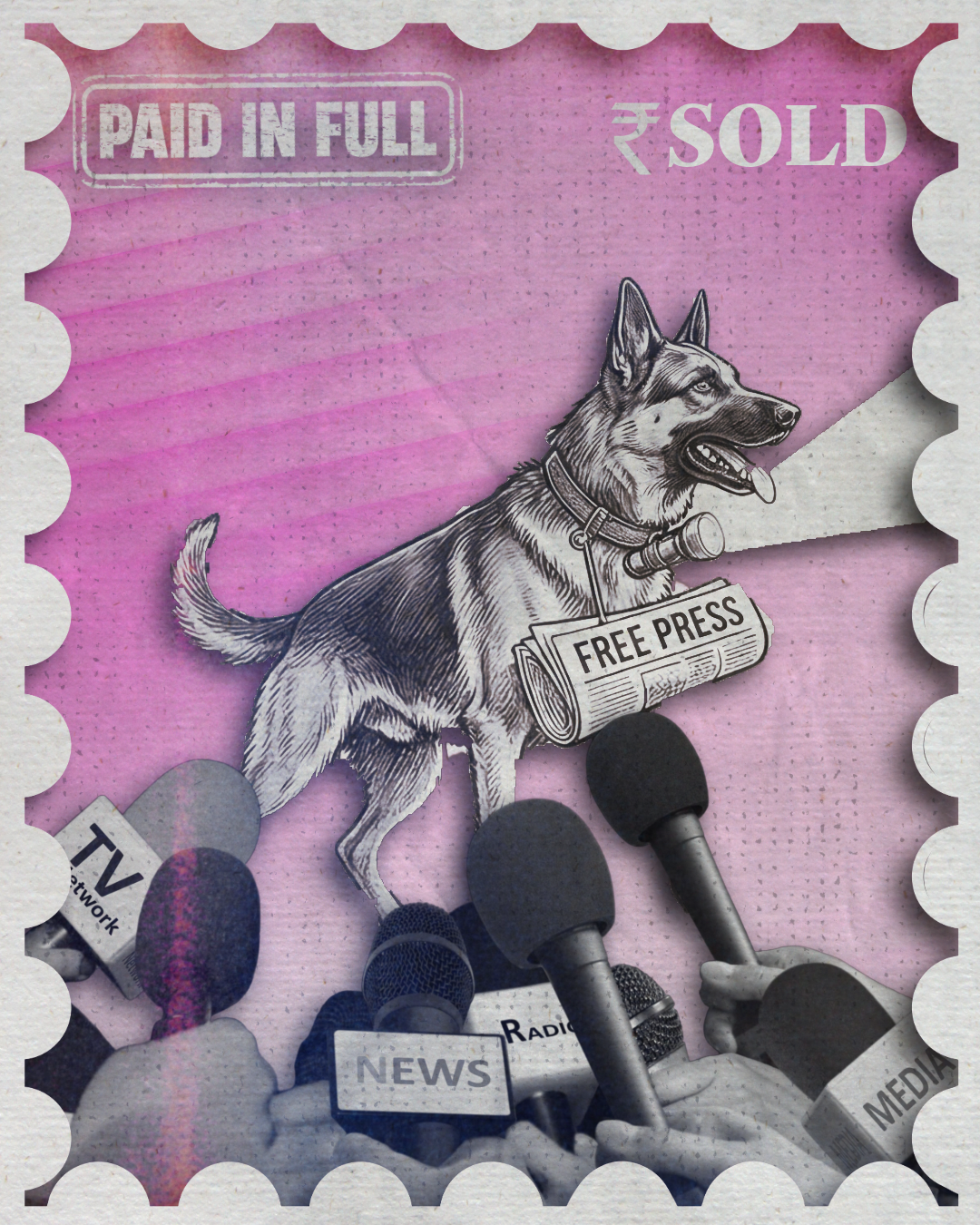
India is termed the largest democracy in the world. Unfortunately, its media ranking has dropped to 159th place out of 180 countries in the World Press Freedom Index 2024. This year, the ranking is slightly better compared to the record low of 161 last year, but the main message is still loud and clear from the falling graph: India’s press freedom and standards have been ranked below the 100th position from 2003 to 2024, which is a clear indication of a decline in the standards of press freedom. The difference between the present and the past is not only the drop but also the extent, velocity, and institutionalization of the control over the media.
Politicians, businessmen, and the government have been the major influences on Indian media for several years. They have been pushing and censoring it in a very subtle way, but it was still daring enough to question the government, uncover its failures, and raise concerns. The worst censorship the country witnessed was during the Emergency (1975–1977). Back then, journalists were thrown into jail without any trial, while the police at night ransacked newsrooms, cutting off the power and phone lines at the likes of The Indian Express and The Statesman to stop the circulation of critical stories. However, the experts are now saying that the environment today is even more dangerous because the decline is happening quietly, systematically, and without an official declaration.
The major reason for the fall is the change of media ownership by corporations and political groups. Telcos like Adani and Reliance have been dominating the television, print, and online media sectors for quite some time now, thus creating a business and political environment where goals go hand in hand without any obstacles. The best example of this is the buying off of a government-critical TV channel, NDTV. The editorial independence was very soon wiped out after the control of the channel was handed over. It was followed by the exit of resisters in India’s media circle. One of the first to go was the veteran anchor Ravish Kumar, who was widely known for his incisive critiques and dedication to ground reporting. He left not long after, pointing out the difficult environment for independent journalism. Other senior figures such as Suparna Singh and Sanjay Pugalia have also left, along with a large number of producers and reporters, which is an indication of the total collapse of the backroom’s honesty. The ruling regime’s disgust for the press was most openly shown by Narendra Modi in 2002. When the BBC asked him about the lessons he had learned from the Gujarat riots, he didn’t talk about stopping the violence or helping the victims. Instead, he emphasized the need to have ‘managed the media better’. The current regime has lived up to its leaders’ words.
At present, journalist safety has become a very big concern. Since 2000, a minimum of 72 journalists have been killed in India, out of which 13 deaths happened after 2014, and 5 in 2024 only. Protesters against the authorities are being arrested, raided, and stopped from speaking online. Many examples illustrate this point:
Siddique Kappan: He was arrested on his way to Hathras to cover the rape and murder of a Dalit girl.
Poonam Agarwal (2025): Her whole YouTube channel was shut down after she exposed corruption in Defense & election financing, thus illustrating the vulnerability of independent digital journalists when there is no corporate backing.
Kunal Kamra (2020, 2025): He was taken to court for contempt due to certain tweets and later for satirical songs that criticized the Maharashtra government. Such events make us think: Is our democracy being put at risk or is it being taken apart bit by bit from inside—slowly, lawfully, and systematically?
Mahatma Gandhi warned that the use of the press by the ruling party for its own advantage would be the first step towards dictatorship. Nowadays, this warning sounds more like a funeral notice than a prediction.
Indian demonstrators have never tasted complete press freedom. However, the most significant feature of the current times is very systematic and repressive measures: the unity of state power and corporate control, the use of surveillance and legal threats, the use of digital censorship as a weapon, and the implementation of propaganda.
The watchdog has not only become a lapdog; it has been trained, controlled, and integrated into compliance.
With the ruling party’s propaganda dominating the mainstream channels, the law being used to persecute dissenters, and digital censorship becoming a standard practice, India is not merely slowly drifting into authoritarianism anymore. It is getting used to it.
Ultimately, the biggest risk of media control in a democracy is not the loudness of propaganda. It is the silencing of public thought. By contaminating the information stream, the distortion does not stop at one issue; it gradually eats away at the very foundation of informed consent, which is the democratic legitimacy prerequisite. When members of society are given a manipulated version of reality, their sovereignty becomes a show, and their votes become responses to fabricated narratives rather than genuine choices. Therefore, the fight for free, pluralistic, and strong media is not only about the safety of journalists; it is a vital fight for the people’s ability to judge, question, and govern themselves. At the end of the day, a democracy without a free press is in fact a paradox.
Wonderful